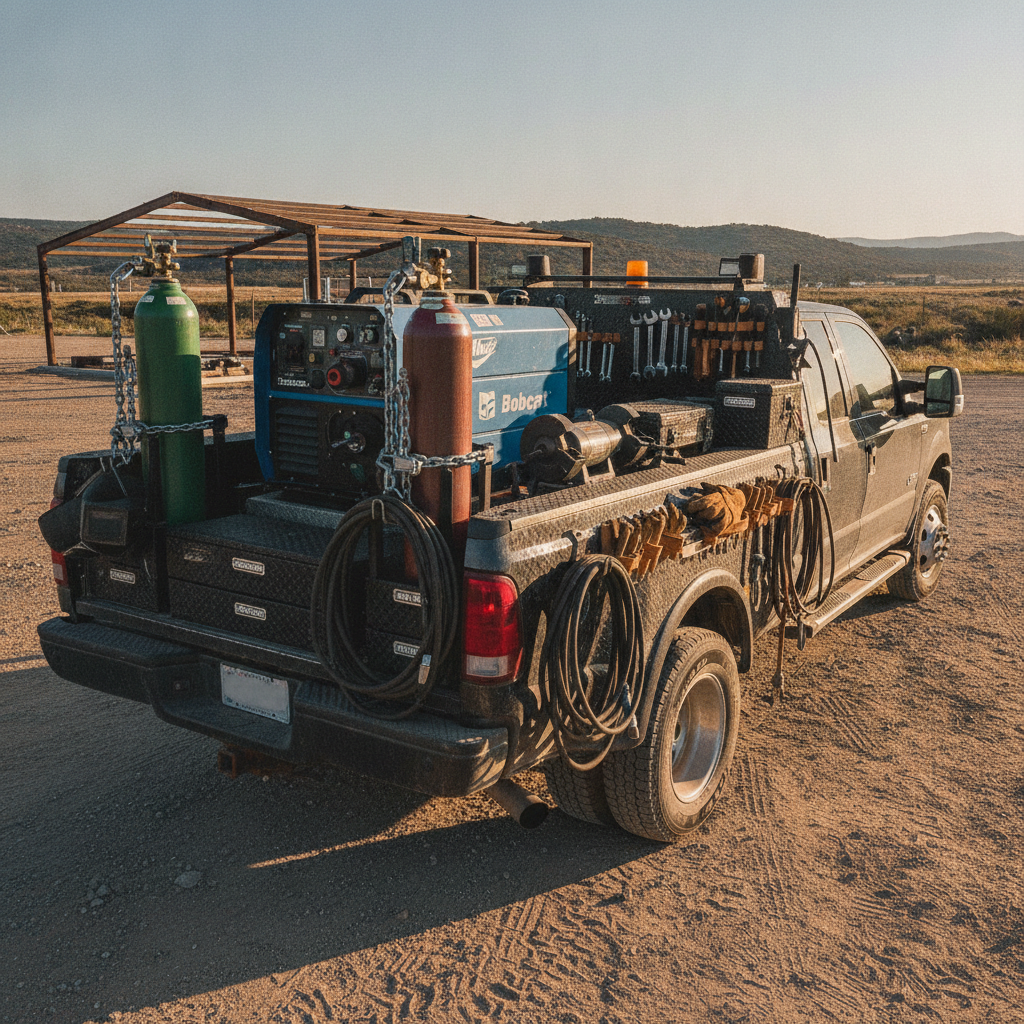
Let me paint you a picture. You pull up to a job site, customer standing there watching you. You climb in the truck bed and start digging. You move the grinder to find the leads. You move the leads to find the rod hood. You move the rod hood to find your chipping hammer. Twenty minutes later, you haven’t struck a single arc and the guy is already checking his watch. That right there is a mobile rig setup problem, and it’s costing you money every single day. Not theoretical money. Real dollars straight out of your pocket.
I’ve been doing this for over ten years. I’ve seen rigs that looked like a yard sale exploded in a truck bed, and I’ve seen rigs dialed in so tight you could find anything blindfolded in the dark. The difference between those two operators, at the end of a week, can be four to six hours of billable time. Think about what you charge per hour. Now multiply that by fifty weeks a year. You still want to leave the grinder buried under the tarp?
This isn’t about buying fancy equipment or building a custom aluminum body. Most of this is just thinking your setup through before you leave the yard. Let’s get into it.
The Real Cost of a Sloppy Mobile Rig Setup
Most guys don’t track their non-billable time on a job. They should. Because if you’re spending fifteen to twenty minutes on setup at the start of every job, and another ten to fifteen minutes packing down at the end, that’s thirty to forty minutes per job that you’re eating. Do three jobs a day and you’ve just given away nearly two hours.
That’s not a small number. If you’re billing $125 an hour, that’s $250 a day you’re working for free. Every single day. Because you didn’t know where your damn chipping hammer was.
The issue isn’t laziness, either. Most guys just load the truck without a system. They throw stuff in after a long job, they’re tired, they’re hungry, they’re done thinking. Then they show up the next morning and the job site becomes their storage unit search party.
If you’re still figuring out the business side of things — how to price jobs, how to position yourself in the market — posts like Strategic Niches and Pricing for Certification Services are worth your time. But none of that matters if you’re bleeding time on the truck before you even start working.
Mistake #1: No Zones on Your Truck Bed
This is the biggest one. Guys treat the truck bed like a flat surface where things live randomly. That’s not a rig. That’s a rolling junk pile.
Your truck needs zones. Think of it like a kitchen. You don’t put the spatula in the refrigerator and the butter in the knife drawer. Everything has a logical home based on how often you use it and what you use it near.
Here’s a basic zone breakdown that works for most mobile rigs:
- Zone 1 — Welder and power: Your machine, leads, ground clamp, stinger. This is the heart of the rig and it needs to be accessible from one side without moving anything else.
- Zone 2 — Consumables: Rod, wire, tips, nozzles, anti-spatter. Keep this close to the welder. You’re going to reach for this constantly.
- Zone 3 — Grinders and cutting tools: Angle grinder, cutoff wheel, wire wheel, flap discs. Keep these together. When you need one, you usually need all of them.
- Zone 4 — Hand tools and measuring: Squares, levels, clamps, tape, soapstone, markers. This is your prep zone.
- Zone 5 — Safety and PPE: Hood, gloves, glasses, hearing protection, fire blanket. You need these before you start working, so they shouldn’t be buried at the back.
This sounds obvious when you write it down. But walk up to most mobile rigs and none of this exists. It’s just stuff in a box.
Mistake #2: Leads Thrown in Loose
Tangled leads are a time tax. Every single job. You pull them out, they’re wrapped around themselves, around the ground clamp, around the gas hose. You spend five minutes unraveling something that should take thirty seconds to deploy.
There’s a simple fix. Use a lead reel or a designated leads bucket. Figure-eight your leads when you coil them — don’t just wrap them arm-to-elbow. That arm-wrap coil is what creates the twist and the tangle. A figure-eight lay keeps the cable memory from fighting you.
If you’re running a machine with a built-in wire feeder or a separate feeder unit, make sure the feeder has a dedicated mount. Nothing slows you down like a feeder that slides around the bed or gets buried under other gear. Secure it. Bolt it down. Done.
Speaking of machines — if you haven’t looked at what’s out there for field work lately, the Field-Ready Multi-Process Welders post breaks down some solid options worth considering.
Mistake #3: Consumables Stored Wrong
This one bites people in two ways. First, they store rods loose and horizontal and then wonder why they’re cracked and contaminated. Second, they keep one of everything and run out at the worst possible moment.
Get a proper rod oven or at minimum a sealed rod canister if you’re running low-hydrogen electrodes. Leaving 7018 rods rattling around in an open toolbox exposed to humidity is how you end up with porosity and a comeback call. And nothing tanks your reputation faster than a callback for bad welds.
For wire, keep your wire spools in a sealed container when they’re not on the machine. Moisture gets into wire faster than people think, especially in coastal or humid environments. A simple Tupperware-style bin with a lid does the job.
Stock minimum quantities on the truck for every job type you do regularly. Know those numbers. Keep a running list. When you drop below minimums, you resupply before you leave the yard — not mid-job from an auto parts store at a 40% markup.
Mistake #4: Your Hood Is the Last Thing You Can Reach
I know guys who keep their hood inside the cab of the truck. I know guys who keep it in a milk crate at the very back of the bed, buried under extension cords. Both of those people are slower than they need to be.
Your hood is the first thing you put on before you work. It should be the first thing you can reach. Mount a dedicated hook or shelf for your hood at the tailgate end of your rig, easy grab height. Same goes for your gloves. If you have to dig for either of them, you’ve already made a mistake.
Same logic applies to your fire extinguisher and your first aid kit. You need those fast in an emergency. They don’t live under the welder.
Mistake #5: Everything Lives on the Floor of the Bed
Flat bed storage is inefficient. When everything sits on the floor, every item is hiding another item. You end up with layers, and finding anything below the top layer means moving everything above it.
Vertical storage and wall-mounted organization multiplies your available space without adding a single square inch to your truck. Magnetic strips for small tools. Pegboard panels on the headache rack or toolbox lid. Stack-able bins. Rail systems with modular holders.
You don’t need to spend a fortune on this. A sheet of plywood, some L-brackets, and a few rows of hooks from the hardware store can completely transform how a truck bed functions. Spend a Saturday building it out once and you’ll wonder how you lived without it.
If you’re in the early stages of building your business and working out of a garage, this same thinking applies to shop layout. The From Garage to Shop post covers how to set up a productive workspace before you scale.
Mistake #6: Gas Cylinders Not Secured Properly
This one isn’t just an efficiency problem — it’s a safety problem. A cylinder tipping over in a moving truck is a serious hazard. But beyond safety, an unsecured cylinder that shifts around also means your regulator and hoses get beaten up constantly. Fittings loosen. Hoses kink and crack. You end up chasing leaks and replacing hardware that should last years.
Mount your cylinder in a proper bracket. Use a chain at minimum. If you run multiple cylinders — say a CO2/Argon mix and a straight Argon — have a mount for each one. Label them. Keep your hoses coiled clean when not in use.
If you’re thinking about how to manage gas costs and usage across multiple jobs, Smart Shielding Gas Management is a solid read for tightening up that part of your operation.
Mistake #7: No Pre-Job Checklist
This sounds like corporate nonsense. I get it. But hear me out.
A pre-job checklist isn’t about bureaucracy. It’s about not showing up to a job three hours from home and realizing you forgot your 4.5-inch grinding discs. Or your soapstone. Or the one clamp you specifically need for that job. It’s happened to every one of us. It doesn’t have to keep happening.
The checklist doesn’t have to be fancy. A laminated card on a hook in the cab works fine. You glance at it before you leave the yard. You confirm the critical stuff is loaded. Takes thirty seconds. Saves hours of driving back or improvising.
Break the checklist into categories that match your truck zones. Welder and power. Consumables. Tools. Safety. Job-specific items. Run through it once before every departure and you’ll stop having those forehead-smacking moments at the job site.
Mistake #8: No Dedicated Job Bag for Each Customer
If you’re doing repeat service work for farms, ranches, construction sites, or industrial clients, this one is a game-changer. Each regular customer or job type has specific needs. Certain rod types, certain wire, certain hardware or fittings. Packing everything fresh each time wastes time and risks forgetting something.
Build job-specific bags or bins. Label them by customer or job type. When you confirm a job with that customer, you grab that bin, verify it’s stocked, and throw it on the truck. The mental load drops, the prep time drops, and you look like you actually have your act together.
This kind of operational efficiency ties directly into how you price and position your services. If you’re thinking about how to structure your business so it scales without chaos, check out Measure Twice, Invest Once for some framework on making smarter operational decisions early.
Mistake #9: Ignoring the Weight Distribution on Your Rig
This one affects you in ways you might not notice until something goes wrong. Heavy gear loaded wrong puts strain on your suspension, affects braking, and wears your tires unevenly. Over time, it costs you real money in maintenance and fuel.
Keep your heaviest items — welder, cylinders, toolboxes — as low and as close to the cab as possible. Keep lighter items toward the rear. Don’t stack heavy stuff on top of other heavy stuff at the back of the bed. Distribute weight left to right as evenly as you can manage.
This is also relevant if you’re moving toward battery-powered or hybrid welding units. Lighter machines change the weight math on your rig. If you’re evaluating those options, Hybrid Battery-Powered Welders breaks down what’s worth looking at in that space.
Building a Better Rig Doesn’t Take a Week Off Work
You don’t have to rebuild your entire setup in one shot. Pick the worst two problems on your rig right now and fix those first. Is it the tangled leads? Fix the leads this weekend. Is it the consumables situation? Spend an hour building a proper storage solution. Is it the hood that lives in Narnia? Mount a hook tomorrow morning.
Small, targeted fixes compound fast. Three weekends of deliberate improvement and you’ll have a rig that actually works with you instead of against you. You’ll stop losing time at job starts. You’ll stop looking like you’re auditioning for a disorganized-tradesman reality show in front of your customers.
The guys who run tight rigs get referrals. The guys who look professional get repeat calls. The guys who show up and are swinging within five minutes of arrival get asked back. None of that requires expensive equipment. It just requires thinking the setup through and being consistent about it.
Your hourly rate is only worth something if you’re actually working the hours. Stop donating setup time to the job site and start putting it in your pocket where it belongs.
Final Thought
A well-organized mobile rig setup is one of those things that separates a professional operation from a guy who happens to own a welder. It signals competence before you ever strike an arc. It keeps your stress down on long days. And it adds up to real, measurable money over the course of a year.
Take an honest look at your rig this week. You already know what’s wrong with it. Fix one thing. Then fix another. Keep going until the truck runs like the business you want it to be.