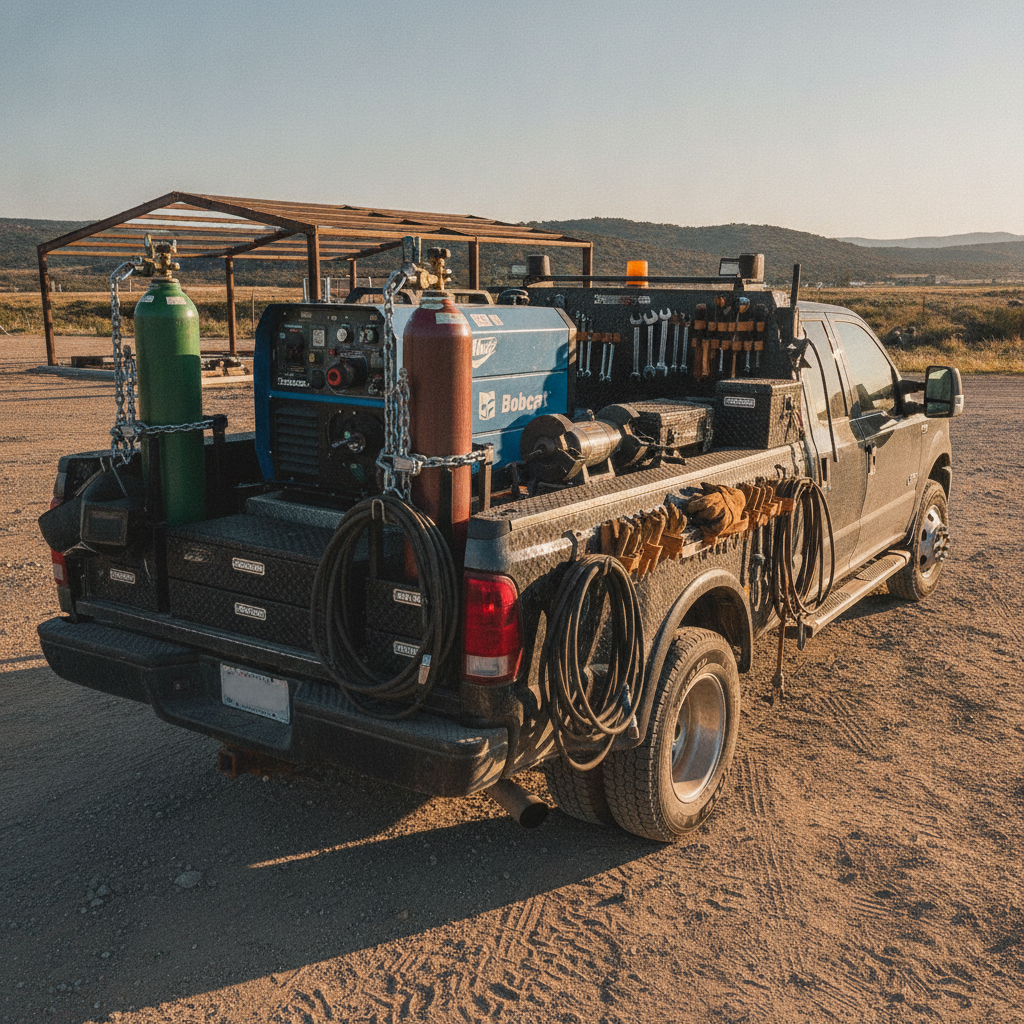
You know that guy on the job site who’s still digging through a pile of leads and grinding wheels twenty minutes after everyone else has struck an arc? Don’t be that guy. Mobile rig organization isn’t some fancy concept from a business school textbook. It’s the difference between running a tight operation and hemorrhaging money before your hood even goes down. If your truck looks like a hardware store threw up in it, this one’s for you.
Why Your Truck Setup Is Costing You Real Money
Let’s do some quick math nobody wants to do but everybody should. Say you charge $95 an hour. You waste 25 minutes every morning hunting for your chipping hammer, re-rolling a lead that got tangled up, and figuring out where your last box of 7018 ended up. That’s roughly $40 out of your pocket before you’ve made a single pass.
Do that five days a week. That’s $200 a week. Over a year, you’ve handed back nearly $10,000 to the universe for absolutely nothing. No materials, no overhead, no labor. Just chaos tax.
And it’s not just the morning setup. It’s every time you need a different rod size mid-job. Every time you can’t find your flow meter. Every time a customer is watching you tear apart your truck while they’re standing there paying you to do it.
Your rig is your shop. Treat it like one.
Mistake #1 — No Zones, No System
The number one mobile rig organization mistake is having no actual system at all. Everything just kind of lives somewhere vaguely in the truck. You know it’s “in there.” But where exactly? That’s tomorrow’s problem.
Fix this by building zones. Think of your truck the same way you’d think about a production shop floor. Everything has a home and it doesn’t move from that home.
Here’s a zone breakdown that works in practice:
- Zone 1 — Consumables: Rods, wire, tips, nozzles, contact points. All of it in one spot, organized by process and size. Labeled bins. Not zip-lock bags floating around loose.
- Zone 2 — Leads and cables: Hung or coiled the same way every single time. Not thrown in a pile. Not loosely wrapped around a machine handle.
- Zone 3 — Hand tools and grinders: Wall-mounted, drawer-stored, or rack-mounted. Not rolling around on the floor getting stepped on.
- Zone 4 — Safety gear: Gloves, hood, sleeves, ear protection. First thing you can grab, not buried under a tarp.
- Zone 5 — Gas and regulators: Cylinders secured properly, regulators protected, hoses coiled and stored away from heat.
Zones aren’t complicated. You just have to decide they matter and then actually stick to it. The hardest part isn’t building the system. It’s putting stuff back where it belongs after every job when you’re tired and just want to go home.
Mistake #2 — Throwing Every Process Into One Pile
A lot of mobile welders run multiple processes. Stick, MIG, TIG, maybe flux-core. That’s great for business — and if you’re thinking about how to leverage that, the post on field-ready multi-process welders is worth a read.
But when every process lives in the same jumbled space, you end up spending time sorting instead of working. Your TIG filler rods are mixed in with your stick electrodes. Your MIG gun is tangled around your TIG torch. It’s a mess and you know it.
Separate your process gear. Even if you’re running a tight space, you can use labeled bins, color-coded tape, or separate bags for each process. When you switch from stick to MIG mid-day, you should be able to grab what you need in under a minute without thinking about it.
Consistency here also matters when you start hiring help or bringing on an apprentice. They can’t read your mind. If your system only makes sense to you at full mental capacity on a good day, it’s not a system. It’s just organized chaos with extra steps.
Mistake #3 — Consumables Stored Wrong
Low-hydrogen rods left open to moisture. Wire spools stored where they pick up humidity and rust. Tips and nozzles bouncing around loose and getting bent. This isn’t just an organization problem. It’s a quality problem.
Bad consumable storage costs you on both ends. You lose time hunting for usable materials. And then you lose time troubleshooting weld problems that were caused by degraded consumables in the first place.
Low-hydrogen electrodes like 7018 need to stay dry. Period. If you’re not running a rod oven on the truck, at minimum you’re keeping them in sealed containers and not leaving opened cans rolling around in the heat for three days. For jobs where moisture control actually matters, this isn’t optional.
Wire spools get a dedicated mount with a cover. Tips go in a small labeled bin with the correct size marked on it. You don’t want to be squinting at a tip trying to figure out if it’s .030 or .035 when you’re standing in the sun with a grumpy foreman breathing down your neck.
Mistake #4 — Leads That Live on the Floor
You know what slows down every single job? Starting the day by untangling leads that got thrown in a pile last night. And you know you’ve done it. We’ve all done it.
Leads need a dedicated home. Wall hooks, retractable reels, coil hangers — pick something and use it consistently. The five seconds it takes to properly hang a lead at the end of a job saves you ten minutes of untangling the next morning. That’s just math.
Also, leads that live on the floor get stepped on, driven over, and damaged faster than leads that are stored properly. Replacing leads because you stored them wrong is throwing money away. And before you say “I’m careful where I park,” no you’re not. Nobody is.
Same rule applies to your ground clamps and electrode holders. Hang them. Don’t set them loose in a bin where the jaws get bent and the cables get kinked.
Mistake #5 — No Inventory Awareness
Running out of consumables on a job site is one of the most avoidable ways to look like an amateur. You drove an hour to get there. You’re set up. You’ve got one pass left on a repair and you’re out of rod. Now you’re making a supply run or calling it a half-day while the customer watches.
This one ties directly into the business side of running a mobile operation. If you haven’t thought hard about how your consumable costs connect to your pricing structure, take a look at how pricing for certification services handles the math on cost-per-job analysis. Same logic applies to consumable overhead.
Keep a basic inventory sheet in the truck. Not a spreadsheet on your laptop. A laminated card on a hook next to your consumable zone. Before you leave for a job, you check it. When something drops below your minimum threshold, you restock before you leave the yard. Not after you run out in the field.
Minimum stock levels to always have on hand:
- Two full boxes of your most-used rod sizes
- At least one full backup wire spool per process you run
- Ten to fifteen tips in each size you use regularly
- Backup nozzles, contact tubes, and diffusers
- A full spare set of grinding wheels and cutting discs
Mistake #6 — Ignoring the Work Surface Problem
Where are you doing your fit-up prep? Where are you laying parts out? If the answer is “the ground” or “the tailgate,” you’re adding time and back strain to every job for no good reason.
A fold-down work surface mounted to the truck or trailer is one of the highest-return upgrades you can make. It doesn’t have to be fancy. Welded steel, a piano hinge, and a couple of support legs. You can build the whole thing in an afternoon.
Having a consistent work surface also means your clamps, squares, and magnets have somewhere logical to live when they’re in use. Instead of setting them on the bumper and watching them fall off, or putting them on the customer’s equipment where they get forgotten.
Small quality-of-life improvements like this are part of what separates a professional operation from a guy with a welder in a truck. And that separation matters when you’re building a reputation and trying to land repeat work.
Mistake #7 — The Truck Is Different Every Day
This might be the one that kills mobile welders the most and they don’t even realize it. You reorganize every time you load up. You put stuff where it fits that day. Next day, nothing is where you think it is.
Mobile rig organization only works when it’s consistent. The same item lives in the same spot every day, every job, every time. Full stop.
Build your load-out like a checklist and actually use the checklist. Not because you’ll forget things — you probably won’t — but because the checklist forces consistency. And consistency is what turns a good system into muscle memory.
After about two weeks of loading the same way, you stop thinking about where things are. You just reach for them. That’s the goal. That’s when your setup starts happening in ten minutes instead of thirty.
Making the Most of Your Equipment Investment
None of this matters much if the equipment you’re organizing isn’t up to the work you’re doing. A well-organized truck with an underpowered or wrong-spec machine is just a clean way to fail. If you’re evaluating what equipment belongs on your rig, the breakdown on field-ready battery welders covers some newer options worth considering for remote work. And if you’re thinking about the gas side of things, smart shielding gas management covers how to stop bleeding money on gas that never makes it into a weld.
Your rig organization and your equipment choices work together. A machine that fits your truck layout and your workflow beats a technically superior machine that’s awkward to load and use in the field every time.
The Bigger Picture — Your Rig Reflects Your Business
Customers notice your truck before they see your welds. A clean, organized rig tells them you run a tight operation. A disaster truck tells them you’re winging it.
That first impression affects whether you get called back. It affects whether you get referrals. It affects whether a foreman recommends you to a plant manager or quietly goes with someone else next time.
If you’re building a mobile welding business from the ground up, this kind of operational detail is part of what separates the guys who stay busy from the guys who struggle. For more on the business side of setting up a professional mobile operation, the post on going from garage to shop covers the bigger picture on building something real.
And if you’re at the stage where you’re trying to figure out which types of work are worth chasing, strategic niches breaks down where mobile welders actually make the most money — which directly affects what equipment and consumables you need on the truck in the first place.
Quick-Win Checklist to Fix Your Mobile Rig Organization Today
You don’t have to overhaul your whole setup in one shot. Start here:
- Pick one zone and sort it completely. Consumables are the easiest starting point.
- Put up two hooks for leads. Just two. Today. Use them every time.
- Make a laminated minimum stock list. One page, on a hook, in the truck.
- Load your truck the same way tomorrow as you do today. Repeat until it’s automatic.
- Take five minutes at the end of every job to reset. Not ten minutes. Five. Everything back in its zone.
That’s it to start. You’re not building a museum. You’re building a functional work rig that makes you faster and more professional every time you pull up to a job.
Bottom Line
Bad mobile rig organization is a hidden expense that shows up in every invoice you write. It eats your setup time, trashes your consumables faster, and tells customers you’re not running a tight ship. None of that is doing you any favors.
The good news is this is entirely fixable and it doesn’t cost much. A few bins, some hooks, a laminated card, and the discipline to put things back where they belong. That’s most of it right there.
Stop digging through your own truck on the customer’s dime. Build the system once, use it every day, and watch your setup time drop. The hours you save go straight back into your rate. That’s not overhead. That’s profit.