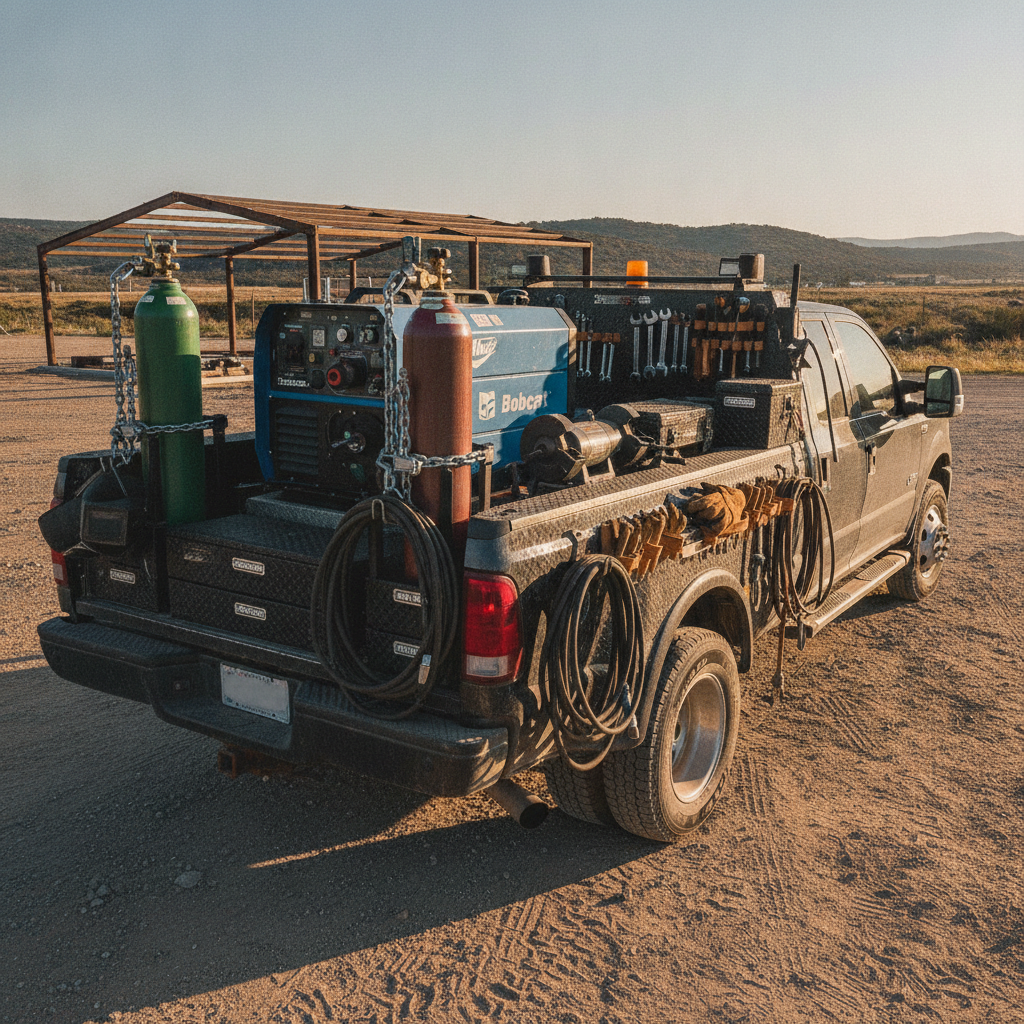
Let me paint you a picture. You pull up to a job site at 7 a.m., customer’s already waiting, and you spend the next twenty-two minutes digging through your truck bed like you lost your car keys in a ball pit. By the time you strike your first arc, you’ve burned nearly half an hour of unbillable time — and the customer is already forming opinions about you. That’s what a bad mobile rig setup does. It doesn’t just slow you down. It quietly drains your hourly rate, makes you look unprepared, and starts every job on the wrong foot. This post is about fixing that before it costs you another season of lost revenue.
Why Mobile Rig Setup Is a Business Problem, Not Just an Annoyance
Most welders think of truck organization as a comfort thing. Nice to have, but not critical. That’s wrong thinking.
Here’s the math: if you lose 20 minutes per job to setup chaos, and you run five jobs a week, that’s over an hour and forty minutes of wasted time every single week. Over a year, you’ve thrown away nearly 90 hours. At $85 an hour, that’s $7,650 you didn’t bill. All because your grinder discs were buried under a pile of old rags and a come-along you haven’t touched since 2021.
When you’re trying to build a legit operation — not just a guy with a truck — efficiency IS your product. If you’re still figuring out the business side of things, the post on going from garage to shop covers a lot of the foundational thinking you need before any of the truck stuff matters anyway.
But let’s get into the specific mistakes. Because odds are you’re making at least three of these right now.
Mistake #1: No Dedicated Home for Consumables
This is the number one time killer on any mobile rig, and it’s completely self-inflicted.
Grinding discs, cut-off wheels, wire tips, tungstens, filler rods — these are the things you need constantly. They are also, for some reason, the things that end up scattered across the most random corners of every welder’s truck. One box of 4.5″ discs is under the seat. Another is in the back corner of the tool chest. Three loose ones are rolling around in the bed.
Fix it with a dedicated consumables box that lives in the same spot every single time. A small plastic bin with a lid, labeled by process and size, bolted or strapped to a consistent location in your truck. When it gets low, you restock it before the next job — not during one.
This one change alone can save you five to ten minutes per job. It sounds stupid. Do it anyway.
What Goes in the Consumables Box
- Grinding and cutting discs, sorted by diameter
- Wire tips and diffusers for your MIG setup
- Tungsten electrodes and collets if you run TIG
- Stick electrodes in a sealed rod holder — not a box that’s been rained on
- Anti-spatter, tip dip, and wire brush
If your machine can run multiple processes, your consumables game gets more complicated fast. That’s a good reason to think hard about what processes you actually run in the field. The breakdown on field-ready multi-process welders is worth reading if you’re still dialing in your machine selection.
Mistake #2: Your Leads Are a Bird’s Nest Every Morning
Tangled leads are a tax on your patience and your time. Every. Single. Morning.
If you’re throwing your leads in the bed at the end of the day without coiling them properly, you’re setting yourself up for a ten-minute untangling session before you can even plug in. Worse, you’re stressing the connections and the insulation, which turns into a repair bill down the road.
Get in the habit of over-under coiling your leads — not the lazy wrap-around-your-arm method that puts a twist in the cable every loop. Over-under keeps the cable happy and unrolls clean every time. Then hang them on a set of fixed hooks or a rack mounted inside the service body or on the headboard of your flatbed.
If you’re running a service truck with compartments, dedicate one full compartment to nothing but leads and ground cables. Not tools. Not spare parts. Leads. Give things a home and they’ll be there when you need them.
Mistake #3: Gas Cylinders Stored Like They’re Decorations
Rolling cylinders are a liability. Literally — a loose cylinder that tips over and snaps its valve is a projectile, not a welding supply.
But beyond the safety angle, loose cylinders mean you’re wasting time repositioning them, checking connections, and fiddling with regulators that shifted in transit. A cylinder rack or wall-mounted bracket — even a simple chain system — takes ten minutes to install and solves this problem permanently.
While you’re at it: know what you have before you leave the shop. Running out of shielding gas mid-job is amateur hour, and it’s 100% preventable. If gas management is something you haven’t systematized yet, the post on smart shielding gas management covers it better than I’m going to here.
Mistake #4: Tools with No Fixed Location
Every tool on your rig should have one place it lives. Not a general area. One specific spot.
The angle grinder goes here. The tape measure goes here. The square goes here. The wire feed gun hangs here. When a tool doesn’t have a home, it ends up wherever it landed last — which is usually the worst possible place when you need it in a hurry.
Shadow boards are popular in shops for exactly this reason. On a truck, you can replicate the concept with foam cutouts in drawers, pegboard on a headboard, or magnetic strips for smaller tools. The point isn’t to be fancy. The point is that when you reach for something, your hand knows where to go without your brain having to get involved.
High-Priority Tools That Need Fixed Spots
- Angle grinder — primary and backup
- Wire brush and chipping hammer
- Tape measure and combination square
- Clamps (at least four on the truck at all times)
- Markers, soapstone, and scribe
- Fire extinguisher — accessible, not buried
- First aid kit — same deal
Your fire extinguisher and first aid kit need to be reachable without moving anything else. That’s not optional. That’s a job site requirement and basic common sense.
Mistake #5: No Pre-Job Checklist
You’ve been welding long enough that you think you remember everything. You don’t. Nobody does.
A pre-job checklist isn’t something rookies use. It’s something professional tradespeople use because the cost of forgetting something is showing up to a job without the right rod, the right gas, or the right fitting — and either making a second trip or making a call you don’t want to make to a customer.
Your checklist doesn’t need to be fancy. A laminated sheet stuck inside a cabinet door works fine. The act of running through it before you leave takes three minutes. The cost of skipping it can be an entire wasted drive.
This same discipline applies to your business operations overall. If you haven’t mapped out your systems yet, the post on smart heat maps for startups talks about where your time and money are actually going — which tends to be eye-opening when you see it on paper.
Mistake #6: Trying to Carry Everything for Every Job
This one runs counter to how most welders think, but hear me out.
The instinct is to load every possible tool, fitting, and piece of stock you might ever need, because you never want to be caught without something. The result is a truck so packed that nothing is organized, you can’t find what you need, and you’re hauling an extra 400 pounds of “maybe” everywhere you go.
The smarter move is to know your jobs and load specifically for them. If 80% of your work is structural repairs and farm equipment, your truck should be set up for that. The other 20% might require a few additions, but your base load should reflect your actual work — not every hypothetical.
If you’re still figuring out what kind of work to chase, the post on strategic niches for mobile welders is worth reading. Knowing your niche also tells you exactly what should be on your rig.
Mistake #7: Ignoring the Truck Itself
Your truck is part of your equipment. Treat it accordingly.
A welder running out of a truck with bald tires, a check engine light on, and a battery that’s questionable is one breakdown away from a serious problem — professionally and financially. Mobile work means your truck earns money. Every mile it can’t run is a mile you’re not billing.
Keep a maintenance log. Do your oil changes on schedule. Check tire pressure before long drives to remote jobs. Know the service intervals on your welder and your generator if you’re running one. Equipment that gets maintained doesn’t surprise you.
On the equipment side, if you’re running or considering battery-powered machines to reduce the generator dependency, the rundown on hybrid battery-powered welders covers what’s actually practical in the field versus what’s just marketing talk.
The Real Cost of a Disorganized Rig
Let’s bring it back to the money, because that’s what this actually is — a money problem wearing the costume of an organization problem.
Every minute you spend digging, untangling, searching, or making second trips is a minute you’re not billing. When you’re pricing jobs, you’re factoring in your time on the tools — not your time playing find-the-fitting in your truck bed. But the customer doesn’t care about that distinction. They see a number on your quote. And if your disorganization causes you to quote higher to cover your wasted time, or to run jobs at a loss because you didn’t account for it, you’re losing either way.
If you’re still working out how to price your jobs, especially if you’re getting into certified work, the post on pricing for certification services breaks down the numbers in a way that actually makes sense for field operators.
Getting your rig tight is also about reputation. Customers notice. Other trades on the job site notice. When you pull up, pop open a compartment, grab exactly what you need in thirty seconds, and get to work — that reads as professional. It’s a small thing that signals you know what you’re doing. And in a trade where referrals drive business, perception matters more than most welders want to admit.
Where to Start if Your Rig Is Currently a Disaster
Don’t try to overhaul everything in one weekend. You’ll burn out, put it all back how it was, and call it good enough.
Start with consumables. Get a box, label it, load it, commit to its location. That’s week one.
Week two, tackle your leads. Get hooks or a rack installed, practice the over-under coil, make it a habit before the habit makes itself.
Week three, go through every tool and ask: does this have a home? If not, give it one or get it off the truck.
Small, sequential improvements compound fast. A month from now, your setup time will be measurably shorter. You’ll notice it. Your customers might too.
Final Thought
Nobody’s going to hand you a professional rig. You build it over time, intentionally, by making small decisions that add up. The welders who look like they’ve been doing this forever aren’t smarter than you. They just stopped tolerating waste earlier.
Your mobile rig setup is either working for you or against you every single job. Take a hard look at it this week. Fix the obvious stuff first. Then keep going.
The arc time is the only time you’re getting paid for. Make sure everything before it counts for as little clock as possible.