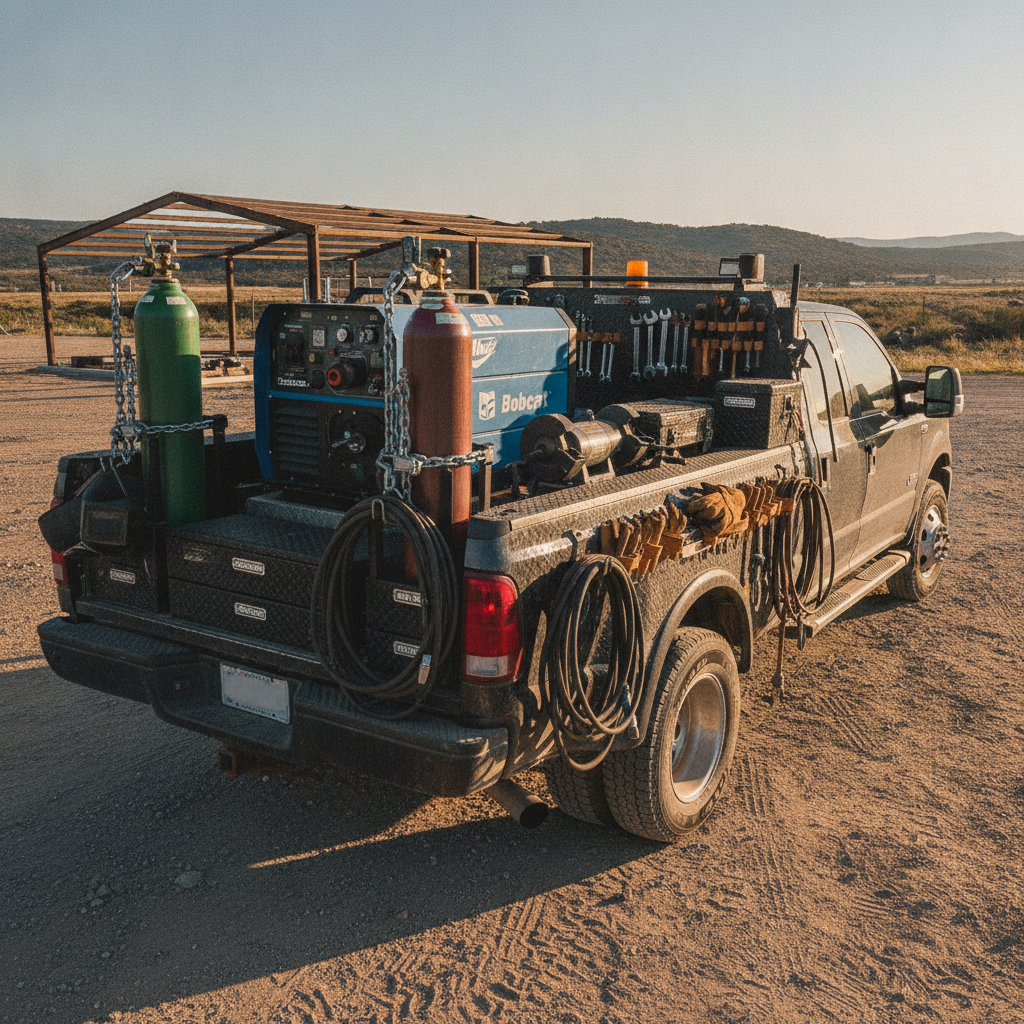
Let me paint you a picture. You pull up to a job. The customer is standing there watching. You hop out, open your truck, and spend the next fifteen minutes digging through a pile of cables, fittings, random bolts, and a grinder disc you’ve been looking for since March. That’s not a good look. More importantly, that wasted time is coming straight out of your hourly rate — and if you’re running flat rates, it’s coming out of your profit. Mobile rig organization isn’t just about looking professional. It’s about not hemorrhaging time before you even touch metal.
I’ve been running a mobile rig for over a decade. I’ve made every single mistake on this list. Some of them more than once. So consider this a peer-to-peer download from someone who’s already paid the stupid tax so you don’t have to.
Why Your Truck Setup Is a Business Problem
Most welders think of their truck as just a way to haul gear. Wrong. Your truck is your shop. It’s your storefront. It’s the first thing a customer sees, and it’s the thing that determines whether you’re efficient or just busy.
A disorganized rig creates a chain reaction of problems. You can’t find the right fitting, so you improvise. You improvise with the wrong consumable, and now your weld quality suffers. Or you spend so long looking for a part that you’re running behind on the next job. Time compounds. One slow setup doesn’t just cost you fifteen minutes — it throws off your whole day.
There’s also the pricing angle. When you’re trying to compete and build a reputation, efficiency is your edge. If you want to understand how your time translates to real dollars, take a look at this breakdown on pricing for certification services — the same logic applies to every billable hour on your rig.
Let’s get into the actual mistakes.
Mistake #1: No System for Leads and Cables
This one alone probably costs field welders two or three hours a week. Leads get tossed in. They tangle. You pull one end and drag six other things with it. By the time you’ve sorted it out, you’re annoyed, you’re slow, and you look like a rookie.
Fix it with dedicated storage. Whether that’s a cable reel, a specific drawer, or a simple hanging system on the side of your bed — it doesn’t matter. What matters is that it’s the same place every single time. Muscle memory is your friend on a job site.
A few things that actually work:
- Figure-eight coiling on a wall-mounted hook, not just tossed in a pile
- Color-coded lead labels so you know what’s what without reading small print
- Separate compartments for work leads versus power leads
- Velcro straps instead of zip ties — you’ll thank yourself when it’s cold and your fingers don’t work
If you’re running a multi-process setup, this gets even more important. Switching between processes in the field is already a headache. Don’t add cable chaos on top of it. Check out this post on field-ready multi-process welders if you’re still figuring out what machine to run on your rig.
Mistake #2: Consumables Scattered Everywhere
You reach for a contact tip. You find three packages, but none of them are the right size. You find the right size, but the package has been crushed and the tips are bent. You find an intact package, but now you’ve dumped four other things on the truck bed floor looking for it.
Sound familiar? Yeah. Me too.
Consumables need a dedicated, organized home. Not a drawer where you throw everything. An actual system.
A Simple Consumable System That Works
Get a small parts organizer — the kind with clear drawers. Label every drawer. Organize by process first, then by size. One section for MIG consumables, one for TIG, one for stick. Within each section, go smallest to largest.
Restock at the end of every job week, not when you run out on a job. Running out of .035 contact tips on a Friday afternoon is a self-inflicted wound. Keep a minimum quantity noted on each drawer so you know when to reorder.
While you’re thinking about consumable costs and managing what you’re spending on materials, it’s worth having a handle on your overall business numbers. The smart heat maps for startups post covers where mobile welding businesses tend to bleed money without realizing it.
Mistake #3: Gas Cylinders Not Secured or Organized
Unsecured cylinders are a safety issue first. But they’re also an organization issue. If your cylinders are rolling around, getting knocked over, or stacked in a way that makes it hard to read the labels, you’re going to waste time and eventually have an incident you don’t want to explain to your insurance company.
Every cylinder gets a dedicated, secured spot. Period. Chain them or strap them individually. Label facing outward so you can read them at a glance. Keep empties physically separated from fulls — a simple colored tag system works fine.
Also know what you have on the truck before you leave in the morning. Not when you get to the job and pop the valve to find 200 PSI left in the bottle. That’s amateur hour, and it costs you a trip or a delay.
If you’re running shielding gas across multiple processes or managing usage on longer jobs, this post on smart shielding gas management is worth reading.
Mistake #4: Tools Without a Home
Every tool on your rig should have a designated spot. Not a general area. A specific spot. When you put it back — and you should always put it back — it goes in that exact spot. No exceptions.
The reason this matters isn’t just efficiency. It’s inventory. When everything has a home, you instantly know what’s missing. You don’t get to a job and realize your angle grinder is sitting in your driveway because you pulled it out to use at home and never put it back.
What to Prioritize for Quick Access
Think about what you touch in the first five minutes of every job. That stuff lives closest to the door or the tailgate. Everything else goes deeper in.
Typical first-five list:
- Angle grinder (with current disc already installed)
- Tape measure and square
- Marker or soapstone
- Safety glasses and gloves
- Work clamp and lead end
Anything you use once a week or less lives further back or in a lower-priority compartment. Reorganize based on how your actual jobs run, not how you think they should run.
Mistake #5: No Standard Setup Routine
This is the one that separates the guys who look like they’ve done this before from the ones who look like they’re figuring it out as they go. Having a standardized setup and teardown routine turns a chaotic pile of tasks into a predictable sequence.
Write it down if you have to. Laminate it and stick it inside a cabinet door. A setup checklist sounds like overkill until you show up to a job and realize you left your ground clamp at the last site because you didn’t follow a teardown checklist.
A good routine covers:
- Machine placement and stabilization
- Lead layout and connection sequence
- Gas hookup and pressure check
- PPE check before the arc goes hot
- Work area assessment (fire hazards, clearance, ventilation)
If you’re building your business from scratch and thinking about how systems like this scale up, from garage to shop walks through how structure early on saves you massive headaches later.
Mistake #6: Too Much Junk on the Truck
Mobile welders are hoarders. I say that with full self-awareness. We keep everything because “you never know.” That mystery fitting from 2019. The torch body with the cracked handle. The three-quarter-full can of anti-spatter that’s basically solid now.
Every piece of dead weight on that truck is something you have to move to get to something useful. It takes up space, adds confusion, and if you’re running a work truck, it’s also adding wear and wasted fuel.
Do a full purge twice a year. Pull everything out. If it’s broken, trash it or fix it and put it back. If you haven’t used it in six months, seriously question whether it belongs on the truck. Stock spares, yes — but targeted spares based on what you actually run, not random stuff you might theoretically need someday.
Mistake #7: Ignoring the Machine Itself
Your welder is the centerpiece of the rig. How it’s mounted, how accessible it is, how protected it is — all of that matters. A machine that’s hard to get to means you’re not checking settings between jobs. A machine that’s not properly secured is a liability if you have to brake hard.
Think about airflow too. Machines need ventilation. Shoving one into a tight enclosure without considering airflow will cook it eventually, and that’s an expensive lesson. If you’re investing in newer machine technology for your rig, hybrid battery-powered welders are worth understanding — they have their own setup and storage considerations.
The Real Cost of a Disorganized Rig
Let’s do some math. If you’re losing twenty minutes per job due to disorganization, and you’re running five jobs a week, that’s over an hour and a half every week. At even a modest $85/hour rate, that’s roughly $125 a week walking out the door. Over a year, you’ve lost $6,500. That’s real money. That’s a new machine, a certification, or three months of truck payments.
Organization isn’t a personality trait. It’s a business skill. If you’re serious about building something sustainable, you treat your rig like the asset it is.
If you’re thinking bigger picture about where your welding business is headed and what niches actually pay, strategic niches is a solid read for figuring out where to focus your energy.
Small Changes, Real Impact
You don’t have to rebuild your whole rig in a weekend. Start with one thing. Fix your lead storage this week. Next week, tackle consumables. The week after, do a purge. Small, consistent improvements compound into a rig that runs like a real operation instead of a rolling junk pile.
The guys who look like they’ve been doing this forever aren’t necessarily more skilled. They’re just more organized. Their first arc hits faster because everything between the tailgate and the arc is sorted out. That confidence is visible to customers. It justifies your rate. It keeps you on schedule.
You’re already doing the hard part — running a mobile welding business is legitimately difficult. Don’t let a messy truck be the thing that holds you back.
Quick Reference: Mobile Rig Organization Checklist
Here’s a stripped-down version you can actually use:
- Leads: Dedicated storage, consistent coiling method, labeled
- Consumables: Organized by process and size, minimum quantities noted
- Cylinders: Secured individually, labeled facing out, empties separated
- Tools: Specific home for every tool, most-used items closest to access point
- Machine: Properly secured, ventilated, accessible for quick setting checks
- Routine: Written setup and teardown checklist, followed every time
- Purge: Full rig cleanout twice a year minimum
Good mobile rig organization isn’t glamorous. Nobody’s going to write a magazine article about your cable storage system. But your bank account will notice, your customers will notice, and after a few months of running a tight rig, you’ll wonder how you ever worked out of a rolling disaster before.
Sort your truck out. Your future self will appreciate it.