You know that guy on the job site — the one who shows up, backs in, and is striking an arc within ten minutes? That’s not luck. That’s mobile rig organization. And if you’re spending the first half hour of every job digging through a pile of leads, hunting for your second clamp, and wondering where you put the 4.5-inch grinding discs, you’re not just annoyed — you’re working for free. Every minute of that chaos comes straight off your effective hourly rate. Nobody’s paying you to play hide and seek with your own equipment.
I’ve been running a mobile welding rig for over a decade. I’ve made most of these mistakes myself, and I’ve watched plenty of other guys make them too. Some of them are still making them. This post is about fixing the common truck setup mistakes that slow down your jobs, make you look unprepared, and silently eat your profits one disorganized morning at a time.
Why Mobile Rig Organization Matters More Than You Think
Here’s a number that should bother you. If you waste 25 minutes per job getting set up and you run four jobs a week, that’s almost two hours of unbillable time every single week. Multiply that across a full year and you’ve given away close to 100 hours. At $100 an hour, you just worked ten days for free. All because your truck looks like a yard sale on wheels.
Beyond the money, there’s the professional image angle. Customers watch you. They see you digging through a pile of junk looking for your stinger and they start wondering if you’re going to treat their equipment the same way. First impressions on a job site matter, even if nobody says it out loud.
Good mobile rig organization isn’t about being neat for the sake of it. It’s about being fast, professional, and in control of your operation. If you’re still building out your business strategy, this ties directly into the kind of efficiency thinking covered in Strategic Niches — knowing your operation inside and out is part of owning your lane.
Mistake #1: No Dedicated Spot for Anything
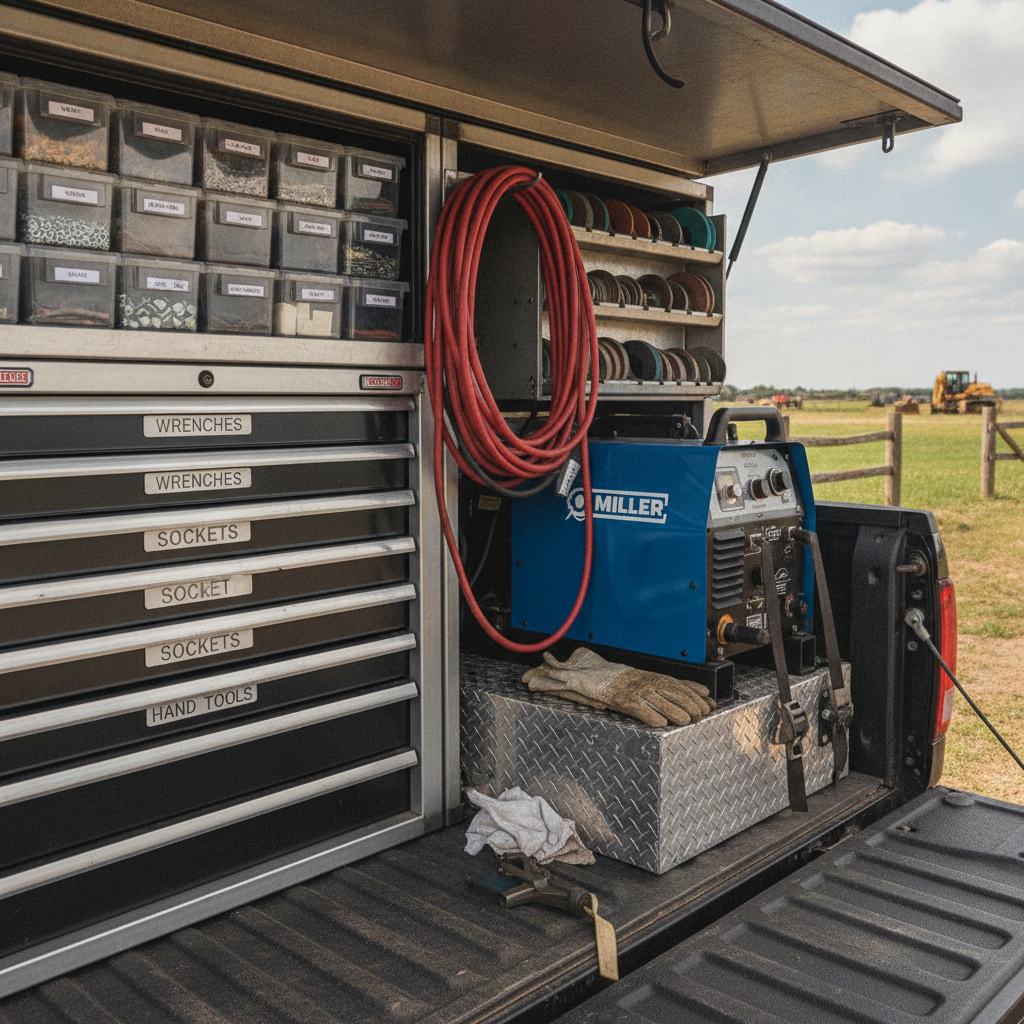
This is the big one. Everything has a home, or nothing does. If your grinding discs are “somewhere in the right side compartment,” you don’t have a system — you have a pile with a lid on it.
Every single item on your rig needs a dedicated, consistent location. Not “usually over here.” Always right here. When you’re half-asleep on a 6 a.m. call, your hands need to find things without your brain getting involved. That only happens through habit, and habit only builds when the location never changes.
Here’s how to start fixing it. Pull everything off your rig. Lay it all out on the ground. Group it by how often you use it and when in your workflow you use it. Things you grab first — leads, clamps, your hood, your grinder — need to be closest to the work side of the truck. Things you rarely touch go in the back or on top.
Label everything. Yes, label it. You’re building a business, not proving how good your memory is.
Mistake #2: Leads and Cables Are a Rat’s Nest
Tangled leads are a time tax. Every. Single. Job. You pull one end and drag three other things with it. You spend five minutes untwisting. You trip over the pile. It’s stupid and it’s fixable.
The solution is simple: coil and hang, or coil and bin. Dedicated lead hooks mounted in the truck bed or compartment keep your leads in shape and ready to deploy. Some guys use large plastic bins with lids. Whatever works in your rig layout, the point is that the leads come out in one motion and go back in one motion.
Also stop leaving your leads on the ground at the end of a job and just throwing them in. Take the extra two minutes to coil them properly. You’ll thank yourself every morning for the rest of your life.
If you’re running multiple processes — stick, MIG, TIG — keep each process’s leads and consumables together. Don’t mix your TIG torch accessories in with your stick electrode holder. Process-specific organization saves you from searching mid-job when the customer is standing right there watching. Speaking of running multiple processes on one rig, it’s worth knowing your machine options — Field-Ready Multi-Process Welders breaks that down well.
Mistake #3: Consumables Are Scattered or Depleted
Running out of grinding discs on a job is embarrassing. Running out of wire mid-weld because you forgot to check before you left is worse. These are not equipment failures — they’re organizational failures.
You need a consumables system that tells you at a glance what you have and what you need. The simplest version is a labeled bin or rack for each consumable type: grinding discs, flap discs, cut-off wheels, electrodes, wire, contact tips, nozzles, anti-spatter. Each bin has a minimum quantity. When you hit the minimum, you restock before the next job. Not during the job. Before.
Some guys keep a running checklist on their phone or a physical card in the truck. Whatever your system, the point is that “I didn’t have it” stops being a reason a job goes sideways. Running low on shielding gas falls into this category too — Smart Shielding Gas Management covers how to handle gas inventory without getting caught short.
Mistake #4: Your Power and Lighting Setup Is an Afterthought
Half the jobs you’ll ever run will involve working in a shadow, inside something dark, or under something. If your work light setup is “that one flashlight that might be in the truck,” you’re fighting yourself before you even start.
Invest in a proper lighting solution. That means a mounted work light on the rig, a couple of magnetic LED lights for inside tight spaces, and a headlamp that’s always clipped to your hood bag or helmet. Power strip or outlet access on the rig for your angle grinder, cut-off saw, and any other tools that need it.
This also means knowing your power situation before you arrive. Does the job have shore power? Are you running off the machine’s built-in outlets? Do you need your generator? Not knowing this ahead of time and showing up unprepared is avoidable with one phone call or text to the customer the day before.
Mistake #5: Your Machine Isn’t Secured Right
A welder sliding around in the truck bed every time you hit a bump is how you end up with a damaged machine and a bad morning. It also means the machine isn’t in the right position to work from, so you’re pulling leads at weird angles and fighting your own setup.
Your machine needs to be on a skid or mounted in a fixed position. It should be accessible from the work side of the truck, with the panel facing out. Leads should be able to run from the machine to the work area without crossing in front of your feet or creating a trip hazard.
The positioning of your machine also affects how fast you can dial in your settings when you step up to a new job. If you’re reaching around and can’t see the panel clearly, you’re adding time to every setup. If you’re running a newer multi-process or battery-hybrid machine, the setup considerations are slightly different — Hybrid Battery-Powered Welders covers what to think about when integrating those into a mobile rig.
Mistake #6: No Pre-Job Checklist
I know how this sounds. You’ve been doing this for years. You don’t need a checklist. You know what you’re doing.
You’re wrong. Everyone leaves something behind eventually. The difference between guys who do it regularly and guys who almost never do it is a checklist. Doesn’t have to be fancy. Can be a laminated card in the cab. Can be a note in your phone. Ten items, two minutes, every morning before you leave the yard.
Your checklist should cover: machine secure and set, leads coiled and loaded, consumables stocked, gas level checked, grinding tools present, safety gear present, hood and accessories, lighting gear, hand tools, and anything job-specific for that day. That’s it. Run through it, leave, don’t look back.
Mistake #7: The Truck Cab Is a Disaster
Your cab is your office. If your paperwork, invoices, and job notes are buried under fast food bags and random PPE, you’re adding chaos to the administrative side of your business too. When you pull up to a customer and they watch you dig through your cab looking for a pen to sign something, the impression isn’t great.
Keep a folder or clipboard in the cab for active job paperwork. Keep a notepad and pen in a consistent spot. If you’re handling quoting, invoicing, and scheduling from your phone, know where your charger is and keep the cab clean enough to work from at a stoplight without losing your mind.
The business side of mobile welding is a real operation. If you’re just getting that side of the house built out, From Garage to Shop is a good read on building the infrastructure of a real welding business, not just a guy with a truck.
Building a Rig That Actually Works for You
Here’s the thing about mobile rig organization — it’s not a one-time project. It evolves. You try something, it doesn’t work, you adjust. You add a new process or a new tool and you have to find a home for it. That’s fine. The goal isn’t perfection. The goal is a system that keeps improving and keeps cutting your setup time down.
Talk to other mobile welders. Look at how experienced guys have their rigs set up. There’s no reason to figure all of this out from scratch when someone has already solved most of it. The welding community is generally pretty open about this stuff when you ask.
Also think about what jobs you’re chasing. If you’re doing a lot of structural work or working with dissimilar metals on varied field jobs, your rig needs to reflect that with the right consumables and processes on hand. Dissimilar-Metal Welding Mastery is worth a read if that’s part of your regular work, and having the right stuff in the truck before you show up is part of being ready for it.
The Real Cost of a Disorganized Rig
Let’s be honest about what’s actually happening when your rig is a mess. You’re not just running slow. You’re telling every customer who watches you that you’re not quite in control of your operation. In a trade where reputation is everything and word of mouth is your best marketing tool, that matters more than most guys want to admit.
The flip side is also true. When a customer watches you back in, open your truck, and have everything you need laid out and ready to go in ten minutes, they relax. They trust you. They call you again. They tell their neighbor about you. That’s how a mobile welding business actually grows — not through ads, but through looking like you know what you’re doing every single time.
Mobile rig organization is one of those unglamorous things that separates operators from amateurs. It’s not exciting. Nobody’s going to write a magazine article about your organized lead rack. But you’ll notice the difference in your hours, your stress level, and your bank account by the end of the first month you take it seriously.
Start simple. Pick your worst disorganization problem right now — probably the leads or the consumables — fix that one thing completely before you move on to the next. Build the system one section at a time. If you’re also trying to tighten up the business side while you sort out your operational efficiency, Smart Heat Maps for Startups covers where to focus your energy when you’re building out a mobile welding operation. Small moves compound fast when you’re consistent about them.
Fix the truck. Stop working for free.