Your Truck Is Costing You Money Before You Even Strike an Arc
Let’s be honest. If you’ve got a mobile welder truck setup that looks like a tornado went through a Harbor Freight, you’re losing money every single day. Not a little money — real, measurable, comes-out-of-your-hourly-rate money. You pull up to a job, and instead of welding, you spend twenty minutes digging through a pile of cables, fittings, half-empty flux cans, and that one chipping hammer you swear you put back last Tuesday.
That’s not a minor inconvenience. That’s overhead you’re eating while the customer watches.
I’ve been running a mobile rig for over a decade. I’ve made most of these mistakes myself. Some of them I made for embarrassingly long stretches before I got my act together. This post is the conversation I wish someone had pulled me aside and had with me when I first started chasing jobs across the county.
Let’s go through the biggest setup mistakes, why they’re killing your efficiency, and what to do instead.
Mistake #1: No System, Just Stuff
The most common mobile welder truck setup mistake isn’t any single thing you’re doing wrong. It’s that you have no real system at all. Everything has a general zone — “welding stuff is in the back, tools are on the side” — but nothing has a specific home. So when you need something specific, you’re hunting.
Every minute you spend looking for something is a minute you’re not billing. Do that twice a day on every job, and you’re talking about a meaningful chunk of lost time by the end of the week. Multiply that over a year, and it gets ugly fast.
The fix is dead simple: everything gets a home, and everything goes back to that home every single time. Not when you feel like it. Every time.
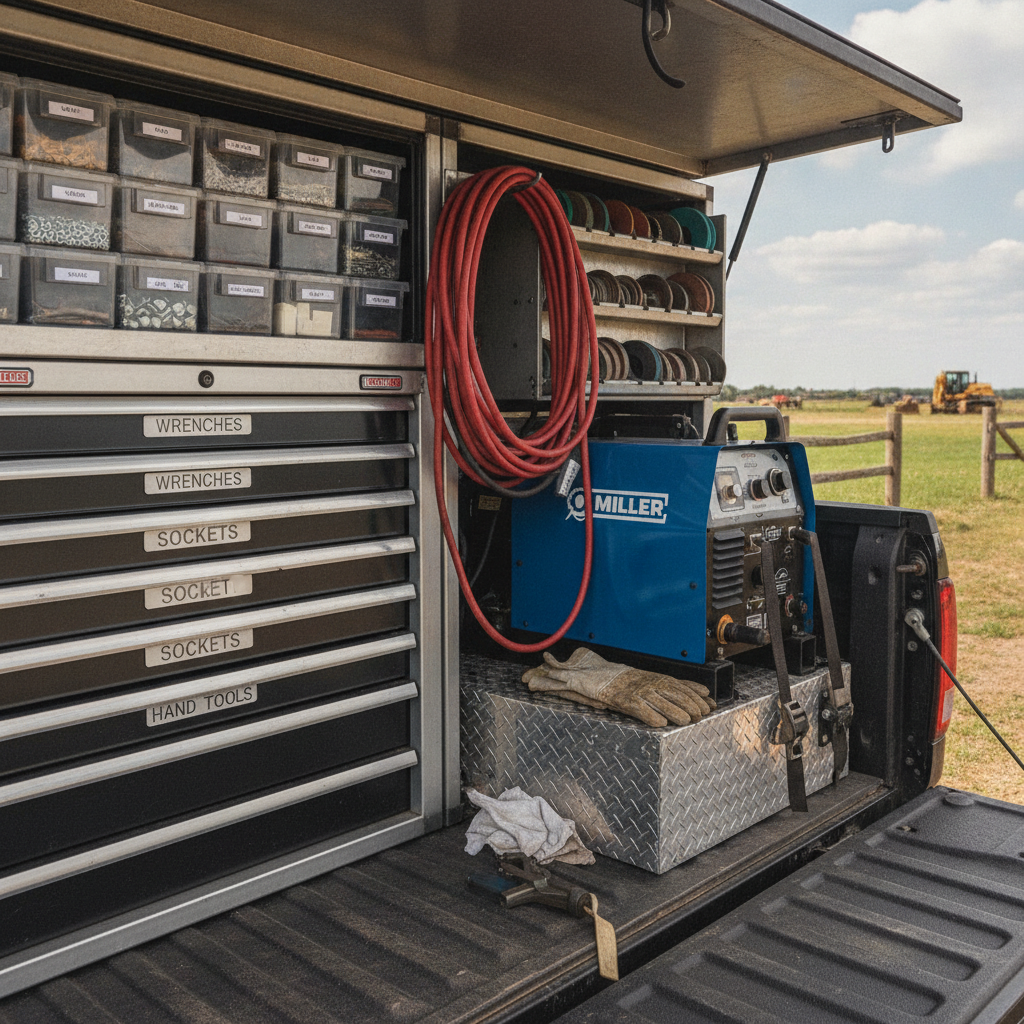
Use foam-lined drawers, pegboards in enclosed trailers, or labeled bins in service body compartments. Whatever works for your rig. The point is repeatability. You should be able to grab what you need without looking — like a surgeon, but with less schooling and more grinding sparks.
If you’re still figuring out what kind of operation you’re building, the post on strategic niches for mobile welders is worth a read before you invest heavily in a rig layout, since your niche dictates what you’re hauling.
Mistake #2: Your Cables Are a Disaster
Tangled welding leads are the physical manifestation of a bad day. You’ve got a 50-foot stinger lead wrapped around a ground clamp, twisted through the handle of an angle grinder, somehow looped around a gas hose. By the time you get it sorted out, you’ve burned fifteen minutes and your blood pressure is up.
Cables need to be coiled properly — over-under, not the death-spiral wrap that kinked your last three leads — and they need to be stored so they come out clean. Cable hooks, retractable reels for shorter runs, or purpose-built cable bags all work. Pick one and use it consistently.
Also, stop leaving your leads plugged into the machine when you’re driving. Every bump in the road works the connectors loose and wears out the connection points faster. Disconnect, coil, store. It adds thirty seconds to your pack-up. It saves you from chasing an intermittent connection problem at 7 AM on a Monday.
The same discipline applies to your gas hoses. Loose hoses get pinched under equipment, develop micro-cracks at the fittings, and create the kind of shielding gas loss that ruins welds before you even know there’s a problem. If you want to go deeper on gas management, check out this piece on smart shielding gas management — it’ll save you money on consumables too.
Mistake #3: Your Machine Is Wrong for the Work
This one stings a little, but it needs to be said. Some guys are running the wrong machine for their work mix, and their mobile welder truck setup is organized around a limitation instead of a capability. They’ve got a dedicated stick machine but they’re constantly getting called for TIG or wire work, so they’re either turning jobs down or hauling a second unit that doesn’t have a real home on the rig.
If you’re running a mobile operation that hits multiple material types and processes, a multi-process machine is almost always the right call. It consolidates space, reduces the cable mess, and makes your rig setup faster because you’re not reconfiguring for different processes.
The post on field-ready multi-process welders breaks down what to look for if you’re evaluating that kind of upgrade. It’s not about having the fanciest machine — it’s about matching your equipment to your actual work, which directly affects how your rig gets organized.
While you’re at it, if you’re open to newer power solutions, there’s a solid case to be made for looking at hybrid battery-powered welders for certain job types. Reduces generator dependency and simplifies your power setup on the truck.
Mistake #4: Consumables Are Everywhere and Nowhere
You run out of a specific rod size mid-job. You know you have more — somewhere. Maybe the toolbox on the driver’s side. Maybe the bin behind the cab. Maybe they’re still in the box from when you restocked, which is sitting on the floor of the truck because you didn’t put it away yet.
This is the consumables problem, and almost every mobile welder deals with it at some point. The fix has two parts.
Part one: Dedicated consumable storage, organized by type and size, that never gets used for anything else. Rods, wire spools, tips, nozzles, cups, tungstens — everything in a labeled spot. Airtight containers for rods you need to keep dry. Done.
Part two: A restocking trigger. When you pull the second-to-last box of something, you add it to your supply order that day. Not when you run out. When you’re down to your last backup. This is basic logistics and it sounds obvious, but you’d be amazed how many guys are making emergency supply runs in the middle of a job week because they didn’t do this.
Running a tight consumable system also matters when you’re doing more complex work. If you’re branching into dissimilar-metal welding, having the right filler metals and consumables on hand without a hunt becomes even more critical — wrong filler on a dissimilar joint is a bad day professionally and structurally.
Mistake #5: The Cylinder Situation
Gas cylinders on a mobile rig are a safety issue first and an organization issue second. If your cylinders aren’t properly secured, you’ve got a potential bomb rolling around in your truck bed every time you hit a pothole. That’s not an exaggeration. An unsecured cylinder that gets its valve knocked off is a serious incident waiting to happen.
Every cylinder gets chained or strapped. Full stop. Two-point restraint if they’re tall cylinders. They stand upright. Always.
Beyond safety, think about your cylinder layout from a workflow standpoint. Where are you pulling hose from? How far does the hose have to run to reach your typical work zone? Are you constantly re-routing around other equipment? Small adjustments to cylinder placement on the rig can save you a surprising amount of hose management time on every single job.
Keep your regulators protected when not in use. Regulator damage from something rolling into it during transit is an annoying and expensive fix. A simple cover or dedicated bracket position does the job.
Mistake #6: Your Lighting and Power Access Is an Afterthought
You’re working inside a confined space, it’s getting dark, and your only work light is a headlamp that you definitely don’t know where you put. Your mobile welder truck setup needs dedicated lighting solutions that are part of the rig, not scavenged from wherever at the moment you need them.
Magnetic work lights on the rig itself. A reliable tripod flood light that has a dedicated spot in a compartment. Extension cords that are coiled and accessible. These aren’t luxury items — they’re tools that affect the quality of your work and your personal safety in low-light conditions.
On the power access side, think about where your outlets are and whether they serve your actual workflow. Running an angle grinder, a cut-off wheel, and your welder from the same circuit with extension cords going in three different directions is a trip hazard and an efficiency problem. Lay out your power access points deliberately when you’re configuring the rig, not as an afterthought when you’re already on a job.
Mistake #7: No Pre-Job and Post-Job Checklist
I know how this sounds. You’ve been welding for years. You don’t need a checklist. You know what you’re doing.
You’re wrong, and I say that with complete respect because I was wrong too.
A pre-job checklist takes three minutes and it means you never show up to a site missing a critical piece of equipment again. A post-job checklist means your rig stays organized because you’re systematically putting everything back instead of doing a rough reload and promising yourself you’ll fix it later. (You won’t fix it later.)
Your checklist doesn’t have to be complicated. It can be a laminated card on the inside of a compartment door. Run through it before you pull out of the yard. Run through it before you leave a job site. That’s it. Simple habit, real results.
If you’re building out the business side of your operation alongside your rig setup, the post on going from garage to shop has some useful framing around building repeatable systems — same principle, broader context.
What a Good Mobile Welder Truck Setup Actually Looks Like
Let me paint a quick picture. You pull up to the job. You open the right compartment, pull out your leads — already coiled, already clean. You hook up your gas in under two minutes because your cylinders are positioned where they need to be and the regulator is protected and accessible. You grab your rod from the labeled bin in the consumable drawer. Your work light is in the same spot it’s always in.
You’re striking an arc twelve minutes after arriving on site. The customer sees someone who’s done this before. You see a job that’s going to get done on time because you didn’t burn your setup buffer before the work even started.
That’s not some idealized version of mobile welding. That’s what a deliberately organized mobile welder truck setup actually delivers in the real world.
The difference between a rig that works for you and a rig you work around is mostly just decisions. Decisions about where things live, how they’re secured, and whether you’re disciplined enough to put them back where they belong every single time.
The Business Case for Fixing Your Rig Organization
Let’s put some rough numbers on this. If you’re losing twenty minutes per job to setup inefficiency, and you’re running five jobs a week, that’s over an hour and forty minutes per week. At a $125 hourly rate, that’s more than $200 a week walking out the door. Over a year, that’s over $10,000 in lost billing capacity.
Ten thousand dollars. For not organizing your truck properly.
The investment to fix your rig layout — some drawer dividers, cable hooks, proper bins, maybe a label maker — is a couple hundred bucks and a Saturday afternoon. The ROI is genuinely absurd.
And it compounds in other ways. A tight, professional-looking rig signals competence to customers. Referrals happen partly because of the work, and partly because the whole experience felt professional. How your rig looks and how efficiently you set up contributes to that perception more than most guys want to admit.
If you’re still dialing in the financial side of your mobile operation, the post on pricing your welding services is worth a look alongside this one. You can’t bill what you’re wasting on disorganization.
Start With One Thing
Don’t try to overhaul your entire mobile welder truck setup in one weekend unless you’ve got the time and you’re the kind of person who can see that kind of project through. Most guys start strong and trail off, and then they’ve got a half-reorganized rig that’s somehow worse than before.
Pick the one thing that wastes the most time on your current rig. For most guys, it’s cables. For some, it’s consumables. For a few, it’s the cylinder situation. Fix that one thing completely. Build the habit around it. Then move to the next thing.
Small consistent improvements beat one ambitious Saturday every time.
Your time is your inventory. Every minute you’re not welding on a job is a minute of inventory you burned for free. Fix the rig, protect the inventory, make more money. That’s the whole play.
Now go clean up that truck. It’s embarrassing.