Truck Setup Mistakes That Slow Down Every Job
If your mobile rig setup looks like a hardware store threw up in a service body, you’ve got a problem. Not a “someday I’ll clean that up” problem. A real, money-leaving-your-pocket problem. Every time you spend twenty minutes hunting for a contact tip or untangling leads that somehow tied themselves in a knot overnight, that time comes straight off your hourly rate. You’re not getting paid to dig through junk. You’re getting paid to weld. Let’s talk about what’s actually slowing you down and how to stop it.
Why Mobile Rig Setup Mistakes Cost More Than You Think
Here’s the math nobody wants to do. Say you waste thirty minutes per job getting organized. You run five jobs a week. That’s two and a half hours a week. Over a year, that’s around 125 hours of unpaid fumbling around in the back of your truck. At even $75 an hour, you just threw away nearly $9,400. Congratulations, you bought yourself a really expensive mess.
And that’s just the time cost. There’s also the professional image problem. When a customer watches you tear apart your truck for ten minutes before you even touch their equipment, they’re making mental notes. Not the good kind. First impressions on a job site matter more than most people admit, and showing up with a chaotic rig tells people you might run your whole operation that way.
This isn’t about being obsessively neat. It’s about being functional. There’s a difference between a working truck and a dumpster with wheels. The goal is to get your hands on whatever you need in under sixty seconds, every time, without thinking about it.
Mistake #1: No Dedicated Zones in Your Service Body
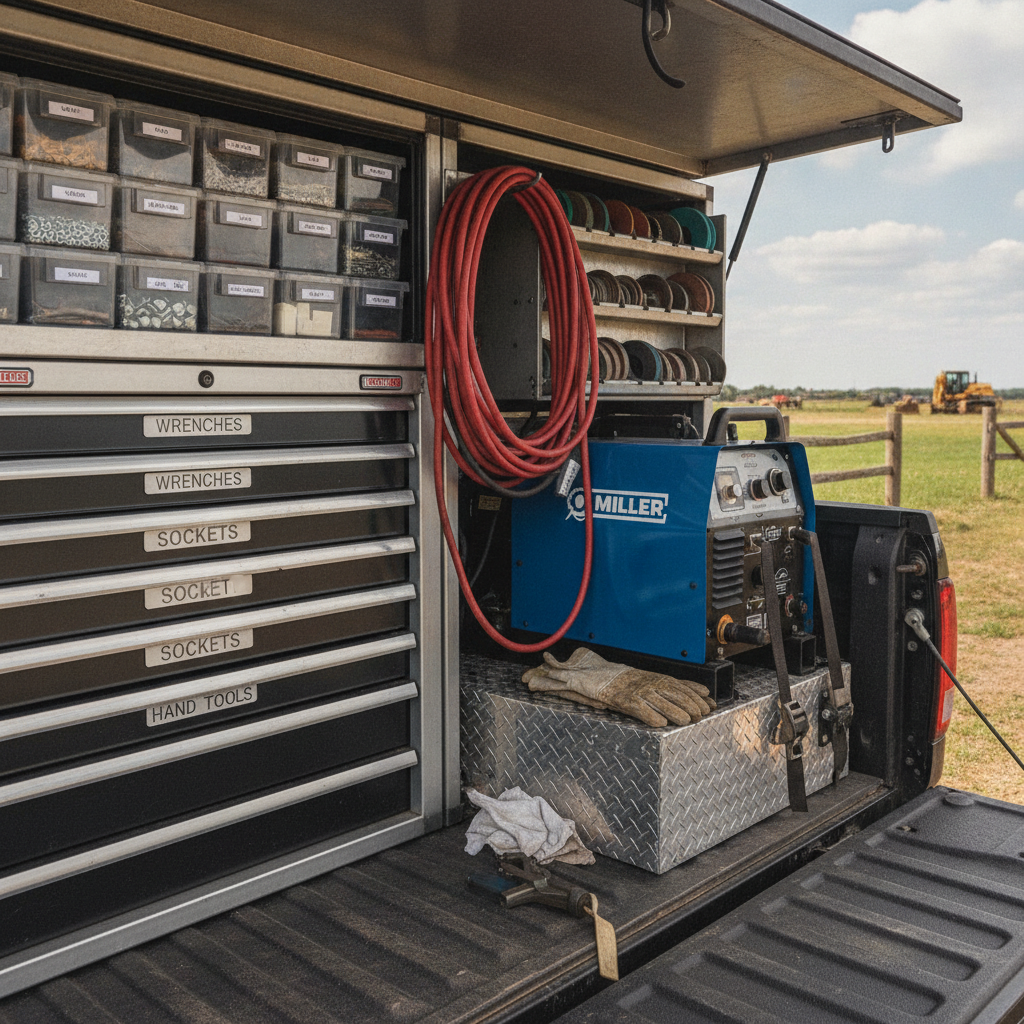
The biggest mobile rig setup mistake is treating your service body like one big junk drawer. Everything gets thrown in, nothing has a home, and you spend half your morning playing archaeologist.
Zone your truck like you mean it. Here’s a simple system that actually works in the field:
- Zone 1 – Consumables: Contact tips, wire, rod, lenses, grinding discs. Everything you burn through or replace regularly lives here. This is your most-accessed zone and should be closest to your work area.
- Zone 2 – Hand tools and measuring: Clamps, squares, tape measures, soapstone, chipping hammer, wire brush. One drawer, always the same drawer.
- Zone 3 – Power tools: Grinders, drill, cut-off saw. Mounted or stored in foam-lined holders so they’re not rolling around destroying everything else.
- Zone 4 – Safety gear: Hood, gloves, sleeves, fire blanket. Accessible without digging. You shouldn’t have to excavate to find your PPE before you can legally strike an arc on some sites.
- Zone 5 – Paperwork and odds-and-ends: Work orders, pens, phone charger, shop rags. Keep it in the cab or in a dedicated pouch. Don’t let it migrate into your equipment zones.
Sounds simple because it is. The hard part is sticking to it when you’re tired at the end of a long day and everything just gets thrown in. Build the habit or the habit of chaos will build itself for you.
Mistake #2: Leads and Cables Coiled Like Spaghetti
Nothing announces “amateur hour” quite like a tangled pile of welding leads spilling out of a service body door. Beyond looking bad, tangled leads slow you down at setup and breakdown, and they get damaged faster when they’re piled up and run over by everything else in the truck.
Invest in proper lead management. A few basic approaches that work:
Lead racks or hooks mounted inside the service body. You can weld these yourself in about twenty minutes. A simple bracket with two or three hooks lets you hang coiled leads properly so they’re not crushed under equipment weight all day.
Figure-eight coiling. If you’re still wrapping leads around your arm like an extension cord, stop. Figure-eight coiling prevents kinks and tangles and takes about the same amount of time. Watch one video on it and you’ll never go back.
Label your leads. Sounds unnecessary until you’re on a job with two welders running different processes and everyone’s grabbing the wrong lead. A piece of tape and a marker takes ten seconds. Not having to sort it out on the clock takes zero seconds, which is better.
Mistake #3: Gas Cylinders Secured Like an Afterthought
This one is both a safety issue and an efficiency issue, so it gets double coverage. If your cylinders are rattling around loose in the truck bed, you’re one hard stop away from a serious problem. Chained cylinders also just stay where you put them, which means you’re not re-positioning them every morning before you can get to anything else.
Use a proper cylinder rack or at minimum double-chain your cylinders to the truck frame. Keep your most-used gas up front where it’s easy to swap regulators without pulling the whole cylinder out. If you’re running multiple gases for different processes — something worth understanding if you’re doing adaptive multimaterial welding — get organized about which cylinder lives where before you’re on a job trying to figure it out.
Also, track your fill levels. A simple whiteboard marker on the cylinder body to note the date you last filled and estimated remaining hours of use will save you the misery of running out of gas mid-bead on a critical weld. That’s a problem with a simple, free solution.
Mistake #4: Your Most-Used Tools Are the Hardest to Reach
This is a layout problem, and it’s surprisingly common. The angle grinder gets used on almost every job, but it’s in the back corner under a pile of clamps. The contact tips are in a bin at the bottom of a stack. Your hood is balanced precariously on top of everything else and falls out every time you open the door.
Do a frequency audit. Spend one week mentally noting how often you reach for each item. Then reorganize your truck so high-frequency tools live in the easiest, most accessible spots. Low-frequency items — specialty fixtures, backup equipment, rarely used consumables — go toward the back or bottom where access doesn’t matter as much.
If you’re running a field-ready multi-process welder, your setup complexity increases because you’re carrying more consumables and equipment for different processes. That makes smart layout even more critical, not less.
Mistake #5: No Inventory System for Consumables
You know what kills a job faster than a tangled lead? Running out of wire or rod and having to make an emergency supply run at 10am. That’s a half-hour minimum, and your customer is sitting there watching the clock while you’re at the welding supply house explaining yourself.
Keep a running inventory of your consumables. It doesn’t have to be fancy. A clipboard or a notes app on your phone with minimum quantities for each item is enough. When you dip below the minimum, you reorder before the next job, not during it.
Common minimums to track:
- Contact tips (by size for each process you run)
- Wire spools (know your burn rate per job type)
- Rod by type (7018, 6010, whatever your bread-and-butter work requires)
- Grinding discs and flap wheels
- Lens covers and shade inserts
- Anti-spatter spray
- Shop rags (seriously, you always need more)
If you’re still figuring out what your actual costs are on consumables and how that affects your pricing, this breakdown on pricing for certification services has a cost-structure approach that translates directly to field work billing too.
Mistake #6: Ignoring the Cab and the Transition Zone
The cab is part of your rig. If your cab looks like a landfill — coffee cups, random fasteners, paperwork, tools that “temporarily” ended up in the passenger seat six months ago — it’s affecting your efficiency whether you notice it or not.
Keep your cab limited to:
- Current job paperwork
- Phone and charger
- Personal items (wallet, water, keys — the basics)
- One small tool pouch for anything you genuinely need arm’s reach access to while driving
The transition zone is the area between your cab and your service body — the side of the truck, the running boards, wherever you stage things when you’re pulling equipment out. Keep it clear and consistent. If you always stage your leads and ground clamp in the same spot before walking to the work area, you build a flow that becomes automatic. Automatic means fast. Fast means more billable time.
Mistake #7: Not Building a Pre-Job and Post-Job Checklist
This sounds like something a manager would say, which is why most independent welders ignore it. Here’s why it actually matters: when you’re running your own operation, there’s no one else to catch what you forgot. If you leave a clamp on a job site, that’s your clamp. If you forget to refill your rod supply, that’s your emergency run.
A one-page checklist takes twenty minutes to build once and saves you real headaches ongoing. Break it into pre-job (what you verify before leaving the shop or yard) and post-job (what you check before leaving a job site). Laminate it and stick it to the inside of a service body door.
Pre-job checks typically include: gas levels, consumables stock, lead condition, tool inventory, safety gear complete, paperwork in order.
Post-job checks: leads coiled and stored, tools accounted for, site cleaned up, any equipment adjustments noted for maintenance.
If you’re scaling up and want to think about where your business is headed, thinking through your strategic positioning is worth the time — there’s a solid framework in this piece on strategic niches that applies directly to mobile operations.
The Bigger Picture: Your Rig Is Your Shop
When you’re working out of a fixed shop, the shop layout gets attention because it’s permanent. You build out your stations, you hang your tools, you set up your workflow. But for a mobile welder, the truck IS the shop. It deserves the same level of intentional setup that any shop would get.
If you’re early in your mobile operation and still figuring out how all the pieces fit together — not just the truck but the business side — this post on going from garage to shop covers a lot of the foundational decisions that mobile welders face when they’re getting started.
Your mobile rig setup is a direct reflection of how you run your business. Customers notice. Referrals come from customers who were impressed, not just satisfied. Being the guy who showed up organized, hit the ground running, and wrapped up efficiently is worth more in repeat business than almost any marketing you can do.
Quick Wins You Can Do This Week
You don’t have to overhaul everything in one Saturday. Here’s a short list of high-impact, low-effort improvements you can make right now:
- Pick one drawer or compartment and fully organize it. One is better than zero. Build the habit from a single success.
- Hang a lead hook. Weld a bracket inside your service body and stop piling leads on the floor of the compartment.
- Do a consumables inventory tonight. Check every item you burn through regularly and note what you’re actually short on.
- Spend ten minutes labeling compartments. Masking tape and a marker. Dumb-simple, but it enforces the system when you’re tired and tempted to throw things wherever.
- Write your first checklist. Pre-job, five items. Post-job, five items. Start there.
None of these take more than an hour total. But they compound. A better-organized rig leads to faster setup, which leads to more jobs per week, which leads to more revenue. Or at minimum, the same revenue with less stress, which honestly sounds pretty good after a long week.
Final Thought
The welders who run tight operations aren’t smarter or more talented than the rest. They just stopped tolerating preventable waste. A clean, organized mobile rig setup isn’t about pride of ownership. It’s about protecting your time, which is the same thing as protecting your income.
You spent good money on your equipment. You worked hard to build your skills. Don’t let a disorganized truck be the thing that caps what you can actually earn in a day. Tighten up the rig, tighten up the workflow, and get back to what you’re actually getting paid for.
Now go clean your truck. You know it needs it.