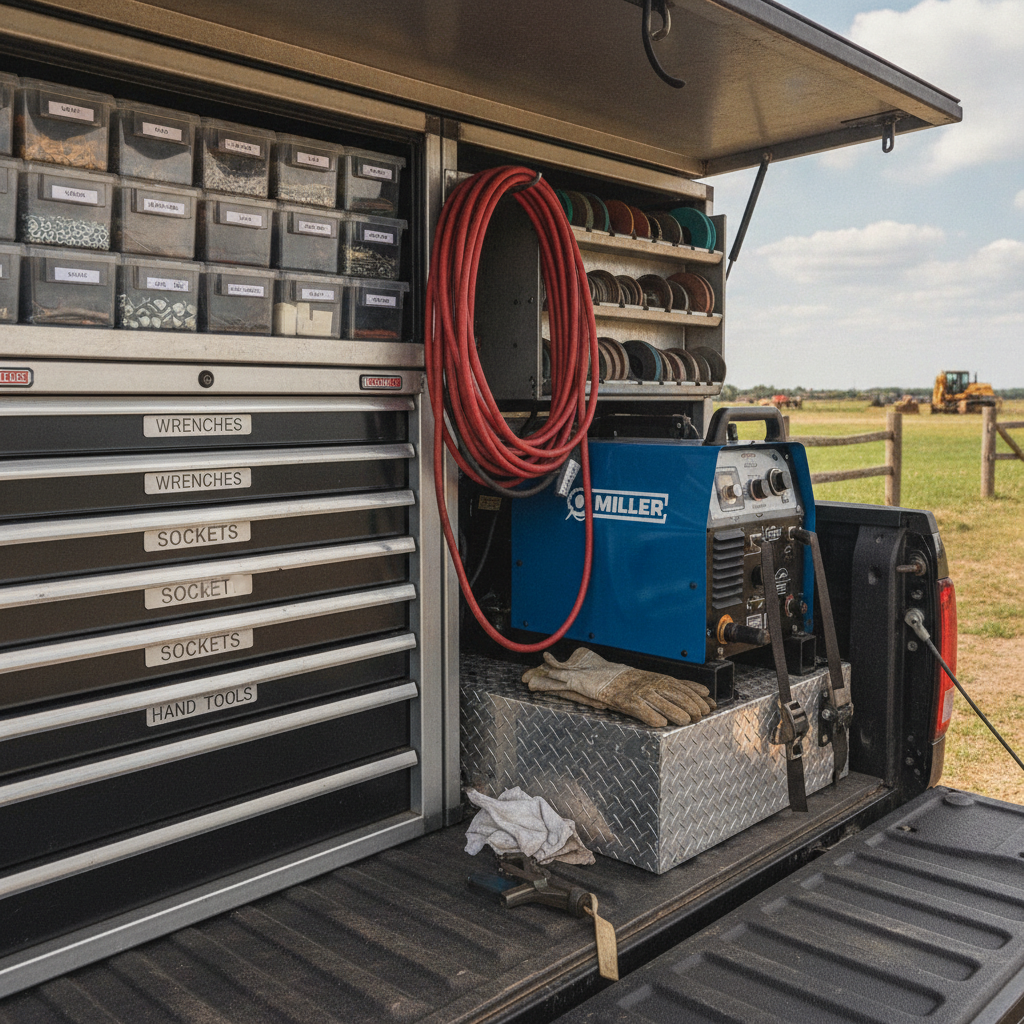
If your mobile rig setup looks like the inside of a dumpster that someone welded shut, you already know what I’m talking about. You pull up to a job, the customer’s watching you, and you spend the next twenty minutes digging through a pile of leads, grinding wheels, and miscellaneous junk you haven’t touched since 2022 just to find your chipping hammer. That time isn’t free. It’s coming directly out of your pocket, and the customer is forming opinions about your operation the whole time. Bad ones.
I’ve been running a mobile rig for over a decade. I’ve made every single mistake on this list — some of them twice. So take this for what it is: a peer-to-peer breakdown of the dumb stuff that wastes your time and makes your rig look like a yard sale on wheels. Fix these, and you’ll run tighter, faster, and a whole lot more professional.
Why Your Mobile Rig Setup Is Costing You Money Right Now
Let’s be blunt. Time is the only thing you’re selling. Every minute you’re not burning rod, you’re not making money. A disorganized rig doesn’t just look bad — it actively bleeds your hourly rate dry before you ever strike an arc.
Think about it this way. If you waste 20 minutes per job getting set up and you’re running five jobs a week, that’s over an hour and forty minutes of unbillable time every single week. At $125 an hour, that’s roughly $200 a week you’re leaving on the ground. Do that math across a year and you’ll want to reorganize your truck today.
Organization isn’t about being neat for the sake of it. It’s about running a tighter business. If you’re still figuring out the business side of things, check out this breakdown on going from garage to shop — a lot of the same efficiency principles apply from day one.
Mistake #1 — No Dedicated Spot for Consumables
This is probably the single biggest time-waster I see on mobile rigs. Electrodes rattling around loose in a milk crate. MIG wire buried under a tarp. Contact tips scattered across the floor of your toolbox like someone dropped a handful of change.
Consumables need a dedicated, weatherproof, clearly labeled home. Period. Not a general area — a specific spot. If you’re running multiple processes, each process gets its own container or drawer. You open it, grab what you need, close it. Done. No digging, no guessing, no “I know I had a pack of 7018 in here somewhere.”
A simple system:
- Plastic ammo cans work great for stick electrodes — moisture-resistant and stackable.
- Label everything on the outside. Not just the container — the specific size and classification.
- Restock at the end of each day, not when you’re already on the job site.
Your gas management matters here too. If you’re running shielding gas on the road, having a solid system pays off fast. We covered smart shielding gas management in a previous post — worth a read if you’re still freewheeling your cylinders.
Mistake #2 — Leads and Cables Are a Tangled Nightmare
Tangled leads are a job site tax. Every time you have to spend five minutes unraveling your work lead or your ground clamp is buried under your electrode lead, you’re paying that tax. And you’re paying it on your own time.
The fix is simple but you have to commit to it. Coil your leads every single time you wrap up a job. Not kind of coiled. Properly coiled, hung, or stored so they come off the truck ready to deploy. Figure-eight coiling works better than circular for most guys — less kinking, easier to unroll.
If your rig allows it, install dedicated lead hooks or a simple rod holder mounted to the bed side. Get those leads up off the floor. Leads on the floor get stepped on, run over, pinched, and tangled. They also get damaged in ways you don’t notice until you’re troubleshooting a mystery arc quality problem at 7 AM on a Monday.
While we’re talking equipment, if you haven’t looked at what’s available in field-ready multi-process welders, it might be worth a look — especially if your current machine is part of the clutter problem on your rig.
Mistake #3 — No System for Hand Tools
Every mobile welder has too many hand tools and no system for any of them. Angle grinders, wire brushes, chipping hammers, soapstone, squares, clamps — they all end up in one drawer that requires both hands and a prayer to open.
Sort your hand tools by frequency of use, not by size or category. The stuff you grab on every single job goes in the most accessible spot. The stuff you use occasionally goes deeper in the box. The stuff you carry “just in case” gets its own bin in the back.
Foam drawer inserts are worth the effort to cut. They look professional, everything has a home, and you can see at a glance if something is missing before you leave the yard — not when you’re on site and 45 minutes from your shop.
Mistake #4 — Your PPE Is Scattered Everywhere
Hood down here, gloves over there, leathers in a bag somewhere in the back, safety glasses are — where are the safety glasses? Sound familiar? Scattered PPE wastes time and creates real safety problems when you’re in a rush.
Your PPE gets one spot on the truck. One spot, always. Not approximately there — exactly there. Hood goes in a protective bag or bin so the lens doesn’t get scratched. Gloves hang on a hook or go in a dedicated slot. Leathers get folded and stored where they’re accessible but protected.
If you’re working toward certifications or bidding certified jobs, your documentation and inspection gear lives in the same organized zone. Getting sloppy with that stuff has downstream consequences. Take a look at certification day tactics if you’re in that world — organization on your rig and organization in your paperwork go hand in hand.
Mistake #5 — Gas Cylinders Not Secured Properly
This isn’t just an efficiency issue. It’s a safety issue. An unsecured cylinder rolling around in your truck bed is a lawsuit and a Department of Transportation headache waiting to happen. Cylinders go upright, chained or strapped, every single time the truck moves. No exceptions.
Beyond safety, proper cylinder storage means you know exactly what you have. How many times have you driven to a job only to realize your Argon is almost empty? Build a simple inventory habit. Check your cylinder levels at the start of each week and at the end of each job. Write it on a whiteboard or use your phone — doesn’t matter how you track it, just track it.
Mistake #6 — No Dedicated Lighting for Night or Low-Light Work
A lot of guys forget about lighting until they’re trying to read a blueprint at dusk or find a fitting under the truck after the sun goes down. By then it’s too late to be annoyed about it efficiently.
Mount a couple of work lights on your rig. LED light bars are cheap and effective. Add a decent headlamp to your PPE setup — one that actually stays charged because you have a dedicated charging spot in the cab. Running extension cords to a trouble light from a nearby outlet is a 1990s solution. You’re running a professional mobile operation. Act like it.
Mistake #7 — Treating Your Truck Bed Like a Storage Unit
This is the one that turns a capable welder into someone who looks like they just started last week. The truck bed isn’t storage. It’s your workshop on wheels, and it should be laid out like one.
Everything in your bed should have a reason to be there. If something hasn’t been used in 60 days, it probably shouldn’t live on your primary rig. Build a dedicated “overflow” bin or keep a second vehicle or trailer for the stuff you only need occasionally. Your daily rig should carry your daily tools — nothing more.
Heavy items go low and centered. Frequently accessed items go at the back of the bed near the tailgate. Fragile stuff gets protected. Nothing slides, nothing rolls, nothing shifts when you hit a bump. Bungee cords are a patch, not a system — invest in proper tie-downs and drawer locks.
Building a Better System: Where to Start
If your rig is currently a disaster, don’t try to fix everything in one afternoon. You’ll overwhelm yourself and quit halfway through, which is somehow worse than just leaving it as is. Work through it in sections.
Start with consumables and PPE — those two alone will cut your setup time significantly. Then tackle leads and cables. Then tools. Then the bed layout overall. Give each change a week to settle in before you move to the next one. You want to build habits, not just rearrange the chaos.
If you’re newer to running your own operation, a lot of this efficiency mindset connects to the bigger picture of how you price your time and structure your business. The post on pricing for certification services gets into some of that — specifically how your overhead and time costs need to be reflected in what you charge.
And if you’re thinking about what equipment makes the most sense for a mobile operation that needs to handle diverse work, the conversation around hybrid battery-powered welders is relevant. The right machine can simplify your rig significantly — less generator noise, less fuel, less maintenance to deal with on the road.
The Bottom Line on Mobile Rig Setup
A solid mobile rig setup isn’t about impressing anyone. It’s about running an efficient, professional operation that protects your time and your rate. Every minute you waste on a job site digging through junk is a minute you didn’t bill. Multiply that across a year and you’ll understand why the guys who have been doing this a long time are almost always the tidiest ones on the lot.
Your rig is your business card. Customers see it before they see your welds. A clean, organized truck tells them you’re serious. A mess tells them something else. You do good work — make sure the first impression matches the quality.
Fix the small stuff. Reorganize in sections. Build the habits. Your setup time will drop, your stress level will drop, and your effective hourly rate will go up. It’s not complicated — it’s just discipline applied to a problem most guys ignore because it feels like it doesn’t matter.
It matters. Now go reorganize your truck.