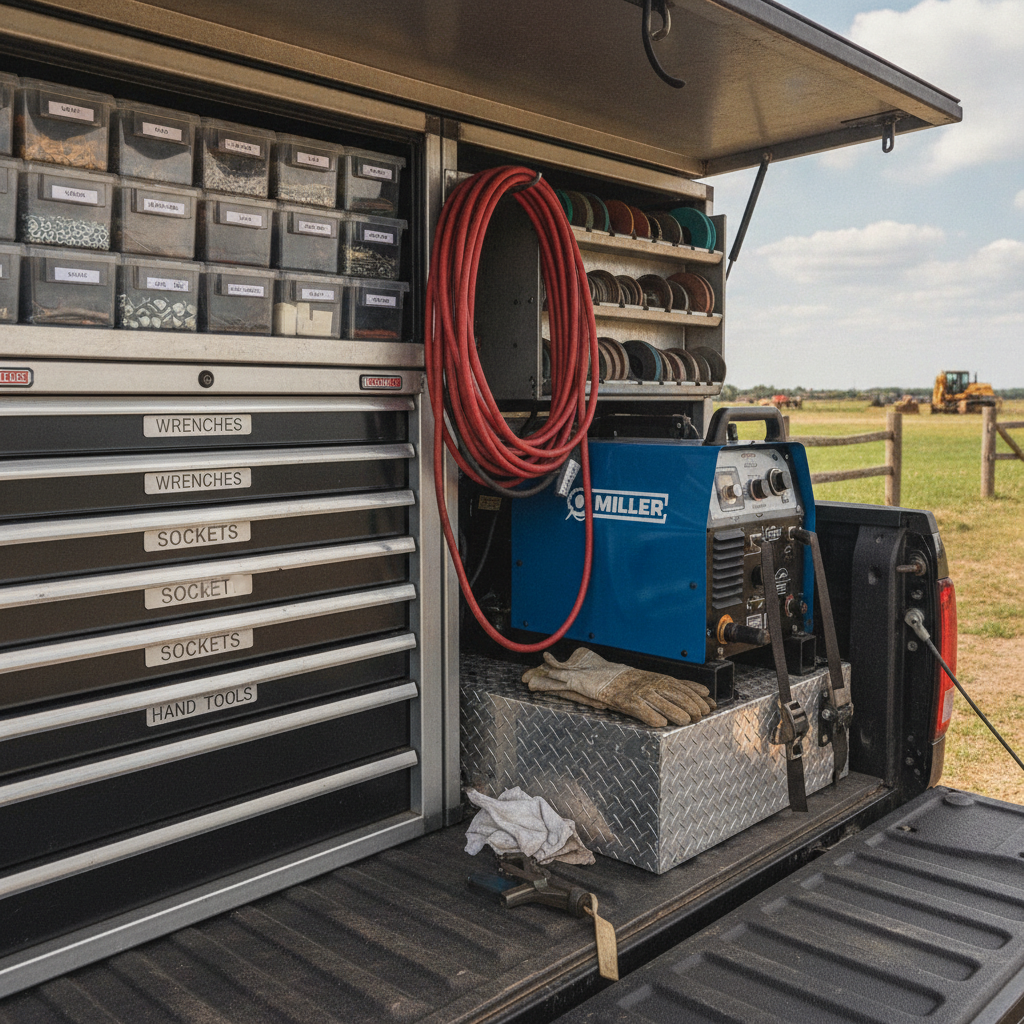
Let me paint you a picture. You pull up to the job, the foreman’s already giving you the look because you’re three minutes late. You pop open the service body and spend the next twenty minutes digging through a pile of leads, stray rods, a grinding disc from 2019, and two pairs of gloves that don’t match. Meanwhile, the clock’s running. Your mobile welder truck setup just robbed you of a half hour of billable time before you even touched a stinger. If that sounds familiar, this post is for you.
This isn’t theory from some guy who’s never been on a job site. This is hard-won, knuckle-scraped experience talking. A badly organized rig is one of the most expensive mistakes in mobile welding — and it’s entirely fixable. Let’s get into it.
Why Your Mobile Welder Truck Setup Is Costing You More Than You Think
Most guys starting out in mobile welding obsess over their machine. Which welder to buy, what processes to run, whether to go with a traditional engine-driven unit or look at something like a hybrid battery-powered welder. That’s fair — the machine matters. But the rig around it? That’s where time goes to die.
Here’s the math. Say you waste fifteen minutes per job finding gear, setting up sloppy, and hunting down consumables. You’re running five jobs a week. That’s seventy-five minutes of unpaid time. At $100 an hour — and you should be charging more than that — you’re leaving $125 a week on the table. That’s over $6,000 a year. For a messy truck.
The clients don’t see your welds first. They see your rig. A chaotic setup signals chaos everywhere. First impressions in this trade are made with your equipment, not your handshake.
Mistake #1: No Defined Home for Anything
This is the big one. Everything in your service body needs a permanent address. Not a “usually here” spot — a permanent, non-negotiable home.
Leads go here. Stingers go here. Grinders go here. Rod oven goes here. If it doesn’t have a home, it becomes clutter. Clutter becomes a twenty-minute treasure hunt at the worst possible moment.
The fix is simple, even if it takes a weekend to implement. Label everything. Use foam inserts in drawers if you’ve got them. Run hooks, hangers, or magnetic strips for leads and cables. Mount your angle grinders so they’re not rolling around loose in a compartment. This is basic stuff, but most rigs I’ve seen look like someone just threw everything in and slammed the door.
Pick a system — any system — and stick to it. The specific organization matters less than the consistency. Your hands need to find gear without your brain having to think about it.
Mistake #2: Overloading the Rig With Junk You Never Use
I get it. You want to be ready for anything. So you throw in every fitting, every rod type, every spare part you’ve ever considered needing. Then your truck weighs a thousand pounds more than it should and every job is a scavenger hunt.
Cut it down. Ruthlessly.
Audit your truck every few months. Pull everything out and ask yourself: did I use this in the last sixty days? If not, it goes in the shop or the trailer — not the daily rig. The goal is a lean kit that covers your most common jobs, not a warehouse on wheels.
Keep your most-used consumables front and center. Everything else lives in secondary storage. If you’re regularly doing specialty work — say, dissimilar-metal welding or jobs requiring specific filler combinations — build a separate kit for that work and load it as needed. Don’t permanently bulk up your rig for jobs you do twice a month.
Mistake #3: Cables and Leads Everywhere
Nothing slows down a setup like a ball of leads that looks like a spaghetti bowl. You pull one cable and three others come with it. The work lead wraps around the ground clamp. Your stinger’s buried somewhere in the middle.
There are a few ways to deal with this. The first is simple: use velcro straps, not zip ties. Velcro lets you un-bundle and re-bundle fast without cutting anything. Second, coil your leads properly when you put them away — over-under, not the garden hose spin that kinks everything. Third, consider running a dedicated cable management system. Reel mounts exist for a reason.
A structured cable setup saves you five minutes minimum every single job. Multiply that out and it pays for the reels inside a week.
Mistake #4: No Consumable System
Running out of 7018 in the middle of a job because you thought you had more is a bad day. Running out of grinding discs on a structural job is worse. Not knowing what you have until you’re already an hour from a supply house is amateur hour.
Build a consumable inventory system. It doesn’t need to be digital — a clipboard with a checklist works fine. What you need to know before every job: what’s stocked, what’s low, and what needs to be ordered before the week’s out.
Keep a par level for everything. When something drops below the par, it goes on the order list automatically. You don’t think about it — the system handles it. This is the same principle behind good shielding gas management on a mobile rig. Know what you have. Know when to reorder. Stop running dry mid-job.
Mistake #5: Poor Lighting and Power Access
You’re working at dusk. Or in a dark equipment bay. Or it’s six in the morning and the sun isn’t cooperating. Your service body has exactly one working light that points the wrong direction. Sound familiar?
Lighting in your service body is not optional. It’s a setup speed multiplier. If you can see what you’re grabbing, you grab it faster. Mount LED strips in your compartments. Add a worklight on the body that you can swing where you need it. This is a cheap upgrade that pays off every single dark morning.
Same goes for power access. Know exactly where your outlets are, where your extension cord lives, and what’s available before you step off the truck. Fumbling for power at setup wastes time and looks sloppy.
Mistake #6: The Machine Isn’t Ready to Run
Your machine should be ready to strike an arc within five minutes of arriving on site. If it’s not, you’ve got a setup problem.
That means fluids checked, cables properly stored and accessible, leads connected or easy to connect, and settings close to where you’ll need them for the job. If you’re running multiple processes, know which one you’re starting with and have it dialed before you drive there.
This is especially true if you’re running a modern field-ready multi-process welder. These units are capable machines, but they have menus and settings that take time if you’re not familiar with them. Know your machine cold. Practice transitions at home, not on the customer’s clock.
Mistake #7: No Job-Specific Prep the Night Before
Winging it works exactly until it doesn’t. When you get a job call, that’s the time to think about what you’ll need — not when you’re standing in front of the rig at 7 AM trying to remember if you have the right rod.
Build a quick pre-job routine. What process? What material? What position? What consumables? Are there any special requirements — certifications, inspection, specific prep? If you’re doing certified work, you’ve already thought through your certification day tactics and your documentation is ready to go.
Ten minutes of prep the night before saves thirty minutes of chaos the morning of. That’s not a philosophy — that’s arithmetic.
Mistake #8: Ignoring the Business Side of Your Setup
This one stings a little. Your truck isn’t just your workspace — it’s your storefront. How your rig looks and operates sends a direct message to every customer and foreman who sees it. A sharp, organized setup communicates competence. A rolling junk pile communicates the opposite.
And if you’re trying to grow a mobile welding business, your rig’s efficiency directly impacts your profitability. You can have all the welding skill in the world, but if your job costing and business strategy aren’t lined up with how you actually operate in the field, you’re leaving money on the table.
Think about pricing too. If your setup is inefficient and you’re consistently losing time, you’re either undercharging to compensate or you’re missing hours you should be billing. Neither is acceptable. Review your service pricing structure alongside your operational efficiency — they’re connected more than most welders realize.
The Real Fix: Build Your Rig Like a System, Not a Storage Unit
Here’s the shift in thinking that makes everything click. Stop treating your truck like a place to store stuff. Start treating it like a machine that runs jobs.
Every machine has a workflow. Think about yours. Where does your day start? What do you grab first? What do you grab last? Build your load-out around that sequence. Most-used items go closest to you at hand level. Rarely-used gear goes high or deep. Heavy stuff goes low and rear. Fragile stuff gets protected.
Walk through a fake setup in your driveway. Time it. Find the bottlenecks. Fix them one at a time. Do that a few times and you’ve got a rig that practically loads itself in your muscle memory.
Then stop touching it unless there’s a good reason. Consistency is the whole point. The moment your system starts drifting — leads in the wrong spot, consumables not restocked, tools not put back — the clock starts running on your next bad day.
Quick Wins You Can Do This Weekend
Not everything needs a full overhaul. Here are some fast fixes that make an immediate difference:
- Label every compartment. Know what’s in it without opening it.
- Purge anything you haven’t touched in sixty days. If it’s not earning, it’s just ballast.
- Buy a decent rod case and stop carrying them loose in a drawer.
- Mount your grinders so they’re accessible and not bouncing around.
- Add LED strips to your main work compartments. Cheap. Instant improvement.
- Print a job checklist and laminate it to the inside of a door. Run it before every job.
None of this is complicated. It’s the kind of stuff that seems obvious once you’ve done it, but somehow never gets done until the pain of not doing it gets bad enough.
Bottom Line
Your mobile welder truck setup is either working for you or working against you. There’s no neutral. Every minute you spend hunting for gear on-site is a minute you’re not billing. Every time a foreman watches you dig through a disorganized rig, you’ve made his day a little more annoying and your next call-back a little less certain.
Fix the rig. Organize the system. Run the checklist. The welding part — you’ve already got that handled. The business of welding is what separates the guys who grind through years of hard work for mediocre pay from the ones who build something real out of their trade.
Your truck is your business card, your workshop, and your profit center all in one. Treat it accordingly.