Let me paint you a picture. You pull up to a job site at 7 AM. The foreman is standing there with his coffee, watching. You pop open your compartments and spend the next fifteen minutes digging past a tangled mess of leads, three grinders with cracked guards, a box of 7018 that got rained on two months ago, and a coffee cup you definitely forgot about. That’s not a great look. More importantly, that’s fifteen minutes of your time — your billable time — gone before you’ve even struck an arc. Mobile rig organization isn’t a luxury. It’s how you protect your rate and your reputation at the same time.
I’ve been running a mobile rig for over a decade. I’ve made every single one of these mistakes personally. Some of them more than once. So take this for what it is — a peer-to-peer breakdown of the dumb stuff that slows you down, and what to do instead.
Why Mobile Rig Organization Directly Affects Your Bottom Line
Most guys starting out think the money problems in a mobile welding business are about pricing, finding customers, or getting the right equipment. And yeah, those matter. But there’s a slow bleed happening every single day that nobody talks about: wasted setup time.
Think about it this way. If you waste twenty minutes on setup at every job, and you run four jobs a day, that’s over an hour of unbillable time. Five days a week, that’s five-plus hours. At $85–$100 an hour, you’re throwing away $400–$500 a week. Every week. Just because your truck looks like a junk drawer.
That math should make you uncomfortable. If it doesn’t, go back and read it again.
Good mobile rig organization is a business decision, not a housekeeping preference. The guys who run tight rigs aren’t neat freaks — they’re just smarter about protecting their time. If you’re still figuring out where to price your services to account for inefficiencies like this, check out this breakdown on pricing for certification services — the same logic applies to field work.
Mistake #1: No System for Consumables
This is the big one. Loose electrodes rolling around in a drawer. MIG wire spools stacked on top of each other. Flux-core on the same shelf as solid wire. Tips, nozzles, and diffusers thrown in a coffee can from 2019.
You know what happens when you need a specific rod and you can’t find it fast? You either waste time hunting or you grab the wrong one and convince yourself it’ll be fine. Neither of those is acceptable.
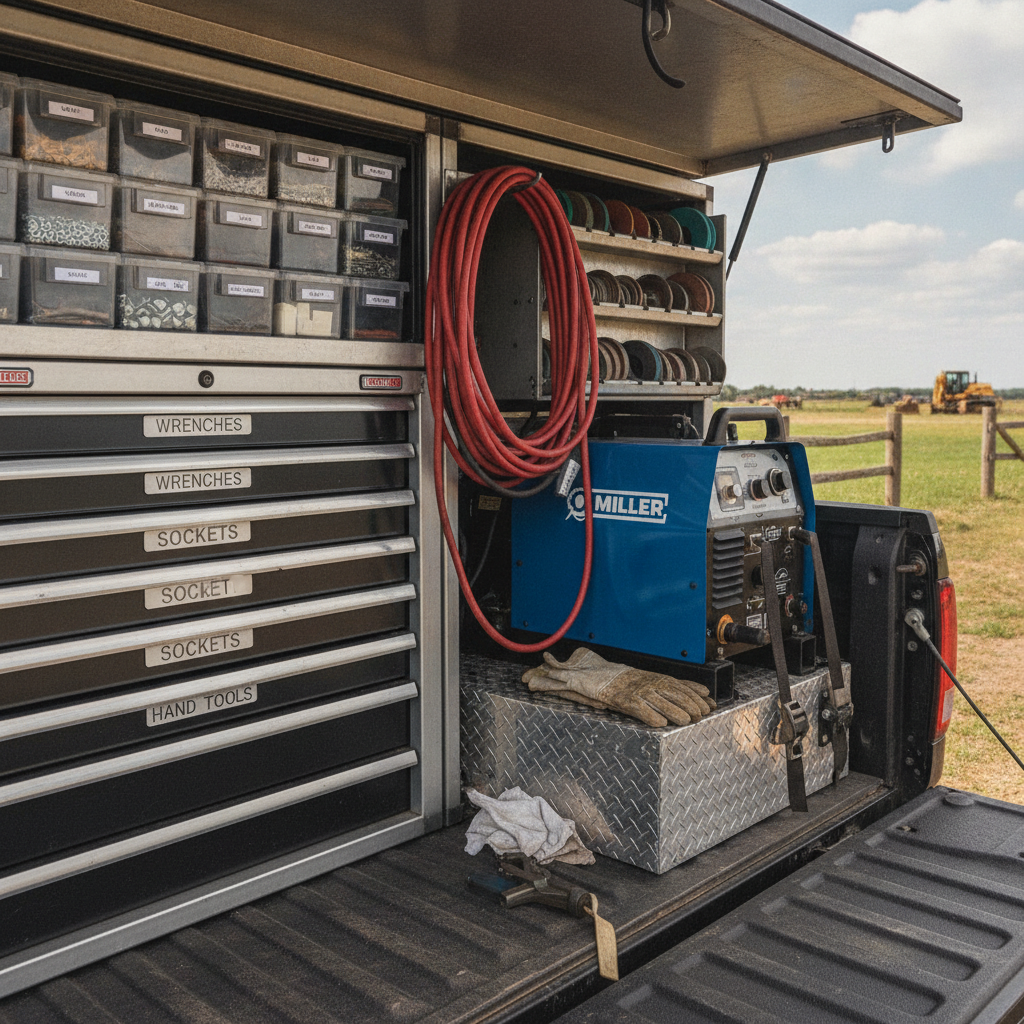
Fix it with labeled bins. Hard bins, not cardboard boxes. Label them clearly — process, type, diameter. If you run multiple processes, separate them physically. Your 7018 lives in one spot. Your ER70S-6 lives in another. Always. No exceptions.
Keep a small inventory list taped inside a compartment door. Check it at the end of every job. Restock before you leave the supply house, not when you’re standing in a field at 6 AM realizing you’re short on 3/32 electrodes.
If you’re running multi-process work in the field — which more mobile welders are doing now — the organization complexity goes up fast. Here’s a solid read on what field-ready multi-process welders actually demand from your setup.
Mistake #2: Your Leads Are Always Tangled
Tangled leads are a rite of passage when you’re starting out. After about the fourth time you spend eight minutes unspooling a kinked lead at 7 AM, you should be motivated enough to fix it. If you’re not, I don’t know what to tell you.
The solution isn’t complicated. It’s just discipline.
Coil your leads properly every single time you pack up. Over-under coiling, not the lazy wrap-around-your-elbow method that puts a twist in the cable every time. Mount dedicated lead hooks or reel systems in your compartments so leads have a home and they go back to that home at the end of every job.
Color-code if you’re running multiple machines or processes. A strip of colored tape on the end of each lead takes thirty seconds and saves you from grabbing the wrong one when you’re working fast.
Heavy leads get their own compartment, bottom shelf, so they’re not crushing your consumables or tangling with lighter cables. Ground cables coiled separately from electrode leads. Every time. This is the kind of thing that takes a week to build into habit and then you never think about it again.
Mistake #3: Gas Cylinders Stored Like an Afterthought
Unsecured cylinders rolling around in a truck bed is a safety issue before it’s an organization issue. I shouldn’t have to say that, but I’ve seen it enough that I’m saying it anyway.
Cylinders need to be chained or strapped upright. Full stop. If you’re hauling CO2/Argon mix and straight Argon, they need to be clearly labeled and stored where you can tell them apart at a glance — not by squinting at a faded sticker in bad light.
Think about your cylinder rotation too. When you swap out an empty, it goes in a specific spot. Empties never get mixed with fulls. You’ve probably grabbed what you thought was a full cylinder and gotten to a job site with about 200 PSI left. That experience is a great teacher. Don’t repeat the lesson.
Regulator storage matters as well. Gauges get broken when they’re bouncing loose in a compartment. A dedicated regulator mount or a padded holder isn’t expensive and it stops you from showing up to a job with a regulator that reads wrong because the gauge took a hit on the highway.
If you’re running battery-assisted or hybrid setups that reduce your gas dependency on some jobs, this is worth understanding from a logistics standpoint — read up on hybrid battery-powered welders and how they change your truck load.
Mistake #4: Tools With No Permanent Home
Angle grinders. Wire brushes. Chipping hammers. Clamps. Squares. Tape measures. These are the things that migrate around your truck like they’re looking for something better. And when you need them fast, they’re never where you left them.
Every tool needs a permanent, designated location. Not a general area — a specific spot. Mount grinder hooks on the wall of a compartment. Hang clamps on a rail. Put your squares and measuring tools in the same drawer every single time.
The rule is simple: if you can’t put your hand on any tool in under fifteen seconds without looking, your system isn’t good enough yet.
Grinding discs and cutting wheels deserve their own attention here. These get damaged when they’re loose. They also create a real mess when a broken wheel is floating around with your good ones. Use a disc organizer or a simple divided container. Know how many good discs you have before you leave for the day.
Mistake #5: The Truck Isn’t Set Up for Your Workflow
This one’s subtler but it matters more than the others once you’ve fixed the basics. Most guys load their truck based on what fits where, not based on what they reach for first.
Think about your actual workflow on a typical job. What do you grab first? What do you grab most often? Those things should be closest to the door, at waist height, easy to reach without crawling into the truck or lifting something heavy out of the way.
Your PPE — helmet, gloves, sleeves — should be the absolute first thing you can grab. Not buried under a lead. Not in the cab. Right there, accessible. If your hood is in the cab and your gloves are in the bottom of a side compartment, you’ve already designed in two extra steps you repeat fifty times a week.
Think through the sequence: arrive, assess the job, gear up, prep the weld area, set machine, run leads, strike arc. Map your compartment layout to that sequence. The stuff you need in step one is in the most accessible spot. The stuff you need in step six is fine being a bit deeper in the truck.
This kind of intentional workflow thinking applies beyond just your truck. It’s the same logic behind smart heat maps for startups — understanding where your time actually goes so you can design your setup around it.
Mistake #6: No Regular Reset Routine
A good system falls apart fast if you don’t maintain it. The truck that’s perfectly organized on Monday looks like a disaster by Friday if you’re not doing a reset at the end of each day or each job.
Build a five-minute reset into your end-of-job routine. Leads coiled and hung. Tools back in their spots. Consumables checked and restocked if needed. Cylinders secured. PPE put away properly, not just thrown in the cab.
Five minutes. Every time. Without fail.
This is the difference between a professional operation and a guy who happens to weld. Customers notice. Foremen notice. The guy who opens up a clean, organized rig gets the repeat call. The guy digging through chaos to find a chipping hammer doesn’t inspire a lot of confidence.
Your truck is your storefront. If you walked into a machine shop and the owner couldn’t find his own tools, you’d have concerns. Your customer is thinking the same thing watching you work.
Mistake #7: Ignoring Weight Distribution
This one affects your truck, your fuel economy, and your tires — all things that cost real money over time. Heavy gear loaded wrong puts unnecessary stress on your suspension and can make the truck handle poorly, especially when you’re hauling a welder and full cylinders.
Keep heavy items low and centered. Weight distributed evenly side-to-side. Don’t stack heavy gear on the driver’s side only because it’s more convenient. Your truck will thank you over the long run, and so will your maintenance budget.
This also connects to how you spec out your rig from the start. If you’re building out or upgrading your setup, the decisions you make about equipment selection affect your load capacity and how you organize everything else. The thinking in Measure Twice, Invest Once applies directly here — make the right call before you bolt something down permanently.
What a Tight Rig Actually Looks Like in Practice
Let me give you the quick version of what a well-organized mobile rig looks like on a real job day.
You pull up. You open the compartment and your PPE is right there. You gear up while you’re walking to assess the joint. You come back, pull your leads off the hooks in about forty-five seconds, connect to the machine, set your parameters — because your machine settings card is taped inside the compartment door — and you’re striking your first arc inside of ten minutes of arriving. The foreman doesn’t have a chance to get annoyed. You look like you’ve done this before. Because you have.
That’s the goal. Not perfection. Just a setup that works for you and doesn’t fight you every morning.
If you’re building a mobile welding business from the ground up and trying to figure out where to invest first, the truck setup is one of those things that pays back fast. The business side of things — niches, pricing, client strategy — all of that matters too, and you can dig into some of that thinking over at strategic niches for mobile welders. But none of that strategy matters if you’re burning an hour a day in setup inefficiency before you ever bill a dime.
The Short Version
Good mobile rig organization isn’t about being tidy for its own sake. It’s about protecting your time, your rate, and your professional reputation. Every minute you spend hunting for a tool or untangling a lead is a minute you’re not billing. Multiply that across a week and you’re looking at serious money left on the table.
Build the system once. Maintain it daily. Make your truck work for you instead of against you. That’s it. That’s the whole lesson.
The guys who last in this trade aren’t always the best welders. They’re the ones who run a tight operation. Your rig is part of that operation. Treat it like it is.