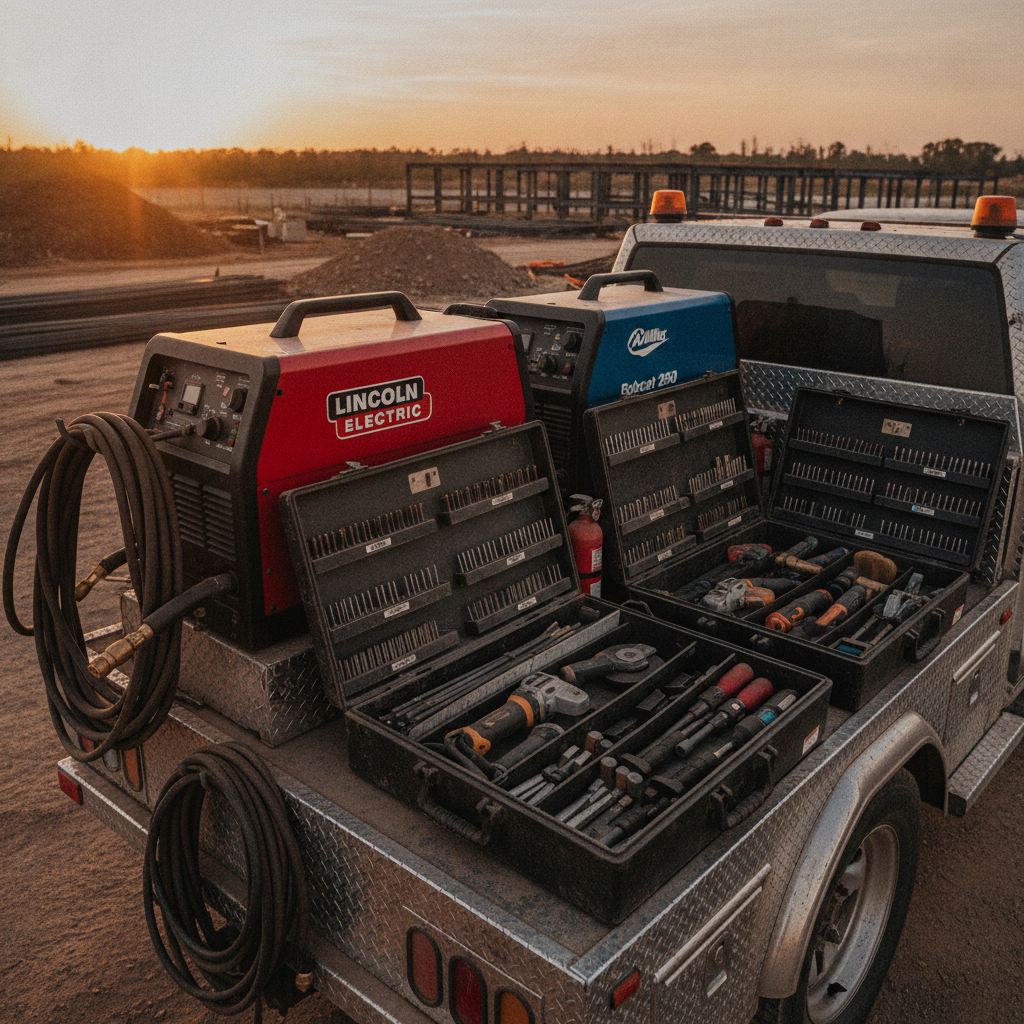
Let me paint you a picture. You pull up to a job site at 7 a.m., customer’s already watching, and you spend the next twenty-five minutes climbing in and out of your truck bed looking for your chipping hammer, a proper ground clamp, and the one fitting you need to hook up your gas line. Your mobile rig setup just made you look like an amateur in front of someone who’s paying you good money. That wasted time isn’t free. It’s coming straight out of your hourly rate — or worse, it’s overtime you’re eating because the job ran long before you even lit your first arc. This post is about fixing that. No fluff, no theory. Just practical changes to how your rig is loaded and organized that will shave real hours off your week.
Why Your Mobile Rig Setup Is Bleeding Money
Most guys don’t track setup time. That’s the first problem. You think of “the job” as the welding. But setup, breakdown, and hunt-and-peck time on your truck is absolutely part of the job. If you’re running five jobs a week and losing fifteen minutes per job digging around your rig, that’s over an hour a week gone. Multiply that by your hourly rate. Multiply that by fifty-two weeks. Now you’re sick to your stomach.
The reason this happens isn’t laziness, usually. It’s that most guys build their rig the same way they built their first shop — reactively. You put stuff where it fits when you buy it. Then you add more stuff. Then you stack things on top of other things. Before long, your truck looks like a rolling yard sale and you can’t find anything without unpacking half the bed.
A solid mobile rig setup isn’t about having the fanciest truck or the most expensive toolboxes. It’s about thinking through your workflow before you load anything. Where does your process start? Where does it end? Your truck should be organized to match that sequence, not fight it.
Mistake #1: No Zones, Just Chaos
The single biggest mistake I see on working rigs is no defined zones. Everything is just… somewhere. Consumables are mixed in with tools. Grinders are buried under safety gear. The rod oven is wedged behind the welder where you can barely reach it.
Fix this first. Break your truck bed or service body into zones:
- Hot zone: Welder, leads, ground clamps, stingers, wire feeders. Everything you touch to actually weld.
- Gas zone: Cylinders, regulators, hoses, fittings. Keep this contained and consistent so you’re never guessing where a fitting went.
- Consumables zone: Rod, wire spools, contact tips, nozzles, anti-spatter. Labeled. Restocked every Friday whether you think you need it or not.
- Tools zone: Grinders, clamps, measuring tape, squares, soapstone, markers. Daily-use stuff at the front or top of the zone.
- Safety zone: Gloves, hoods, respirators, fire blankets, first aid. Don’t let this get mixed in with tools. You’ll need it fast someday and you don’t want to be digging.
This sounds stupidly simple. But I’d bet half the rigs I’ve seen on job sites don’t have any intentional zoning at all. It’s just stuff, loaded with good intentions, turned into controlled chaos over three months.
Mistake #2: The Wrong Equipment for Field Work
Some guys drag shop equipment into the field and wonder why setup takes forever and things keep breaking. A 600-pound transformer welder that was fine in your garage is a nightmare to work around in a truck bed. It vibrates, it shifts, it blocks access to everything behind it.
If you’re serious about field work, your equipment choices matter as much as your organization. I’ve talked before about field-ready multi-process welders that are actually designed for mobile use — lighter, more compact, better suited to a rig environment. The same goes for power options. Hybrid battery-powered welders are changing what’s possible on a mobile rig, especially on jobs where generator access is a pain or noise is an issue.
Smaller, purpose-built equipment doesn’t just save space. It makes your rig faster to set up and easier to work around. Don’t let sunk cost keep you running the wrong gear in the field.
Mistake #3: Leads and Hoses Are Never Coiled
I know. You’re tired at the end of a job. You throw the leads in the truck and deal with it tomorrow. Then tomorrow comes and you’ve got a tangled mess that takes five minutes to sort out before you can even position your welder properly. Do this ten times a week and you’ve lost almost an hour to rat’s nests of cable.
Invest in proper lead management. A few options that actually work in the field:
- Wall-mounted cable reels bolted to the inside of a service body — pull what you need, wind it back up when you’re done.
- Figure-eight coiling technique with velcro straps. Fast to coil, fast to uncoil, no tangles.
- Dedicated hooks or cleats at a consistent height so leads hang the same way every time.
Same goes for gas hoses. A kinked hose costs you time and can mess with your shielding gas flow. If you haven’t sorted out your shielding gas management on the rig, that’s worth its own afternoon to get right.
Mistake #4: Consumables You Have to Hunt For
You’re mid-job, you burn through your last contact tip, and now you’re tearing through a plastic tote looking for more while the customer watches. This is a confidence killer. It makes you look unprepared even if you’re a twenty-year veteran.
Consumables need a dedicated, labeled, consistent location. Not a bin where they might be. A specific spot where they always are. I use a small metal cabinet with drawer dividers. Each drawer is labeled: contact tips by size, nozzles, rods by type, anti-spatter, wire brush. Takes me thirty seconds to restock and thirty seconds to find what I need on a job.
Also: stop waiting until you run out to restock. Every Friday, I do a five-minute consumables check. What’s low gets ordered or restocked from my backup supply before the weekend. I’ve never shown up to a Monday job short on consumables in years because of that one habit.
Mistake #5: Your Truck Bed Is a Storage Unit, Not a Work Platform
If you can’t get to your welder without moving three other things, your rig is set up wrong. Your truck bed or service body should have clear access paths. You should be able to pull your welder out, hook up your leads, connect your gas, and be ready to weld in under ten minutes on a normal job. If that sounds impossible right now, it’s a layout problem.
Think about the order of operations when you arrive at a job:
- Position the truck
- Pull welder to working position
- Run leads to work area
- Connect gas and check flow
- Grab consumables and tools for the specific job
- Set up safety gear
Every single one of those steps should be unobstructed. If step two requires you to first move a cylinder, a toolbox, and a bag of grinding discs — your layout is working against you, not for you. Redesign it so step two is just step two.
Mistake #6: No Standardized Checklist
Memory is unreliable, especially when you’re tired, running late, or jumping between jobs. A mobile welder without a checklist is one forgotten ground cable away from a wasted trip back to the shop.
Build a simple laminated checklist. Mount it inside your truck cab or on the back of the tailgate. It should cover two scenarios:
- Leaving the shop: Everything loaded, cylinders secured, consumables stocked, leads coiled, equipment secured for road travel.
- Arriving on site: Equipment positioned, gas connected and tested, leads run, ground confirmed, PPE accessible.
This isn’t babying yourself. Pilots use checklists. Surgeons use checklists. You’re running a small mobile operation with real liability and equipment worth tens of thousands of dollars. A checklist is just good business. Speaking of good business — if you’re still figuring out the business side of running a mobile operation, the post on going from garage to shop covers a lot of the early-stage thinking that applies here too.
Mistake #7: Ignoring Load Security
This one isn’t just about efficiency. It’s about safety and liability. Cylinders that aren’t properly secured can shift, fall, and become serious hazards. Equipment that slides around in the bed gets damaged and can damage other equipment. And if you get into an accident with unsecured load, you own that problem legally.
Every cylinder gets chained. Every welder gets strapped or bolted. Toolboxes get latched. This should be non-negotiable, not something you do when you remember. Build it into your departure checklist and make it automatic.
Beyond safety, secure loads mean your equipment arrives in the same condition it left your shop. Vibration and shifting over a hundred miles of road can loosen fittings, knock regulators out of calibration, and damage wire feeders. What feels like a minor rattle over a week of driving turns into a service call and downtime you didn’t budget for.
The Business Case for a Better Rig
Here’s the thing about all of this — it’s not just about efficiency on individual jobs. A well-organized mobile rig setup is part of your brand. When a customer sees a clean, organized truck with everything in its place, they see a professional. They see someone who charges what they’re worth and delivers accordingly. When they see a rolling disaster, they start wondering if they got the best guy for the job.
Your rig is the first thing customers see before you even put on your hood. It signals whether you’re operating a real business or just doing side work out of a junky truck. If you’re trying to build a premium service — and you should be, because that’s where the margin is — everything about your operation needs to reflect that. That includes how you’re priced, how you position yourself, and yes, what your truck looks like when you pull up.
I’ve written about strategic niches for mobile welders before, and a big part of owning a niche is looking the part consistently. If you’re targeting industrial maintenance, agricultural equipment, or high-end structural work, your rig needs to match the tier of work you’re going after. And if you want to understand how to price that work properly once your operation is running clean, the post on pricing for certification services has a solid framework that applies to service pricing more broadly.
How Long Should Setup Actually Take?
Here’s a benchmark I use: a standard field job with my rig should take me eight to ten minutes from parking to first arc. That includes positioning, connecting gas, running leads, confirming ground, and getting my consumables sorted for the job. On a complex setup or a cramped site it might stretch to fifteen. If it’s taking you thirty or more, something in your rig layout is broken.
Track it for a week. Actually time yourself. You’ll either confirm you’ve got a good system, or you’ll see exactly where you’re hemorrhaging time. Either way, the data is useful. I’m a believer in measuring before you spend money changing things — that thinking applies to equipment investments too, and the post on measuring before you invest covers that mindset well if you’re thinking about upgrading gear alongside reorganizing your rig.
One Weekend, Permanent Gains
The good news: fixing a bad mobile rig setup doesn’t take months. It takes one solid Saturday. Pull everything off the truck. Lay it all out on the shop floor. Sort it into your zones. Figure out what you actually use every day versus what you’ve been hauling around for six months without touching. Get rid of what you don’t need. Organize what you do. Load it back in with intention.
Add labels. Add proper cable management. Build your checklists. Then run your next week of jobs and see what’s still not working. Iterate from there. Most guys who do this once tell me it’s one of the best ROI projects they’ve ever done for their business — and they wonder why they waited so long.
Your time is the most expensive thing on that truck. Stop treating your rig like it doesn’t matter and start treating it like the profit center it is.
Final Word
A bad mobile rig setup isn’t just inconvenient. It’s expensive, it’s unprofessional, and it’s completely fixable. Every mistake covered in this post has a straightforward solution that costs more in time to implement than in money. The barrier is just deciding it matters enough to fix.
You’re running a business. Act like it. Your truck is your shop floor — keep it organized, keep it tight, and stop showing up to jobs looking like you’re figuring it out as you go. The guys billing top dollar in this trade don’t leave anything to chance, including how their rig is loaded. Neither should you.