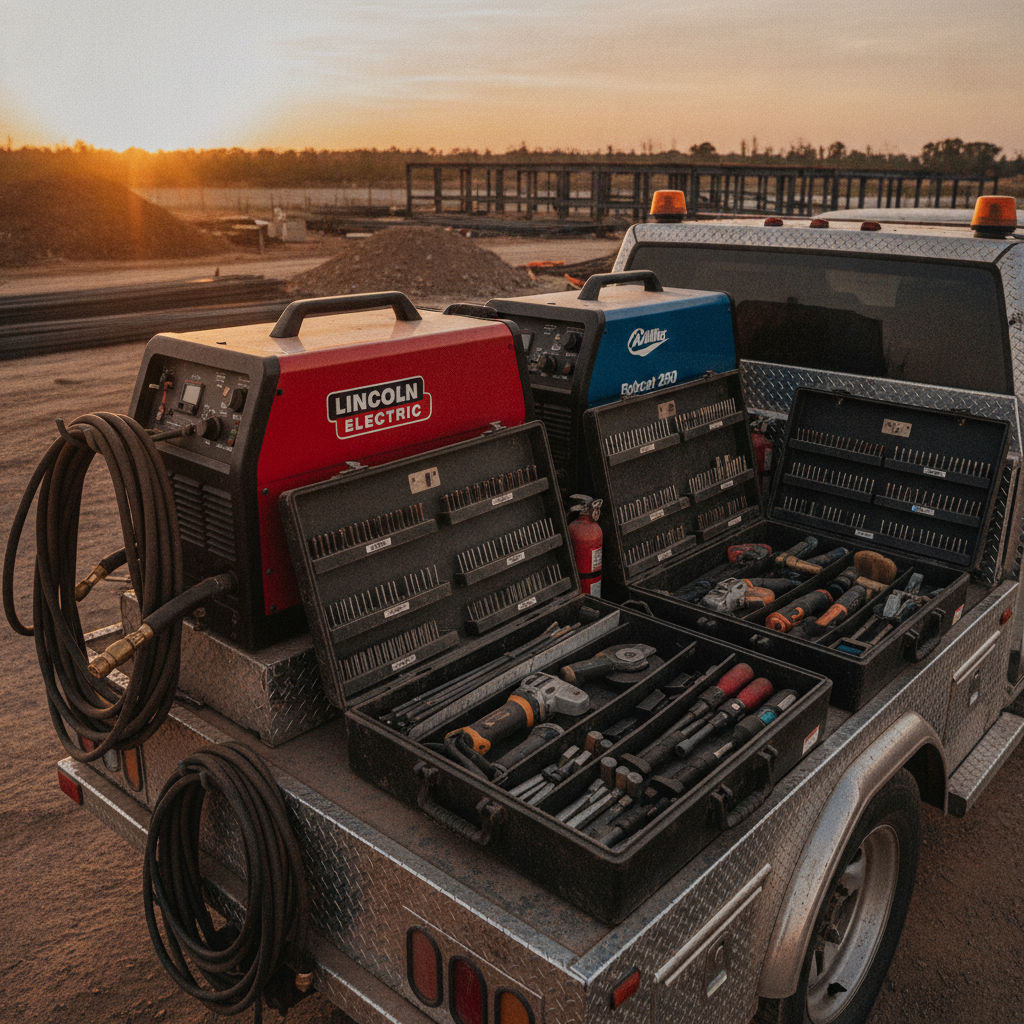
Let me paint you a picture. You pull up to a job site at 7 a.m. The foreman is watching. The client is watching. You open your truck bed and spend the next twenty minutes digging through a pile of leads, grinding discs, mystery rods, and a wire brush that somehow ended up under your argon bottle. That right there is a mobile rig setup problem — and it’s costing you money you haven’t even earned yet.
I’ve been running mobile rigs for over a decade. I’ve made every one of these mistakes myself. Some of them more than once, which is embarrassing to admit, but here we are. The good news is that none of this requires buying a new truck or spending four grand on a custom rig buildout. Small changes, done consistently, are what separate the guys who look like professionals from the guys who look like they just raided a scrap bin.
Let’s get into it.
Why Your Mobile Rig Setup Is Your Business Card
Before we talk about bins and brackets and bungee cords, let’s be clear about something. How your rig looks and how fast you’re set up says something to every person on that job site. It tells them whether you’ve done this before or whether you’re figuring it out on the fly.
Clients notice. Foremen notice. General contractors who might hire you again — definitely notice. A clean, organized rig communicates competence without you saying a word. A rolling disaster communicates the opposite.
This isn’t about being fancy. It’s about being efficient. And efficiency, when you’re billing by the hour or quoting flat rates, is literally money. If you’re still fuzzy on how to price your time correctly, take a look at this breakdown on pricing for certification services — the same logic applies to your mobile work rate.
Alright. Here are the mistakes. You probably recognize some of them.
Mistake #1: No System for Leads and Cables
This is the big one. Tangled leads are the number one time-killer on any mobile job. You pull one end and the whole thing comes with it, wrapped around your gas hose, your stinger, and whatever else had the bad luck of being nearby.
The fix is simple but requires actual discipline. Every lead gets coiled the same way, every single time. Over-under coiling if you want to be proper about it. Each lead has a designated spot — not just “somewhere in the back.” Use hooks, a lead caddy, or even just a few large carabiners clipped to a rail.
Color-code or label your leads. Ground leads, stinger leads, MIG guns — all different. When you need the 50-foot lead instead of the 25-foot, you should be able to grab it without inspecting every coil you own.
This one change alone can save you five to ten minutes per job. That’s not nothing. Over a five-day week with multiple stops, that’s a real chunk of time you’re getting back.
Mistake #2: Consumables Scattered Everywhere
Here’s a fun game: how many partial boxes of 7018 do you have floating around your truck right now? If the answer is “more than two,” you’ve got a consumables problem.
Rod, wire, tips, nozzles, and contact tips need a home. A dedicated, labeled, waterproof home. Not a cardboard box that’s slowly disintegrating in the corner of your truck bed. Not loose in a toolbox drawer mixed in with your chisels and a random bolt you’ve been meaning to throw away for six months.
Get a rod oven or a sealed rod canister for your low-hydrogen electrodes. Get a dedicated drawer or bin for MIG consumables. Wire spools should be in a dry, covered storage spot — not riding loose where they can get banged up or contaminated.
When you’re mid-job and you need a new contact tip, you should be able to reach for it without thinking. If you’re hunting for it, your system failed you.
Mistake #3: Gas Cylinders Not Secured Properly
This one goes beyond efficiency. An unsecured cylinder rolling around in your truck bed is a safety issue, a liability issue, and a “scratched-up truck bed” issue. Chain or strap every cylinder. Every time. No exceptions.
Beyond safety, think about accessibility. Where are your cylinders relative to where you’ll actually be working? If you have to drag a full argon bottle fifty feet every time you set up, that’s dead time. Consider your hose lengths and your typical setup distance when you decide where cylinders live on your rig.
If you run multiple processes and multiple gases, label your regulators clearly. Color-coded valve covers help. You don’t want to be hooking up CO2 to your TIG setup because everything looks the same at 6 a.m. in bad lighting. Speaking of running multiple processes efficiently, field-ready multi-process welders are worth understanding if you’re not already optimizing your process selection on the truck.
Mistake #4: Tools With No Assigned Spots
Every tool on your truck should have one place it lives. Not “somewhere in the toolbox.” A specific drawer, a specific hook, a specific spot on a rack. When you put it back — and you put it back immediately after use — it’s there next time without a search party.
The tools you use on every single job go in the most accessible spots. Angle grinder, wire brush, chipping hammer, tape measure, soapstone, clamps — these are your all-stars. They should be within arm’s reach, not buried under your spare PPE and a rain jacket.
The tools you use occasionally go in secondary spots. Specialty stuff goes wherever it fits, clearly labeled so you’re not guessing.
I know some guys who run a shadow board system on the wall of their enclosed trailer. Every tool has an outline. If the outline is empty, that tool is not where it should be. Overkill for some, lifesaving for others. Depends on how your brain works.
Mistake #5: PPE Thrown in a Pile
Your helmet is the one thing you absolutely cannot start without. So why is it at the bottom of a duffel bag under two pairs of gloves and a leather jacket?
PPE gets its own dedicated spot. Helmet on a hook or in a dedicated case — not rolling loose where it gets dropped and the auto-darkening lens gets cracked. Gloves in a specific bin. Leathers hung up or folded neatly, not balled up in a corner.
This also protects your gear from damage, which is a real cost consideration. A new welding helmet isn’t free. Treating yours like a hat you toss on the floor is how you end up replacing it every year.
Mistake #6: No Pre-Job Checklist Routine
A lot of guys will read everything above and say “yeah, I know, I just don’t always have time to stay organized.” That’s the trap. The disorganization isn’t the problem — the lack of a system for maintaining organization is the problem.
A five-minute end-of-job reset is worth more than an hour of searching at the start of the next one. Before you leave a job site: leads coiled and hung, consumables back in their spots, tools wiped down and put away, gas off, everything strapped and secured. Five minutes. Every time.
If you’re building your business from the ground up and still figuring out the operational side, the post on going from garage to shop has some useful perspective on building habits that scale.
Some guys use a literal checklist on a clipboard or phone. I’m not going to tell you that’s not masculine enough, because I’ve done it and it works. The point is to make the reset automatic, not something you do when you feel like it.
Mistake #7: Machine Settings Not Documented
You show up to a repeat job on the same material, same thickness, same process. What did you run last time? If the answer is “I’ll figure it out again,” you’re wasting setup time. You’re also introducing inconsistency into your welds, which is a quality problem on top of a time problem.
Keep a small notebook or a note on your phone with your common settings. Material, thickness, process, wire, gas, voltage, wire speed. When you come back to that application, you’re dialed in before you run a bead. No guessing, no test runs on scrap for ten minutes.
This pairs well with understanding your equipment. If you’re still dialing in which machine makes sense for your mobile operation, the comparison of hybrid battery-powered welders is worth a read, especially if you’re working remote sites without reliable power.
Mistake #8: Underestimating Setup Time When Quoting
This is where rig disorganization directly hits your bottom line in the most obvious way. If your setup takes thirty minutes because your truck is a disaster, and you quoted the job assuming fifteen minutes of setup, you just gave away fifteen minutes of labor for free. Multiply that by every job in a week and it’s a material income problem.
Clean up your rig, time your actual setup accurately, and quote accordingly. Your prices should reflect reality, not an optimistic version of how fast you’d be if everything went perfectly. If you haven’t thought hard about how to structure your pricing as a mobile welder, the post on strategic niches for welding businesses gets into how the type of work you specialize in affects how you should be pricing and positioning.
Quick Wins You Can Do This Weekend
Not everyone has time for a full rig rebuild. Here are five things you can do in a few hours that will make a noticeable difference immediately.
- Add a lead caddy or hooks to keep your leads coiled and off the floor.
- Label every drawer and bin in your toolbox — no more mystery drawers.
- Buy a dedicated rod canister and stop carrying loose rods in cardboard.
- Mount a helmet hook at the tailgate level so your lid is always the first thing you grab.
- Set a five-minute reset timer at the end of every job until it becomes automatic.
None of these cost much. All of them pay back immediately.
The Bigger Picture on Mobile Efficiency
Your truck is your shop. For most mobile welders, it’s also your brand, your first impression, and your logistics center all in one. The guys who run tight operations — clean rigs, fast setups, consistent quality — are the ones who get called back and get referred.
Disorganization isn’t a personality trait you’re stuck with. It’s a system problem, and system problems have system solutions. Build the system once, maintain it with discipline, and it pays dividends on every single job from that point forward.
If you’re thinking about expanding what you can offer from your rig — different processes, different materials — the work you put into dissimilar-metal welding and process flexibility is only worth it if your rig is organized enough to support it. You can’t run a sophisticated multi-material job efficiently if you’re spending half your setup time untangling equipment.
And if you’re working toward certifications to open up higher-paying work, understand that professional habits on your rig translate directly to professional habits in a test environment. Take a look at the certification readiness calendar if that’s on your radar — the discipline required to prep for a cert test is the same discipline that keeps your rig clean.
Final Thought
A bad mobile rig setup isn’t just an inconvenience. It’s a direct tax on your time, your professionalism, and your income. You can be the best welder on the job site and still leave money on the table every week because your truck is a rolling junk drawer.
Fix the system. Run a tighter rig. Stop digging for stuff you should be able to grab in ten seconds. Your hourly rate will thank you — and so will your blood pressure.
Now go clean out that truck.