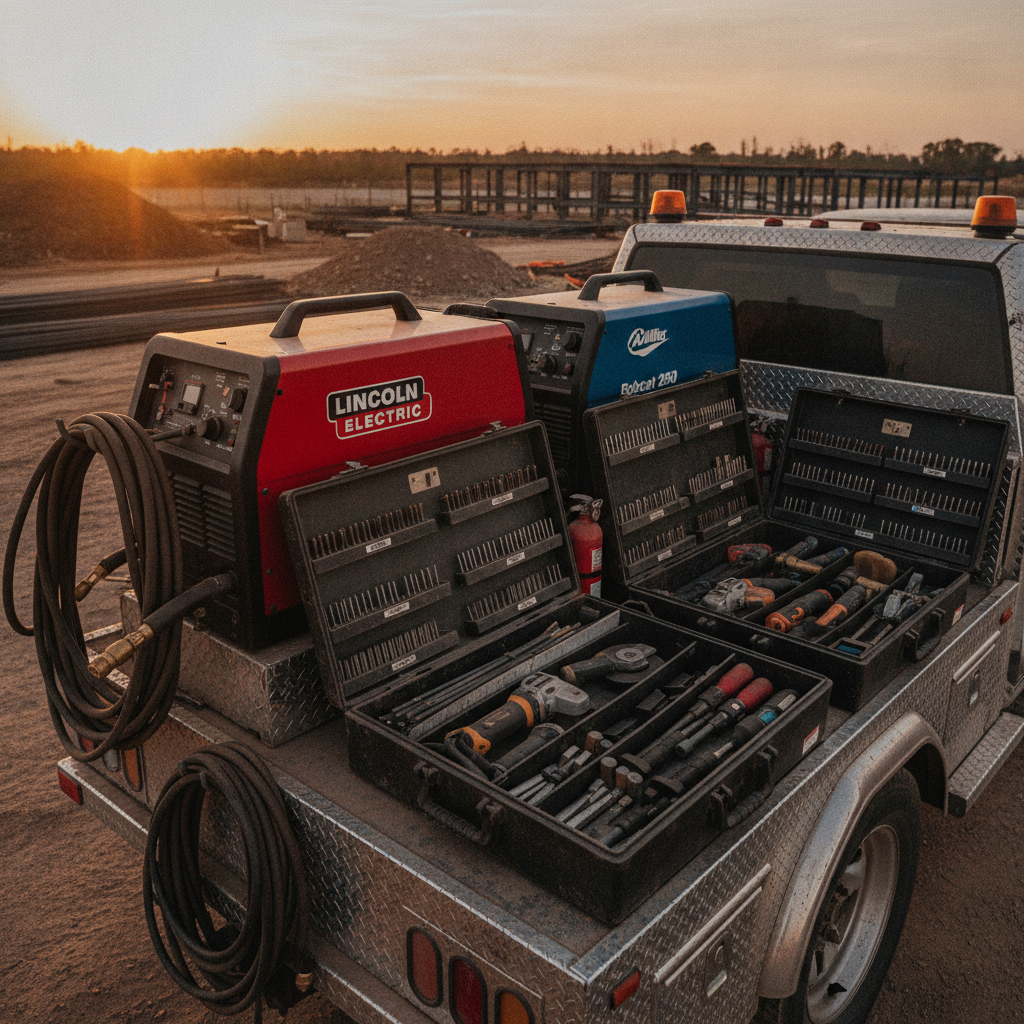
Let me paint you a picture. You pull up to a job site, customer’s watching you from across the parking lot, and you spend the next twenty minutes digging through your truck like you’re looking for a lost sock. Cables tangled around your grinder. Consumables rolling around loose in a milk crate. Your hood buried under a tarp with a come-along and three random lengths of chain on top of it. You finally strike your first arc forty-five minutes after you got there. Congratulations — you just gave away a good chunk of your hourly rate for free. Truck setup mistakes are one of the biggest silent killers of mobile welding income, and most guys don’t even realize it’s happening.
This isn’t about being neat for the sake of neat. This is about money, professionalism, and not wanting to blow a gasket every time you go to grab a piece of equipment. If you’re running your own operation — or trying to get one off the ground — how your rig is set up directly affects what you can bill and what customers think of you before you even weld anything.
Let’s get into it.
Why Truck Setup Mistakes Are Actually Billing Problems
Here’s the math nobody talks about. Say you’re billing $125 an hour. Every fifteen minutes you waste digging for gear is roughly thirty bucks out of your pocket. Do that twice a day, five days a week, and you’ve just donated over $1,500 a month to disorganization. That’s a truck payment. That’s a good chunk of your gas and consumables budget. That’s real money.
And that’s just the time you lose at your own rig. It doesn’t account for the jobs that run long because you couldn’t find the right tip size, or the customer who watched the whole circus and decided to call someone else next time.
When you’re building a mobile welding business, every minute on the clock counts. I’ve written before about smart ways to measure your investment decisions before you spend — same principle applies to your time. You’ve got to treat wasted setup minutes the same way you treat wasted materials. It’s overhead, and it’s killing your margin.
The good news is that fixing this isn’t complicated. It just requires you to actually think about your truck layout instead of throwing gear in wherever it fits when you’re tired after a job.
The Most Common Truck Setup Mistakes Mobile Welders Make
1. No Dedicated Zone for Consumables
Stick electrodes rattling around in a plastic bin with your chipping hammer, extra contact tips loose in a drawer with bolts and tape — sound familiar? Consumables need their own dedicated, labeled home. Not a “probably in this general area” home. A real one.
Build or buy a small consumables station. Tubes or PVC holders mounted to the wall of your service body work great for stick rod. Small parts organizers with labeled bins for MIG tips, nozzles, and liners. If you run multiple processes — and if you’re serious about this business, you should be — keep each process’s consumables grouped together and separated. When you’re on a tight job and need a specific tip size, you want to reach and grab, not search and curse.
If you’re running multiple processes in the field, take a look at what equipment choices make sense for that kind of work. Field-ready multi-process welders can simplify your truck load-out significantly when one machine handles what used to take three.
2. Cables and Leads with No System
Tangled leads are the number one time-waster on a mobile rig. I don’t care how experienced you are — nobody moves fast when they’re fighting a rat’s nest of welding cable first thing in the morning. You need a coiling and hanging system, and you need to actually use it every single time you pack up.
Mount hooks or cable reels at a consistent height. Coil your leads the same way every time — over-under method keeps the memory out of the cable and keeps it from kinking. Your work lead and your electrode lead should have their own designated spots. If your ground clamp ends up at the bottom of a pile every job, that’s a system problem, not a luck problem.
Same goes for extension cords, air hoses, and any other lines you run regularly. Give everything a home. Use it.
3. Gas Cylinders Stored Wrong or Swapped Around
Cylinders falling over is a safety issue. Cylinders being in the wrong spot is a workflow issue. Both are preventable.
Your cylinders need to be chained upright, always — that’s not negotiable and it’s not just about regulations. A falling full cylinder is a genuine hazard. Beyond safety, organize them so you know which is which without reading every label. If you run argon, CO2, and mixed gas, those should have consistent, dedicated spots with clear visual cues. Color-coded caps or valve covers cost almost nothing and save you from grabbing the wrong gas when you’re in a hurry.
Managing your shielding gas properly goes beyond just the truck, too. If you haven’t thought about your gas consumption as a real cost center in your business, smart shielding gas management is worth a read. The savings add up fast when you’re running a mobile operation.
4. Tools Without Assigned Spots
Your grinder lives in a specific spot. Your wire brush lives in a specific spot. Your chipping hammer lives in a specific spot. Not “usually over here,” not “I think I put it in this drawer” — a specific, consistent spot.
This sounds almost insultingly simple, but it’s where most rigs fall apart. You’re packing up after a long day, you toss stuff in roughly the right direction, and by the end of the week your truck looks like a salvage yard. Then you pay for it at 7 AM on Monday when you’re trying to set up at a customer’s shop.
Foam cutouts in drawers, shadow boards on walls, magnetic strips for small metal tools — use whatever system you’ll actually maintain. The key is that every tool returns to the exact same spot every single time. Build the habit or keep wasting the time. Your choice.
5. Your Truck Is Loaded for Storage, Not for Workflow
This one’s subtle but it matters a lot. Most guys load their truck to fit everything in, which is understandable. But the smarter approach is to load your truck for how a job actually flows. Think about the sequence: you arrive, you assess, you set up your machine, you run your leads, you prep the work, you weld, you clean up, you pack out.
The stuff you need first should be the easiest to access. The stuff you need last can be deeper in the truck. Your machine controls should be visible and reachable without climbing over anything. Your PPE should be right at the door — hood, gloves, sleeves — so you’re not suited up before you can even start assessing the job.
If you’re newer to building a mobile operation and figuring out how to structure your whole business setup, going from garage to shop covers a lot of the foundational decisions that shape how efficient your day-to-day operation becomes.
Building a Rig That Works the Way You Work
Do a Time Audit on Yourself First
Before you rearrange anything, spend one week paying attention. Every time you can’t find something immediately, note it. Every time you have to move three things to get to one thing, note it. At the end of the week, you’ll have a pretty clear picture of where your specific workflow is breaking down.
Your truck setup mistakes aren’t going to be identical to mine or anyone else’s. The fixes have to match how you actually work and what jobs you’re actually running.
Standardize Your Load-Out
Once you’ve identified the problem areas, build a standard load-out checklist. This is the configuration your truck should be in at the start of every workday. Not a rough approximation — the actual, specific layout. Laminate it. Put it on the inside of a cabinet door. Use it when you pack up at night, not when you’re rushing to leave in the morning.
A standard load-out also matters if you ever bring on a helper or second guy. They need to be able to find things without a twenty-question tour of your rig.
Separate Your “Every Job” Gear from Your Specialty Gear
Not every job needs every piece of equipment you own. But a lot of guys pack everything for every job because they haven’t built out a clear system for what’s core versus what’s specialty. Your core gear — the stuff that goes out on literally every single call — should be in the most accessible spots. Specialty equipment for specific job types can live deeper in the truck or in a second compartment.
This also applies to how you think about building out your service offerings. If you’re targeting specific niches where certain equipment always comes along, that shapes your load-out strategy. Strategic niche selection and truck layout planning go hand in hand more than most guys realize.
Lighting Inside Your Truck Matters More Than You Think
Cheap LED strip lights inside your service body or enclosed trailer can completely change how fast you find things in low light. Dawn jobs, covered parking structures, early winter mornings — you’re going to be loading and unloading in the dark regularly. If you’re squinting to read labels or guessing which bin is which, you’re burning time. A decent LED strip kit is twenty dollars and an afternoon. Do it.
The Professionalism Factor Nobody Talks About
Here’s something the business side of this trade doesn’t discuss enough. Customers notice your truck before they notice your welds. An organized, professional-looking rig tells a customer you know what you’re doing before you’ve struck a single arc. A rolling dumpster fire tells them you’re going to be a problem.
This matters even more when you’re building your customer base. Word of mouth is your biggest marketing tool as a mobile welder. People talk. “Yeah, the guy who showed up had this crazy organized rig, super professional” is the kind of thing that gets you referrals. Nobody brags to their neighbor about hiring the guy who dug through piles of junk for half an hour.
If you’re thinking seriously about your business growth and how to price your services competitively, pricing for certification services covers how to structure rates when you’re bringing real value to the table. An organized, efficient operation is part of that value proposition.
Small Changes That Add Up to Real Time Savings
Let’s get specific. Here are quick wins that make an immediate difference:
- Color-coded cable ties — match colors to machines or processes so leads sort themselves visually.
- Magnetic parts trays mounted to the inside of your service body door — small parts stop disappearing.
- A dedicated “daily driver” tool roll — the ten tools you use on literally every job, rolled up and always in the same spot.
- Angle grinder holder — mount a proper holder so your grinder isn’t rolling around loose ever again.
- Label everything — not because you don’t know what it is, but because you won’t be thinking clearly at the end of a long day.
- One trash bag, always accessible — consumable packaging, electrode stubs, used grinding discs. Keep the rig clean as you go.
None of these are complicated. None of them are expensive. All of them save real time across a week’s worth of jobs.
Don’t Let Gear Choices Complicate Your Setup
One thing worth mentioning: sometimes the truck setup is a symptom, and the equipment selection is the underlying problem. If you’re running four separate machines for different processes, you’re going to have a harder time maintaining a clean, organized rig than the guy running one capable multi-process unit.
Newer hybrid battery-powered welders are changing what’s possible in terms of reducing the equipment footprint on a mobile rig. Less equipment means less to organize, less to load and unload, and a cleaner, faster setup every time. Worth factoring into your equipment decisions if you’re looking to streamline your operation end-to-end.
The Bottom Line on Truck Setup Mistakes
Truck setup mistakes are not a minor inconvenience. They are a direct, measurable cost to your business. Every minute you’re not working at a customer’s site is a minute you’re either billing or not billing. There’s no middle ground in this trade.
Fix your consumables organization. Fix your cable management. Build a standard load-out and actually use it. Add some lighting. Think about your workflow sequence when you load, not just about whether everything fits. These aren’t glamorous improvements, but they’re the kind of thing that separates the guys who make real money in mobile welding from the guys who stay busy but wonder why the bank account never looks right.
Your rig is your shop. Treat it like one.
Now stop reading and go clean your truck.