You ever show up to a job, open your truck, and spend the next twenty minutes digging past a pile of rods, a half-empty grinding disc sleeve, three lead whips tangled like Christmas lights, and a can of anti-spatter you haven’t seen since last October? Yeah. That’s not a truck — that’s a dumpster with wheels. And your mobile rig organization problem is coming straight out of your hourly rate, dollar by dollar, every single day.
I’ve been running a mobile welding rig for over a decade. I’ve made every one of these mistakes myself. The difference between a guy who looks like he knows what he’s doing and a guy who looks like a first-year apprentice isn’t always the quality of the weld — sometimes it’s just whether or not he could find his damn tungsten in under sixty seconds.
This post is about fixing that. Practical stuff. Things you can actually do this weekend to stop bleeding time on every job.
Why Mobile Rig Organization Is a Business Problem, Not Just a Habit
Let’s be real about what’s happening when your truck is disorganized. You’re not just “a little messy.” You’re losing money. If you spend fifteen to twenty minutes getting set up on every job because you can’t find what you need, that adds up fast.
Say you run five jobs a week. That’s an hour and a half — maybe two hours — of unbillable time spent rummaging around your own truck. At $85 an hour, you’re throwing away $125 to $170 every single week. Every week. That’s real money for a one-man operation trying to build something.
And beyond the money, there’s perception. Customers notice when you look frantic. They notice when you’re muttering curses while digging through a pile of loose consumables. They also notice when you pull up, open your rig, and go straight to work like you’ve done it a thousand times. Because you have. First impressions on a job site matter more than most welders want to admit.
If you’re still in the early stages of building your business, take a look at this breakdown on going from garage to shop — solid foundation thinking that applies to your rig setup too.
Mistake #1 — You Don’t Have Zones, You Have Chaos
The single biggest mobile rig organization mistake I see is the lack of any zoning system. Everything just gets thrown in wherever it fits. Leads on top of the toolbox. Rods in the same bin as grinding discs. Personal PPE shoved under the seat.
Fix it with zones. Your truck should have clearly defined areas for clearly defined categories of gear. Here’s a simple breakdown that works for most mobile rigs:
- Zone 1 — Electrical and leads: Welding leads, ground clamps, lead extensions, and stingers. Coiled and hung or stored in a dedicated compartment.
- Zone 2 — Consumables: Rods, wire, tungsten, tips, nozzles, cups. Organized by process if you’re running multi-process. Dry, accessible, sorted.
- Zone 3 — Grinding and cutting: Angle grinders, cut-off wheels, flap discs, wire brushes. Not mixed with consumables. Not loose.
- Zone 4 — PPE and safety: Helmet, gloves, sleeves, fire blankets, first aid. Consistent location. Every single time.
- Zone 5 — Hand tools and misc: Chipping hammer, wire brush, clamps, squares, tape measure, markers. One dedicated spot.
This sounds obvious. It is obvious. But I’d bet money your rig doesn’t look like this right now.
Mistake #2 — Your Leads Are a Disaster
Leads deserve their own section because welders are universally terrible at managing them. A tangled lead pile is a time sink every single time you deploy it and every single time you pack it back up. Multiply that across five jobs a day and you’ve invented your own personal inefficiency machine.
Coil your leads properly after every single job. Not kind of coiled. Actually coiled, using the over-under method or a consistent figure-eight wrap. Then either hang them on dedicated hooks in your bed or store them in a lead bag or bucket.
Get in the habit of coiling before you do anything else on pack-up. Before you clean the slag. Before you swap out your lens. Leads first. It takes three extra minutes and saves you ten minutes the next morning.
While you’re thinking about your process equipment, check out this rundown on field-ready multi-process welders if you’re running more than one process on the road — machine selection affects how your rig needs to be organized.
Mistake #3 — You’re Reloading Consumables at the Job Site
Nothing looks worse than showing up to a job and telling the customer you need to run to the supply house before you can start. But almost as bad is arriving with barely enough consumables to get through the work, then scrambling to stretch what you’ve got.
Build a truck stock system. Keep a minimum quantity of every consumable you regularly use staged in your truck at all times. Set a reorder point — when you break into your backup stock, that triggers a supply run before the next job, not during it.
For most mobile welders, that minimum stock looks something like this:
- One full sleeve of your most-used rod diameter
- One spare spool of wire (if you’re running MIG)
- At least five tungstens per diameter you carry (TIG guys)
- Ten grinding discs, ten flap discs
- Spare tips, nozzles, and cups by process
Keep consumables in waterproof containers or sealed bins. Moisture kills rods. It also kills your weld quality and your reputation in one shot.
Mistake #4 — Your Machine Is Hard to Access
I’ve seen guys with their welder buried under tool bags, extension cords, and a spare tire mounted sideways in the bed. Getting to the machine to adjust settings mid-job means a full excavation project. That’s not a rig. That’s a storage unit.
Your machine needs to be accessible from at least one side, with clear space around the controls. The lead connections should be reachable without climbing in the bed. If you’re running a welder-generator combo, the exhaust needs clearance and the controls need to be visible and reachable.
If you’ve been looking at newer machine options for your rig, this post on hybrid battery-powered welders covers some equipment that changes how you think about rig layout entirely — smaller footprint, different power requirements.
Mount your machine securely. Not bungee cord secure. Properly strapped or bolted. That machine is worth more than most people’s cars. Treat it like it is.
Mistake #5 — No System for Job-Specific Gear
A lot of mobile welders I know run the same base setup for every job, then throw job-specific stuff in wherever it fits when they get a call. Pipe fittings for a repair job go in a grocery bag on the floor. A special fixture for a repeat customer gets tossed behind the seat. And then when they need it next week, it’s gone or buried.
Create a staging area in your truck — a designated space for job-specific items that gets loaded and unloaded with intention. A milk crate, a small bin, a dedicated drawer. Whatever fits your rig. But it needs to be a defined space, not “somewhere in the truck.”
Before every job, that space gets loaded with what’s needed. After every job, it gets emptied back to base stock or staged for the next job. Sounds like extra work. It’s actually less work because you stop looking for things you already loaded and forgot about.
Mistake #6 — Your PPE Is Wherever You Left It Last
Your helmet is in three different places depending on the day. Your gloves might be in the truck, might be in your bag, might still be on the tailgate of a job you finished last Tuesday. This is a safety issue as much as an efficiency issue.
Assign a permanent home to every piece of PPE. Same spot every time. No exceptions. Helmet goes in the helmet bag or on the helmet hook. Gloves go in the glove pocket or the PPE bin. Sleeves go with the gloves. Period.
This doesn’t just save time — it means you’re never the guy who shows up and realizes he left his shade 10 lens on the workbench at home. That guy looks like an amateur. Don’t be that guy.
Mistake #7 — You Haven’t Thought About Weight Distribution
This one’s more mechanical than organizational, but it affects your rig every day. Throwing heavy gear all to one side or all to the rear of your truck creates handling problems. A truck that rides weird is a truck that wears out faster and handles worse on a wet job site access road.
Think about where your heavy items live — welder, generator, gas bottles, toolboxes — and try to balance the load side-to-side and front-to-back. It won’t always be perfect, but a little thought goes a long way. It also keeps your gear from shifting and breaking things during transit.
If you’re growing your operation and thinking about what gear actually belongs on your rig versus what belongs in a shop, this post on strategic niches for mobile welders helps you think through what kind of work you’re actually building toward — and that shapes your rig.
A Simple Weekly Rig Audit Takes Ten Minutes
Here’s a habit that will change how your week runs: spend ten minutes every Friday afternoon — or Monday morning, pick one and stick with it — auditing your rig. Not reorganizing the whole truck. Just a quick walk-through.
Check consumable levels. Verify your PPE is in the right spots. Coil anything that’s gotten loose. Restock anything below your minimum threshold. Wipe down the machine if it needs it. Log anything that needs to be replaced or repaired.
Ten minutes. That’s it. Done consistently, it means you never show up to a Monday morning job unprepared. And it means your mobile rig organization doesn’t slowly drift back to chaos over a few weeks of busy jobs.
If you’re tracking job profitability and want to understand where your time is actually going, this post on smart heat maps for startups gives you a framework for seeing where your hours leak.
What a Good Rig Actually Looks Like
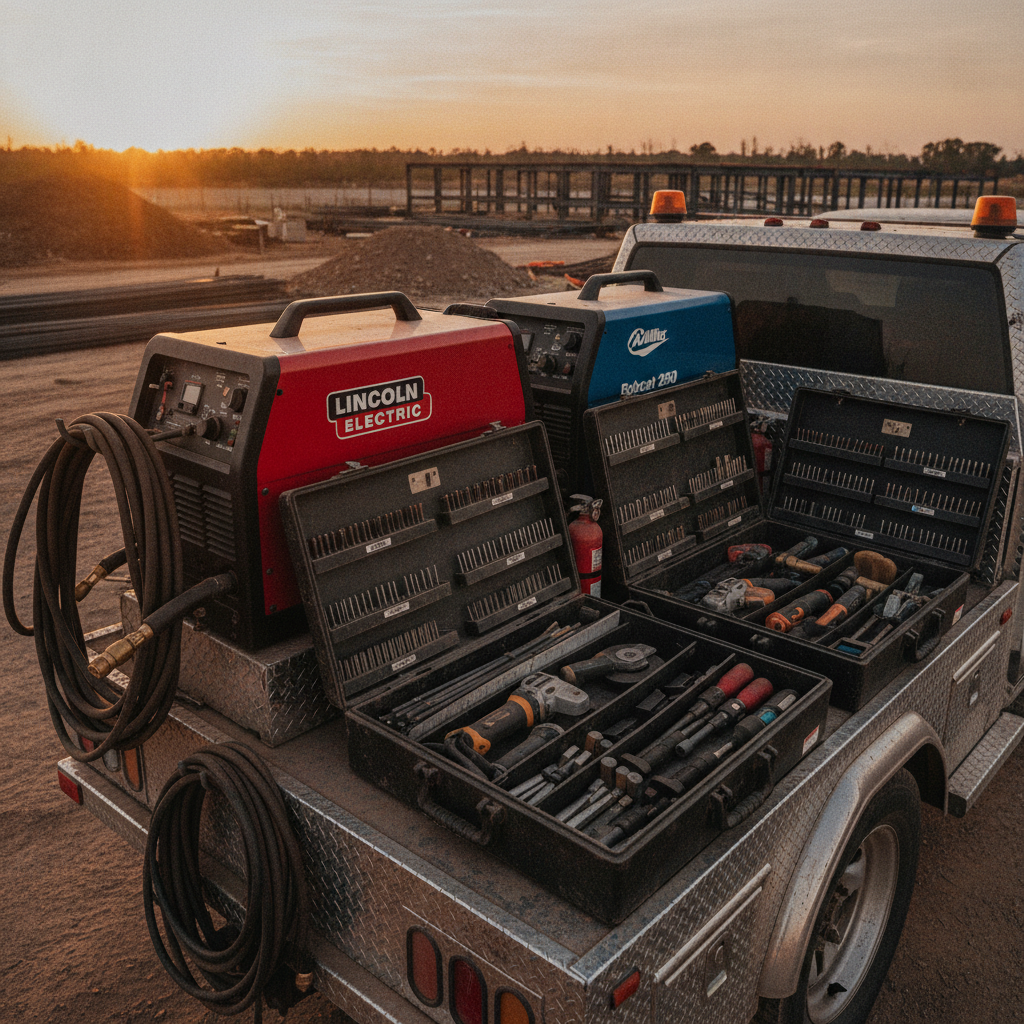
Let me paint the picture for you. You pull up to the job site. Customer or site super is watching. You step out, walk around to the passenger side, open your compartment. Leads are coiled and hanging. Consumables are in labeled bins. Grinding gear is in its spot. You grab what you need, move to the machine, adjust your settings, and strike an arc inside five minutes of arriving.
That’s not magic. That’s just having a system and actually using it. It’s also what separates the guys who build a real mobile welding business from the guys who are always scrambling, always behind, always explaining why they’re not ready yet.
And if you’re pricing your time — which you should be — you can check out this breakdown on pricing for certification and specialty services to make sure you’re actually getting paid for your efficiency, not giving it away.
The Bottom Line on Mobile Rig Organization
Your truck is your shop. It’s your livelihood on four wheels. The way it’s organized — or not organized — directly affects how much money you make, how professional you look, and how much of your day you spend actually welding versus hunting for gear.
None of this requires expensive toolboxes or a custom built-out truck body right out of the gate. It requires a system and the discipline to use it every day. Zones. Minimum stock levels. Dedicated PPE spots. Lead management habits. A weekly ten-minute audit.
Small changes. Real hours saved. Real money back in your pocket every week.
Stop digging through junk before you strike your first arc. You’ve been at this too long for that.