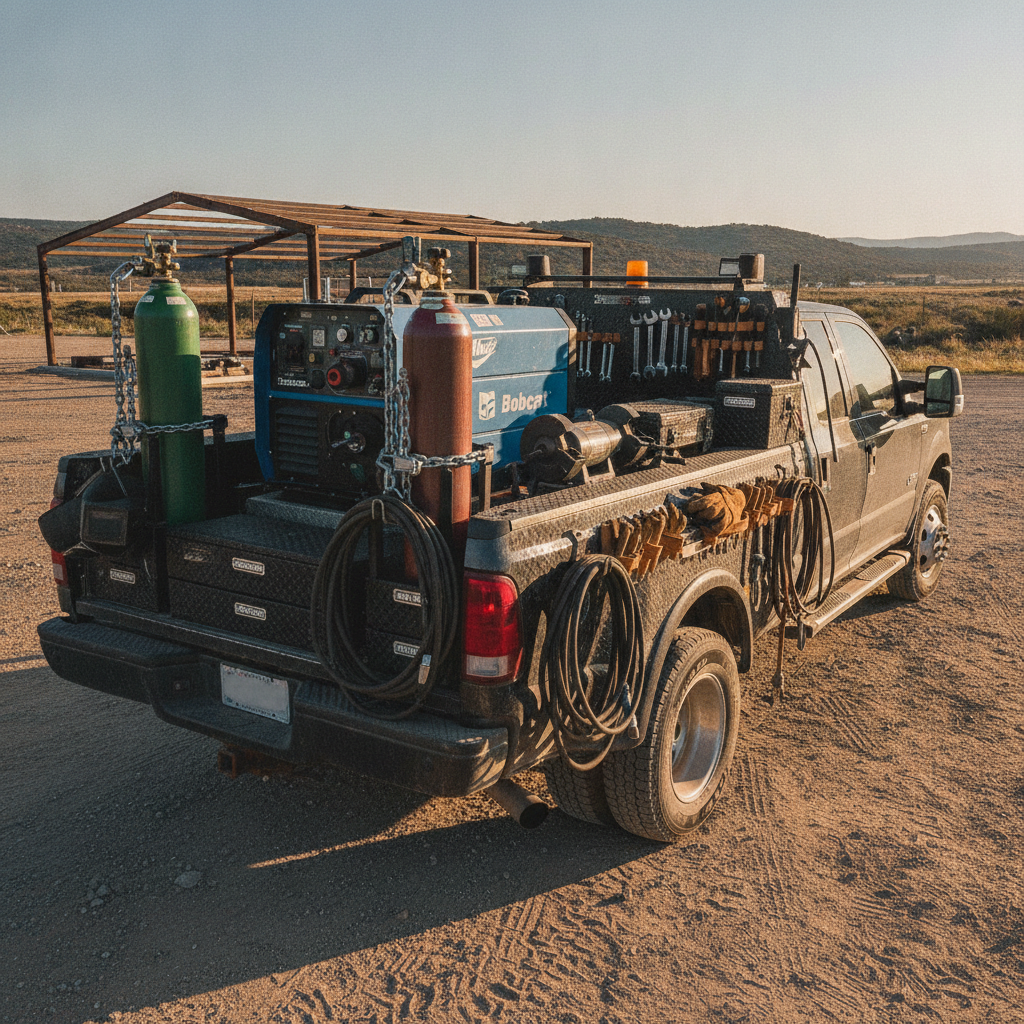
If your mobile rig organization looks like a yard sale that lost a fight with a welder’s supply house, you already know what I’m talking about. You pull up to a job, crack open the truck, and spend the next twenty minutes playing “where the hell did I put that” while the customer watches from the window. That’s not a great look. Worse, that time comes straight out of your pocket. You’re burning unbillable minutes every single time, and if you’re doing five or six jobs a week, those minutes add up to real money by Friday.
I’ve been running a mobile rig for over a decade. I’ve made most of these mistakes myself. Some of them I made embarrassingly late in my career. So this isn’t a lecture from some guy who’s never worked out of a truck. This is peer-to-peer, job-site-level advice from someone who’s had a come-to-Jesus moment with a pile of tangled leads and a customer tapping his foot.
Let’s go through the mistakes that are actually costing you time, and what to do instead.
Mistake #1: No Zones, No System, No Sense
The single biggest mobile rig organization problem I see is trucks that have no logic to them. Everything just gets thrown in wherever it fits after the last job. Consumables next to the angle grinder. Leads piled on top of the wire spool. Safety gear buried under a tarp somewhere in the back.
Here’s the fix: build zones. Treat your truck bed or service body like a shop floor with designated areas for specific categories of gear.
A basic zone breakdown that works for most mobile welders:
- Arc zone: machine, leads, ground clamp, stingers — all together, all accessible first
- Consumables zone: rods, wire, tips, nozzles, gas lenses — in a single drawer or labeled bin
- Prep zone: grinders, wire brushes, clamps, magnets, layout tools
- Safety zone: PPE, fire blankets, first aid — always in the same spot, never buried
- Gas zone: cylinders secured upright with straps, regulators protected
When everything has a home, you stop thinking and start working. That’s the goal.
Mistake #2: Your Leads Are a Bird’s Nest
Tangled leads are a rite of passage for rookie mobile welders. They are also completely avoidable after about the third time you waste ten minutes unraveling them in a client’s driveway.
Coil your leads properly every single time you wrap up a job. I know you’re tired. I know it’s the end of the day. Do it anyway. Use lead hangers or saddle hooks mounted to the side of your service body. If you’re running a flatbed or a utility truck without a service body, use rubber bungee tie-offs or Velcro straps to keep coils together.
Also: get your lead lengths right. Running 100 feet of lead when you only need 50 is just extra weight and extra tangle risk. If most of your jobs are tight quarters work, carry the shorter leads as your primary and keep the long run as a backup.
While you’re thinking about your machine setup, it’s worth revisiting whether your actual welder is right for field work. If you haven’t looked at purpose-built options recently, check out this breakdown on field-ready multi-process welders — some of the newer units are designed specifically with mobile setup in mind.
Mistake #3: Consumables Spread Across Three Different Spots
You have a box of 7018 on the floor. Some tips in your shirt pocket from last week. A half-roll of wire shoved behind the seat. And you can’t remember where you put the extra contact tips you bought Tuesday.
This is how you end up doing the consumables shuffle on every job. It wastes time, and it also means you never actually know what your stock levels are until you run out mid-job. That’s a special kind of frustrating that I wouldn’t wish on anyone.
Fix: one drawer, one bin, one dedicated spot — all consumables, always. Label it if you have to. Audit it every Friday before you leave for the weekend. Restock before Monday. This habit alone will save you a panicked trip to the supply house more times than you can count.
If you’re running multiple processes — stick, MIG, TIG — and your consumable variety is getting complex, you might also find value in thinking through your material-specific approach. This post on adaptive multimaterial welding has some useful context on how process choices affect what you need to carry.
Mistake #4: Gas Cylinders Sliding Around Like They Own the Place
I shouldn’t have to say this, but here we are. An unsecured cylinder bouncing around in the back of your truck is a lawsuit and a hospital visit waiting to happen. I’ve seen guys running with cylinders just laying on their side, wedged against a toolbox, held in place by vibes and optimism.
Get proper cylinder restraints. Mount them to the truck. Secure the valve caps when you’re moving. This is not optional, and it’s not just about safety — it also protects your regulators, which are not cheap and are very easy to snap off when a cylinder tips over at 40 miles per hour.
While you’re sorting out your gas management, this older post on smart shielding gas management has some solid tips on tracking usage and not running out on a job.
Mistake #5: Setup Takes Too Long Because Your Machine Is Last In
Here’s a loading order mistake that’s painfully common. The welder machine ends up at the back of the truck, buried behind everything else, because it was the last thing you put in. So when you arrive at a job, you’re unloading half the truck before you can even get to the thing you came to use.
Your welding machine should be one of the first things you can access. It doesn’t have to come out every job — a lot of the time you’re running leads from it in place — but you need clear access to the controls, the wire compartment, and the power connections without moving a bunch of other gear to get there.
Think about load order like a military packing list: last thing you need goes in first, first thing you need goes in last. If you’re typically setting up leads and firing up the machine within the first five minutes of arrival, the machine and its immediate accessories should be right at hand.
Mistake #6: No Dedicated Spot for Small Parts and Hardware
The little stuff will kill your efficiency faster than anything else. Nuts, bolts, tack strips, magnets, soapstone, wire wheel, extra grinding discs — this is the stuff that ends up loose on the floor of your truck, rattling around under the toolbox, falling out every time you open a drawer.
Small parts organizers — the kind with adjustable dividers — are cheap and they solve this completely. Mount one to the inside of a cabinet door or dedicate one small drawer to hardware. When you need a 3/8″ bolt on a job, you go to one spot and you find it. That’s the whole game.
Good mobile rig organization isn’t about being neat for the sake of neat. It’s about building a system where the answer to “where is it” is always the same answer, every time.
Mistake #7: Your Truck Looks Like You Don’t Know What You’re Doing
I know this sounds like a soft concern compared to functional ones, but hear me out. Your truck is your shop front. It’s the first thing a new customer sees when you pull up. A rig that looks organized and professional signals competence before you say a word.
You don’t need a brand new service truck to pull this off. You need clean, organized, and intentional. Labeled drawers. Secured equipment. Leads coiled and stored. Grinders hung or racked, not thrown on the floor.
If you’re working on building the business side of your operation — not just the rig itself — there’s some useful thinking in this post about strategic niches for mobile welders. The presentation of your truck ties directly into how customers perceive your value and what they’re willing to pay.
Speaking of what they’re willing to pay — if your pricing structure isn’t dialed in, your efficiency gains won’t matter as much as they should. This breakdown on pricing for certification services is worth a read even if certs aren’t your main game, because the pricing logic applies broadly.
Mistake #8: No Pre-Job Checklist, No Post-Job Reset
The rig gets disorganized in the first place because there’s no reset routine. You finish a job tired, you throw stuff back in roughly where it goes, you drive home. Next morning, it’s already half-chaotic, and by Wednesday it’s a disaster.
Build a ten-minute post-job reset into your workflow. It doesn’t have to be perfect. It just has to be consistent. Leads coiled and hung. Consumables back in their spot. Trash out of the truck. Tools back in their zones. Grinders disc-checked so you’re not showing up to tomorrow’s job with a worn-out wheel.
A pre-job check is equally valuable. It’s a thirty-second walk-around that confirms you have what you need before you’re standing on a customer’s property without the right rod or the right tip size. If you want a framework for building check-based habits in your operation, the thinking in this certification readiness calendar post translates surprisingly well to field prep routines.
The Real Cost of a Disorganized Rig
Let’s put some math to this. Say you’re losing twenty minutes per job to disorganization — finding gear, untangling leads, rummaging for consumables. That’s conservative. At five jobs a week, that’s 100 minutes. At your billing rate — let’s say $100/hour — you’re losing $167 a week. That’s $8,300 a year in time you’re not getting paid for.
That’s not nothing. That’s a decent chunk of a new machine. That’s a truck payment. That’s the difference between a good year and a tight year.
Good mobile rig organization isn’t a luxury. It’s a financial decision. The guys who look like they’ve been doing this forever — the ones who show up, crack open the truck, and are striking an arc in five minutes — they’re not more skilled than you. They just built better habits and a better system.
If you’re at the stage where you’re building out your business infrastructure more broadly — thinking about your shop-to-field transition, your equipment investment strategy, and where you want to spend the next few years — this post on going from garage to shop and this one on measure twice, invest once are worth your time on a slow afternoon.
Quick Reference: Mobile Rig Organization Wins
If you want to implement this stuff without overhauling your whole setup at once, here’s where to start:
- Zone your truck — assign a purpose to every section, no mixing categories
- Fix your lead storage — hooks or hangers, coiled every time, no exceptions
- Consolidate consumables — one spot, audited weekly, restocked before Monday
- Secure your cylinders — proper restraints, every trip, no compromise
- Rethink your load order — machine access first, everything else builds around it
- Add small parts storage — cheap organizers, labeled, mounted where you use them
- Build a reset routine — ten minutes post-job, thirty seconds pre-job, every time
None of this costs much. Most of it costs nothing except habit-building and a weekend afternoon with a label maker. But the compounding return on a well-organized rig is one of the highest-ROI moves you can make as a mobile welder. Fix the truck. Get to work faster. Stop leaving money in the parking lot.