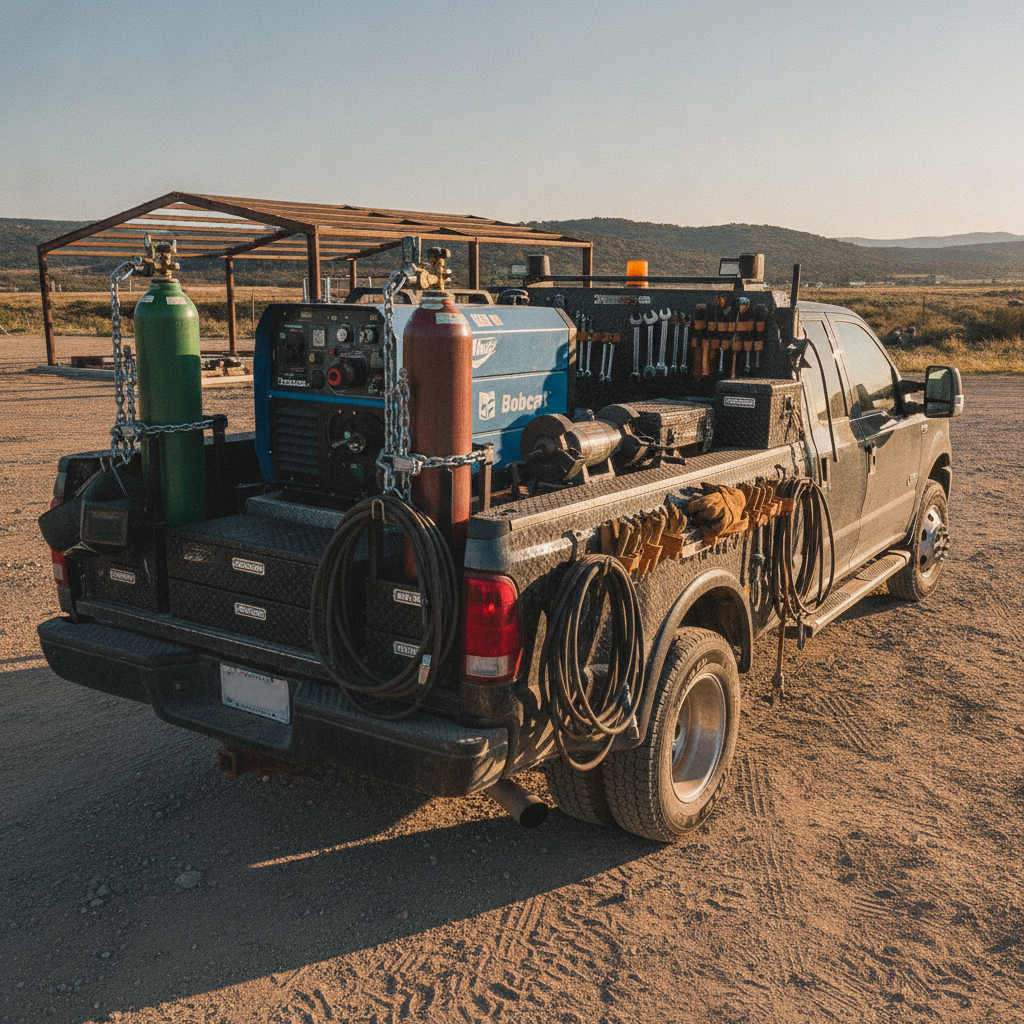
Let me paint you a picture. You pull up to a job. Client’s watching from the porch. You climb out, look confident, then spend the next twenty-two minutes digging through a pile of cables, random fittings, three angle grinders with no discs, and a box of 7018 that’s been open since February. These truck setup mistakes aren’t just embarrassing — they’re costing you real money. That wasted time comes straight out of your effective hourly rate, and your client just watched every second of it.
I’ve been running a mobile rig for over a decade. I’ve made every single one of these mistakes personally. Some of them twice. So consider this the talk I wish someone had given me when I bolted a Harbor Freight toolbox to a flatbed and called it a business.
Why Truck Setup Mistakes Are a Business Problem, Not Just an Annoyance
Most welders think about their rig in terms of equipment. What welder am I running? What processes do I need? Those are important questions — and if you’re still sorting that out, the breakdown on field-ready multi-process welders is worth your time.
But the rig organization question is different. It’s a time question. And time, on a flat-rate or hourly job, is your inventory.
Here’s a rough number that’ll sting a little. If you’re wasting fifteen minutes per job on setup fumbling — and that’s conservative — that’s over an hour a week on a five-day schedule. Over a year? You’re looking at fifty-plus hours of billable time just evaporating because you couldn’t find your damn contact tip wrench.
Fix the organization. Protect the hours.
Mistake #1: No Zones, No Logic
The number one truck setup mistake I see on working rigs is loading everything based on what fits where. You grabbed it, found a spot, tossed it in. Makes sense at the time. Falls apart by week two.
Your truck needs zones the same way a shop needs a layout. Everything on the rig should have a category and a location based on how often you use it and where you need it in the work sequence.
Think about it this way:
- Hot zone (driver’s side, easy reach): PPE, gloves, hood, first thing on — first compartment you open.
- Work zone (passenger side or rear): Consumables, rods, wire, contact tips, grinding discs.
- Power zone (rear or bed): Leads, ground clamp, stingers, gas hose, regulators.
- Tool zone: Hand tools, clamps, squares, markers. Separate from consumables. Always.
This isn’t rocket science. It’s just thinking before you load. Most guys skip that step entirely and pay for it every single morning.
Mistake #2: Cables and Leads That Live on the Floor
You know the feeling. You open the compartment, the leads fall out onto your boot, you spend four minutes untangling them, you stub your toe on the bumper, and now you’re already annoyed before you’ve done any actual work.
Welding leads need to be stored on a reel or in a dedicated bin — coiled properly, not just thrown in a pile. This is non-negotiable if you’re running a professional operation.
Cable reels don’t have to be fancy or expensive. A simple wall-mounted reel on the inside of a service body compartment works fine. What matters is that every lead has a home, and it goes back there every single time. No exceptions. Not even when you’re tired at the end of a long day.
The guys who are most consistent about this are the ones who’ve wasted the most time not doing it. Painful lessons stick.
A Note on Lead Length
While we’re on the subject — stop carrying more lead than you actually need for most jobs. Yes, you need reach. But hauling around 150 feet of lead on every call when 75 feet covers 90% of your work just means more weight, more coiling, and more opportunities for things to get tangled. Carry what’s practical. Store extra length separately if you need it for occasional bigger jobs.
Mistake #3: Consumables Are a Disaster Area
Open rods rattling around loose. Contact tips in four different sizes mixed together in a coffee can. MIG wire that’s been partially used with no label on what it is. Grinding discs from three different manufacturers thrown in a bucket together.
This is the norm on a lot of rigs. It doesn’t have to be.
Get a dedicated consumables system. Doesn’t matter if it’s a fancy drawer system or labeled plastic bins from a hardware store. What matters is that every consumable type has its own spot. 7018 doesn’t live with 6011. .035 ER70S-6 wire doesn’t live with your TIG filler. You should be able to reach in and grab exactly what you need without looking twice.
If you’re running multiple processes — and most of us are — the organization complexity goes up. That’s why your process selection and your storage strategy have to talk to each other. A rig optimized for stick isn’t set up the same way as one running MIG, TIG, and flux-core depending on the job. Plan accordingly.
Mistake #4: Gas Bottles That Move Every Time
Gas management on a mobile rig deserves its own conversation. Bottles need to be secured, accessible, and in a consistent position every time you pull up to a job. If your bottle is loose in the bed, rolling around, or needs to be completely unloaded to access the regulator, that’s a setup problem.
Invest in a proper bottle rack or cage that mounts permanently to the truck. Your bottles should chain in and out in under a minute. Your regulator and hose connection points should be accessible without climbing over other equipment.
For a deeper look at how to handle gas logistics on the road, the post on smart shielding gas management covers the practical side of this well.
Mistake #5: Tools Mixed With Consumables Mixed With Personal Gear
Your chipping hammer should not be in the same compartment as your lunch. Your PPE should not be buried under a box of tie wire. This sounds obvious until you look at the average working rig, and then it becomes obvious why most mobile welders are moving slow.
Keep personal gear completely separate from work gear. That means no food, no phone chargers, no random personal items living in work compartments. When you open a work compartment, everything in it should be a work item. Full stop.
This also means having a designated spot for your personal stuff that’s actually convenient. If it’s not easy, you won’t do it consistently.
Mistake #6: The Rig Isn’t Built for Your Actual Workflow
Here’s where most guys get it wrong at the foundational level. They set up the truck based on what they think looks organized, rather than what actually matches the sequence of how they work a job.
Walk through your typical job start to finish in your head. What do you grab first? Where do you go next? What do you need when you’re actively welding versus when you’re prepping versus when you’re cleaning up? Your truck should be loaded in roughly that order. The first things you need should be the first things you can reach.
If you’re in the early stages of building your business and still figuring out what your typical jobs even look like, some of the strategic thinking in the strategic niches post might help you get clarity on what your workflow actually is — which directly affects how your rig should be configured.
Mistake #7: No Inventory System for Consumables
You show up to a job. You need 7018. You reach in, and there’s half a rod and some flux flakes at the bottom of the tube. Now you’re either making a run or calling it a partial day. Both of those options cost you money and credibility.
A simple consumables checklist — even a laminated piece of paper stuck inside a compartment door — is the difference between this happening and not happening. You check it before you leave the yard. You restock before you load out. It takes five minutes and saves you the kind of embarrassment that clients remember.
Pair this with a restocking threshold. When you’re down to your last rod tube of a given size, that’s when you order more. Not when you run out. This is basic inventory management and it applies to your rig exactly the same way it applies to any other operation.
If you’re thinking about the business side more broadly, the From Garage to Shop post has some solid thinking on building operational habits from the ground up.
Mistake #8: The Welder Itself Isn’t Secured or Accessible
Your machine is the centerpiece of the whole operation. It should be the easiest thing to access on the rig, with cables routing cleanly and power connections that don’t require gymnastics to make work.
If your welder is buried, poorly secured, or positioned so that you’re pulling leads at awkward angles every time, that’s setup time and wear on your equipment. Mount it intentionally. Think about cable routing from the machine to your typical work positions. Think about ventilation. Think about whether you need to be able to reach the controls mid-job without walking back to the truck.
For welders who are running newer battery-backed or hybrid units with different power and positioning considerations, the discussion on hybrid battery-powered welders covers some of the setup-specific stuff worth knowing.
The Real Cost of All These Mistakes
Let’s add it up honestly. Twenty minutes of fumbling at job start. Five minutes finding a tool mid-job. Ten minutes dealing with tangled leads at pack-up. That’s thirty-five minutes per job. On a four-job week, that’s over two hours. Two billable hours just gone.
At $100 an hour — and you should be charging more than that — that’s $200 a week. Over $10,000 a year. From truck setup mistakes.
That number isn’t made up. It’s conservative. And it doesn’t even account for the client perception hit that comes from watching you dig through your truck like you’re looking for keys you lost.
If you want to think more carefully about what your time is actually worth on a per-job basis, the thinking in smart heat maps for startups applies directly to figuring out where your hours are going.
Quick Wins You Can Do This Weekend
You don’t have to rebuild the whole rig in one shot. Here are the changes that have the most immediate impact:
- Label every compartment. Even tape and a marker works. You’ll load it right and your helper will load it right.
- Get your leads on a reel or coiled in a dedicated bin. Stop living with the tangle.
- Separate consumables by type into labeled containers. This one change will save you ten minutes a day immediately.
- Do a full truck audit. Pull everything out, ask if it belongs there, put it back with intention.
- Build a pre-load checklist. Check it before you leave for the first job every morning.
None of this is complicated. All of it requires you to stop doing what’s easy in the moment and start doing what works over time. That’s actually the hardest part.
Organization Is How You Scale
When you’re a solo operator, a disorganized rig just hurts you. When you bring on a helper or a second truck, a disorganized system hurts your whole operation. The habits you build now are the ones that scale — or don’t.
A professional rig isn’t about having the newest equipment or the cleanest truck. It’s about being able to walk up, open a compartment, grab exactly what you need, and be welding in ten minutes. That’s the standard. Every truck setup mistake you fix moves you closer to it.
The guys who run tight, organized rigs aren’t smarter than you. They just got tired of losing money to bad habits faster than you did. That’s fixable. Start this weekend.