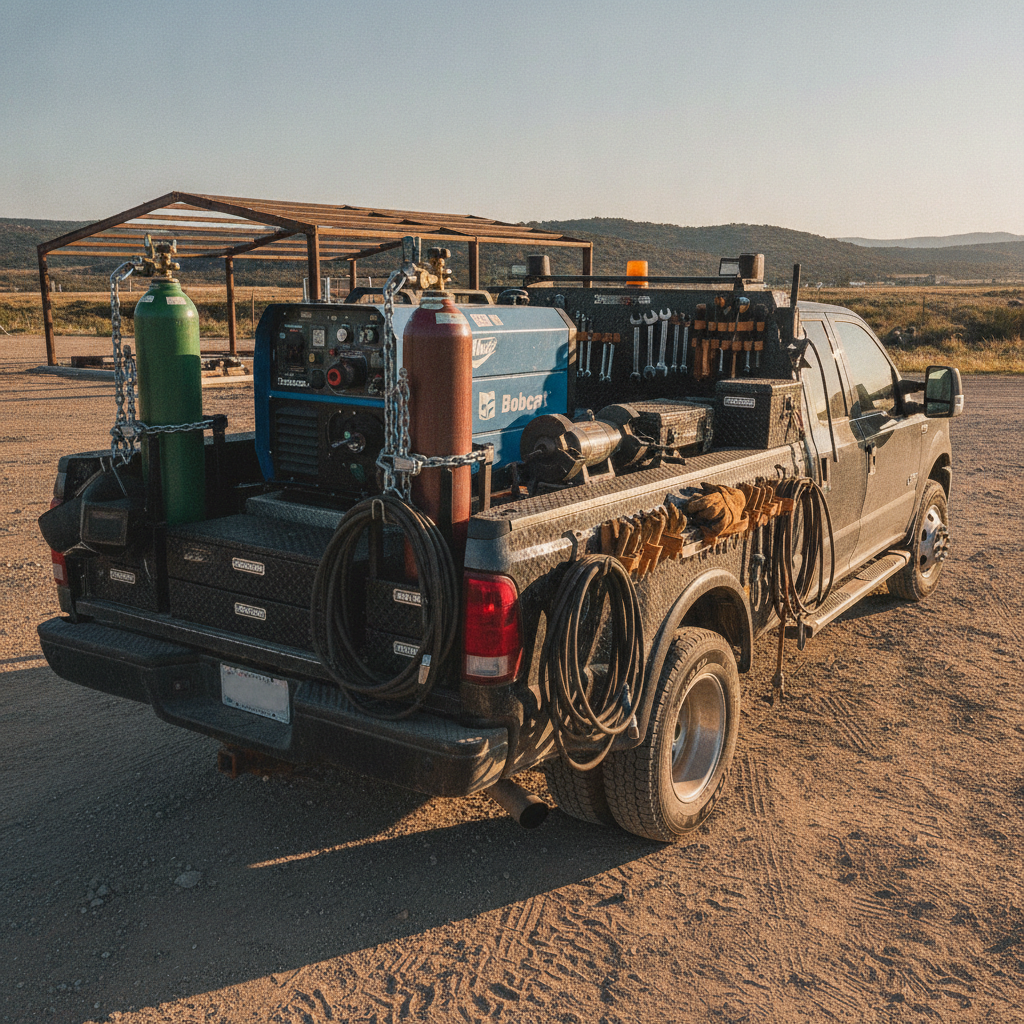
Let me paint you a picture. You pull up to a job, customer’s standing there watching, and you spend the next twenty-five minutes crawling around your truck looking for your ground clamp. You find it under a coil of 2/0 cable, three empty flux-core spools, and what appears to be a sandwich from two weeks ago. That right there is your mobile rig organization problem — and it’s bleeding money out of your pocket every single day you let it ride.
I’ve been running a mobile rig for over a decade. I’ve made every one of these mistakes myself. This post isn’t theory from some guy who watched a YouTube video. This is what actually costs you time, money, and credibility on the job site.
Why Mobile Rig Organization Is Actually a Business Problem
Most guys think of their truck setup as a convenience thing. Get around to organizing it when there’s time. There’s never time. So the rig stays a disaster and you keep losing twenty minutes per job.
Here’s the math. Say you’re losing thirty minutes a day to setup inefficiency. That’s two and a half hours a week. At $85 an hour, that’s over $200 a week you’re leaving on the table — or more accurately, that you’re working for free. Multiply that over a year and you’ve basically done three weeks of unpaid work because your tie-wire is buried under your electrode holder.
This stuff matters. If you’re serious about running a real business — not just a guy with a welder in a truck — you need to treat your rig like a revenue-generating tool, not a rolling junk drawer. The same way you’d think carefully about choosing the right strategic niche to grow your business, you need to be strategic about how your truck is loaded.
Mistake #1 — You Have No System, Just Zones of Chaos
The number one mobile rig organization sin is not having a system at all. Everything just kind of lives where it got thrown last. Your leads go wherever they land. Tools get tossed in the general direction of a box. Consumables end up mixed together in a pile that makes zero sense to anyone, including you.
Fix this by building zones. Simple concept. Your truck should have defined areas for defined categories of gear.
- Welding leads and ground cables — dedicated spot, always coiled the same way
- Consumables — rods, wire, tips, nozzles — organized by process
- Hand tools — grinders, chippers, brushes — accessible without digging
- Gas and regulators — secured, consistent location, never buried
- PPE — helmet, gloves, jacket — front and center, not under everything else
Once you build zones and actually stick to them, your brain starts auto-piloting to the right spot. Setup gets faster without you even thinking about it.
Mistake #2 — Your Leads Are a Tangled Nightmare
Nothing wastes time on a job site like fighting your own leads. You grab what looks like your electrode holder lead, give it a tug, and half your truck contents come with it. Then you spend five minutes untangling before you can even think about running a bead.
Coil your leads properly every single time you wrap up a job. Not “good enough” coiled. Actually coiled. Over-under method if you’re going to be particular about it — it keeps the twist out and makes them lay flat. Hang them on hooks or dedicated lead hangers, not wadded up in the corner of your bed.
Color-code if you run multiple processes. Red for one process, black for another, whatever system makes sense to you. After a while you’re not even looking — you’re just grabbing the right one. That’s the goal.
If you’re running a multi-process setup on your rig, this matters even more. Keeping your processes organized ties directly into how you’ve set up your machine. Worth reading up on field-ready multi-process welders if you’re still figuring out that side of things.
Mistake #3 — Consumables Are Everywhere and Nowhere
You’re out of 6011 but you have no idea how many you have left because the rods are in four different places. Some are in the job box. Some are in the cab. Some are somewhere under the truck seat. You’re running low on .030 wire but you grabbed a spool of .035 by accident and didn’t notice until you’d already set up.
Consumable chaos is a productivity killer and a money waster. Here’s how you fix it.
First, build a dedicated consumables box or drawer. Everything in that box is a consumable. Nothing else lives there. Label the sections if you need to — there’s no shame in it. Sorted by process, sorted by diameter, sorted by whatever makes sense given what you actually run.
Second, run a restock system. When you crack open the last box of something, that’s your trigger to order more. Not when you run out mid-job like an amateur. Keep a whiteboard or a notes app — whatever you’ll actually use — and track what’s getting low.
Third, stop storing open rod cans loose. Get a proper rod oven or at minimum a sealed container for low-hydrogen electrodes. Letting your 7018 absorb moisture because it’s rattling around in an open can is a weld quality problem, not just an organization problem. Your consumable management directly affects what you put on the metal.
Mistake #4 — Your Grinder Setup Takes Longer Than Your Weld Setup
Grinders should be ready to run. Not buried. Not missing their guard. Not with a worn disc that needs changing before you can use it. You should be able to grab a grinder and be grinding within thirty seconds of deciding you need to grind something.
Keep your grinders in a consistent spot, discs pre-installed, guards on, power cables not tangled around everything else. Have a small dedicated spot for spare discs near the grinders — not across the truck in a random drawer.
Same principle applies to every tool you use regularly. Wire brushes, chippers, clamps, squares — if you reach for it more than twice a day, it needs a fixed home that you can access without moving three other things first.
Mistake #5 — Gas Cylinders Are an Afterthought
Running out of shielding gas mid-job because you didn’t check your levels is embarrassing. Showing up to a job with a half-empty cylinder because you didn’t swap it out is even worse. But the organization issue that really bites people is not having a consistent, safe, accessible spot for their cylinders.
Cylinders need to be secured — that’s non-negotiable for safety. But they also need to be in a spot where you can see the gauge before you start a job, not after you’ve run your leads out forty feet and started your machine. Put your regulator where you can read it during your pre-job walkthrough. Make cylinder checks part of your standard setup routine, not an afterthought.
While we’re talking gas — know your consumption rates well enough to predict when you’ll need a swap. If you’re doing bigger production runs or specialized work, good shielding gas management is something worth thinking about systematically, not just by feel.
Mistake #6 — No Pre-Job Checklist
You’ve worked on the same kind of job a hundred times. You still forget something on a regular basis. That’s not a memory problem — that’s a system problem. Pros use checklists. Surgeons use checklists. Pilots use checklists. A mobile welder running a one-person operation has more moving parts than most people realize, and your brain can only hold so much.
Build a simple pre-job checklist and laminate it. Stick it where you’ll see it before you pull out of the driveway. It should cover:
- Machine powered up and settings checked
- Leads accounted for and coiled properly
- Gas cylinder level checked
- Consumables stocked for the day’s work
- PPE in place
- Grinders ready
- Any job-specific tools needed
It takes you ninety seconds to run through this list. It saves you from showing up to a job without the right rod diameter or with a dead machine because you didn’t check your connections. Worth it every single time.
Mistake #7 — Your Truck Layout Was Never Actually Planned
Most guys load their truck based on what fit where at the time. Machine went here because that’s where it fit. Toolboxes went where they went. Over time stuff just accumulates and the layout makes zero logical sense for how you actually work.
Spend one Saturday doing a serious rethink. Pull everything out. I mean everything. Lay it all out and look at what you actually use daily, what you use occasionally, and what you’ve been hauling around for six months and never touched.
Daily-use items go in the most accessible spots. Occasional-use items go in harder-to-reach storage. Never-use items either get a permanent home somewhere out of the way, or more honestly, they need to come off the truck. Dead weight is dead weight.
Think about workflow. When you pull up to a job, what’s the first thing you need? That thing should be the easiest thing to reach. Then second, then third. Build your layout around how you actually work, not around what fit where.
If you’re in the early stages of figuring out your whole mobile operation — not just the truck but the business side of things — the from garage to shop walkthrough covers a lot of ground worth thinking through as your operation grows.
Mistake #8 — You’re Not Tracking the Cost of Your Disorganization
Most mobile welders have never actually counted how much time they waste on setup and logistics. They know it feels like a lot, but they haven’t put a number to it.
Track it for one week. Write down every time you waste time looking for something, untangling something, or dealing with a tool that wasn’t ready. Be honest about it. At the end of the week, multiply that total by your hourly rate.
That number is going to make you angry. Use that anger productively. Fix your rig.
If you’ve already nailed down your rates and you’re trying to figure out where the money is actually going, taking a look at smart heat maps for your business can show you patterns you’d otherwise miss. Same idea — data beats gut feelings.
The Payoff Is Real
Good mobile rig organization isn’t about being a neat freak. It’s about running a professional operation that shows clients you know what you’re doing and allows you to actually capture the hours you’re supposed to be billing.
When your rig is dialed in, you pull up to a job and you’re striking an arc within ten to fifteen minutes. Machine’s set up, leads are run, gas is confirmed, you’re working. That’s what a professional looks like. That’s what gets you referrals and repeat customers — because people notice when someone knows what they’re doing.
On the flip side, if you’re also trying to maximize what you can earn per job by expanding your capabilities, getting smarter about pricing for certification services or specialized work is worth a serious look. Efficiency on the truck and smart pricing are two sides of the same coin when it comes to running a profitable mobile operation.
Quick Wins You Can Do This Weekend
You don’t have to overhaul everything at once. Start with these and you’ll feel the difference immediately:
- Coil and hang your leads properly. Just this one thing will save you ten minutes a day.
- Build one dedicated consumables drawer. Everything else comes out of it. Nothing else goes in it.
- Write a pre-job checklist. Laminate it. Use it.
- Pull everything out and put it back with intention. At least once, actually plan your layout.
- Get rid of stuff you don’t use. If it’s been six months, it’s ballast.
None of this costs you much. All of it pays back fast. Your truck is your shop — treat it like one.
Bottom Line
A disorganized rig is a tax on your time, your credibility, and your sanity. Mobile rig organization isn’t glamorous work. Nobody’s going to come up to you on a job site and compliment you on how nicely your leads are coiled. But your bank account will notice, your customers will notice, and honestly — you’ll notice because the job days will feel less like a constant battle against your own equipment.
Fix the small stuff. It’s always the small stuff that’s actually the big stuff when you add it up over time.