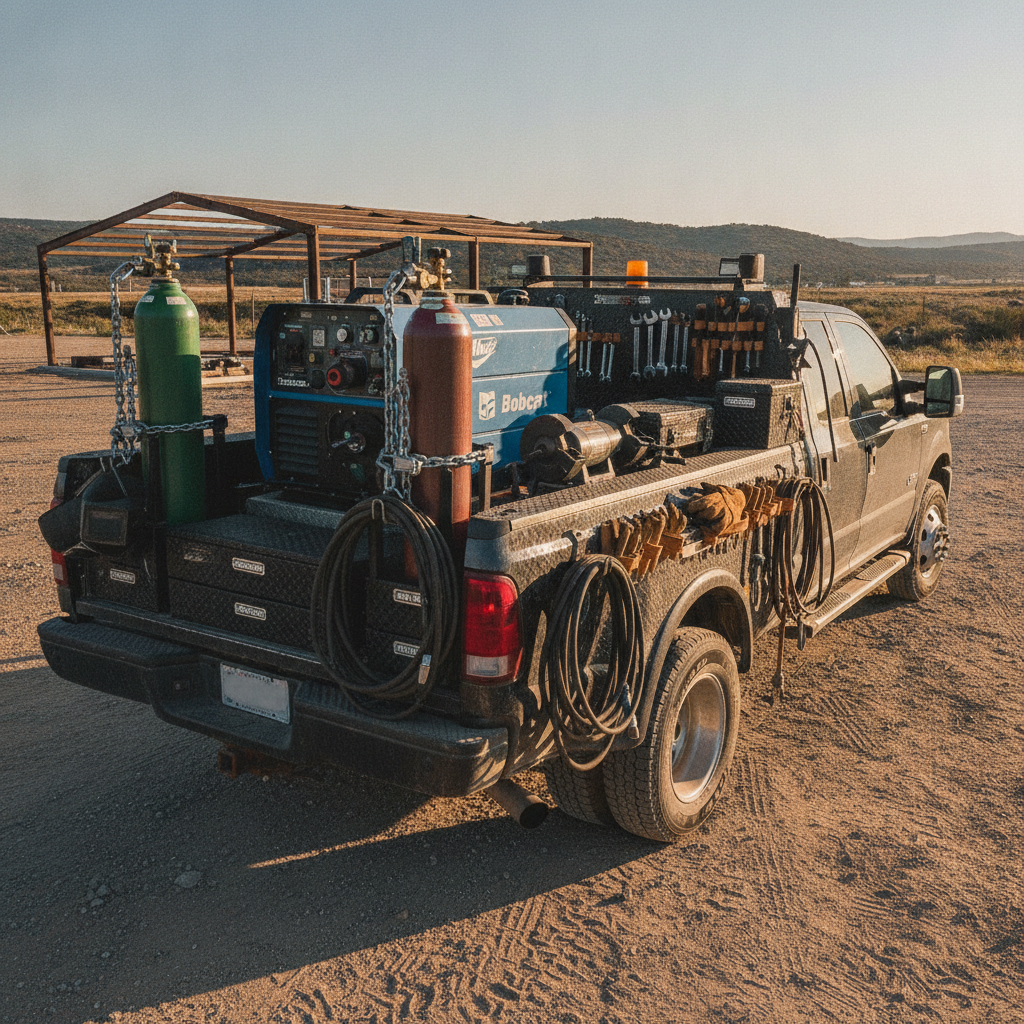
Let me paint you a picture. You pull up to a job site, customer’s already watching from across the yard, and you spend the next twenty minutes digging through your truck bed like a raccoon in a dumpster. Cable under the grinder. Helmet somewhere behind the gas bottle. Rod ends scattered loose in a milk crate from 2019. That right there is your mobile welder truck setup costing you real money. Not maybe. Not eventually. Right now, today, on every single job.
I’ve been running a mobile rig for over a decade. I’ve made most of these mistakes myself. Some of them twice. So this isn’t a lecture — it’s a field report from somebody who wasted enough time on a disorganized truck to know exactly how much it hurts your bottom line.
Let’s get into it.
Why Your Truck Setup Is a Business Problem, Not Just an Annoyance
Most guys think of their truck organization as a comfort issue. It’s not. It’s a revenue issue. If you’re billing $85–$125 an hour and you’re burning 20–30 minutes per job just getting set up, you’re handing money back to the customer without them even asking for it.
Run the numbers. Five jobs a week, 20 minutes of wasted setup each time. That’s over an hour and a half of billable time gone. Every week. Week after week. By the end of the year, you’ve donated something like 75+ hours of work to your own disorganization.
That’s not a small thing. That’s a real-money problem dressed up as a “I’ll get organized eventually” problem.
If you’re still figuring out how to price your time correctly, go read this breakdown on pricing for certification services — the same logic applies to how you value your setup time on any job.
Mistake #1: No Defined Home for Anything
This is the root cause of almost everything else on this list. If your gear doesn’t have a fixed location, it will never be in the right place when you need it. Period.
The fix is boring and obvious and most people still don’t do it: assign every piece of equipment a permanent home on your rig. Every. Single. Thing.
Angle grinder lives here. Extra discs live here. Helmet lives here. Chipping hammer, wire brush, markers, soapstone — all of it gets a designated spot. You should be able to reach for any tool on your truck without looking. Like a surgeon’s tray, except covered in spatter and smelling like flux.
Here’s how to start. Lay out everything you regularly carry. Group it by how often you use it and what tasks it belongs to. High-frequency gear goes closest to where you work. Stuff you rarely touch gets buried toward the front or in a lockbox.
Label the spots if you have to. Nobody’s watching. Nobody cares. If labeling a shelf means you stop losing your striker every other day, label the shelf.
Mistake #2: Cables and Leads Treated Like Garden Hose
Welding leads crammed into a pile, kinked, tangled, run underneath everything else in the truck bed — this is one of the most common things I see on mobile rigs. And it’s not just annoying. It’s slowing you down every single deployment.
A good lead management system doesn’t have to be fancy. It just has to be consistent. Get yourself a proper cable reel or build a simple spool mount on your truck. Keep your leads coiled correctly — over-under, not round-and-round like a garden hose. That kinking and tangling cuts your cable life short anyway, so good habits here save money twice.
Same applies to your ground clamp. It should have a home. Not “somewhere in that pile.” A home.
If you’re running a multi-process machine, you’re probably swapping leads and torches more often than a single-process guy. That makes organization even more critical. Check out this post on field-ready multi-process welders for more on managing that kind of setup in the field.
Mistake #3: Gas Bottles Not Secured or Organized by Use
Two problems here. First: bottles rolling around or not properly secured is a safety issue that will eventually bite you. Hard. Properly chained or strapped upright — that’s not optional, that’s basic.
Second: having the wrong bottle accessible. If you’re doing a TIG job and your argon is buried behind your oxy-acetylene setup, you’re moving things around before you’ve even touched the metal. Think about which gas you use most on the majority of your jobs and make sure that one is the easiest to access.
If you’re running a hybrid setup or working off battery-assisted power in remote locations, your gas management gets even more critical. Smart shielding gas management is worth a full read if you’re not already thinking about this systematically.
Mistake #4: PPE Buried Instead of Staged
Your personal protective equipment should be the first thing you can put your hands on when you climb out of the truck. Not because OSHA says so — because every minute you spend hunting for your gloves is a minute you’re not working.
Helmet goes in a specific spot. Gloves hang from a hook or go in a dedicated bin right at the rear of the truck. Hearing protection, safety glasses, leather jacket — all staged and ready before you even think about touching the machine.
I’ve seen guys put their helmet on the passenger seat. Fine, it works, but it also means it’s not there when you’re working out of the back. Figure out where you actually start your jobs from and stage your PPE there.
This also applies to your fire watch gear if you’re working in environments that require it — fire extinguisher accessible, not buried under a tarp from last fall.
Mistake #5: Your Machine Has No Dedicated Mount or Slide
The welder itself just sitting in the truck bed, sliding around, getting banged into by everything else — that’s a quick way to damage a machine that costs you several thousand dollars to replace. More than that, it means you’re repositioning it on every job instead of just pulling leads.
A proper welder mount — whether that’s a manufactured truck bed tray, a custom-built platform, or a slide-out drawer system — makes setup dramatically faster. You roll it to the edge or it stays fixed, and you work from there. Simple.
If you’re running one of the newer battery-assisted machines, mount stability matters even more because you’ve got more components to manage. Hybrid battery-powered welders are changing how mobile guys operate — but only if your rig is set up to take advantage of them.
Mistake #6: Consumables in One Big Pile
Rods, wire, tips, nozzles, cups, lenses, discs — all of it in a single box or bin, mixed together, unlabeled. I’ve seen this on rigs that have been running for years. The welder knows what’s in there “by feel.” Sure you do. Until a new helper reaches in or you’re working in the dark or you’ve got three jobs in a day and you’re rushing.
Consumables need to be sorted by process and by size. Small bins with labels. Stick rod in a proper rod tube or dry storage so you’re not dealing with moisture-contaminated electrodes. Wire spools covered and protected from dust and debris.
This also means keeping an accurate inventory so you don’t show up to a job short on what you need. Nothing kills your professional image faster than running back to the supply house mid-job. If you’re building out your business systems, Measure Twice, Invest Once has a solid framework for thinking about what tools and stock you actually need to carry.
Mistake #7: No System for Job-Specific Staging
This one separates the guys who’ve been doing this a while from the guys still figuring it out. Your truck setup shouldn’t just be organized for general use — it should be reconfigurable for specific job types.
When you book a structural job, you should know exactly what comes off the truck and in what order. Pipe job? Different kit. Farm equipment repair? Different kit again. The best mobile operators I know mentally pre-stage their truck the night before a job. They know what they’re pulling, in what order, and where it’s going on site.
That mental preparation isn’t overthinking. It’s the difference between a 10-minute setup and a 35-minute clusterfail in front of a customer who’s already skeptical about whether you know what you’re doing.
If you’ve been thinking about niching down your services to get better at this kind of targeted preparation, strategic niche selection is worth your time.
Mistake #8: Ignoring the Underneath and Exterior of the Rig
Underbed storage, trailer tongue boxes, exterior toolboxes — most guys either don’t use them efficiently or stuff them full of junk that should have been thrown away two years ago. Go through everything. If you haven’t touched it in three months and it’s not a backup for something critical, it doesn’t belong on your rig.
Dead weight costs you fuel. Clutter costs you time. Both cost you money.
Exterior boxes are great for storing things you need access to without digging into the truck bed — jumper cables, tie-downs, shop rags, basic hand tools. Keep that stuff sorted and accessible so you’re not climbing around the rig to find a crescent wrench.
Small Changes, Real Results
Here’s the honest truth about a better mobile welder truck setup: none of this is complicated. None of it requires a big investment. Most of it is just making decisions and sticking to them.
Assign homes for tools. Manage your cables properly. Stage your PPE. Secure your bottles. Mount your machine. Sort your consumables. Pre-stage for job type. Clear out the dead weight. That’s it. That’s the whole list.
Do those things consistently and your setup time drops. Your professional image improves. Your stress on site goes down. And — here’s the part that matters — your effective hourly rate goes up because you’re not donating setup time to every customer you work for.
If you’re serious about running a mobile welding business that actually makes money, the truck is where it starts. A clean, organized, well-staged rig is one of the clearest signals that you run a real operation. Customers notice. Other tradespeople notice. And more practically, you notice — every single day when you pull up to a job and know exactly where everything is.
That’s the goal. Not perfect. Just functional, consistent, and faster than yesterday.
If you’re also working on the business side of your mobile operation — estimating, client acquisition, scaling — From Garage to Shop walks through the growth path in a way that’s actually useful for field welders.
Final Word on Mobile Welder Truck Setup
Your truck is your shop. It’s also your first impression, your storefront, and your primary tool. Treat it like one. A disorganized rig isn’t just inconvenient — it’s a sign to everyone on site that you might not have your act together in other areas either, even if you can lay down a perfect bead once you finally find your helmet.
Get the mobile welder truck setup right. Everything else gets easier from there.