If your mobile rig organization looks like the inside of a dumpster that backed into a hardware store, you already know what I’m talking about. You pull up to a job, the customer’s watching you, and you spend the first twenty minutes digging through a pile of junk just to find your chipping hammer. That wasted time isn’t free. It’s coming straight out of your effective hourly rate, and the customer is standing there doing mental math on whether they should’ve called someone else. This post is about fixing that — practical changes to how your welding truck is loaded that will actually shave hours off your week.
Why Mobile Rig Organization Is a Business Problem, Not Just a Preference
Let me be direct about something most guys don’t want to admit: a disorganized rig is a symptom of not running your operation like a business. It’s easy to excuse when you’re slammed and just throwing stuff wherever it lands at the end of a job. But that habit compounds daily.
Think about it this way. If you spend fifteen minutes hunting for gear at the start of every job, and you’re running four jobs a day, that’s an hour of unbillable time — every single day. Five days a week, that’s five hours. Over a year, you’ve lost over 200 hours to disorganization. At $85 an hour, that’s $17,000 you left on the table because you couldn’t find your contact tips.
That’s not a storage problem. That’s a revenue problem.
The good news is that this is one of the most fixable issues in mobile welding. Unlike equipment investments that require careful financial planning, rig organization mostly costs you an afternoon and some rack hardware.
Mistake #1 — No Dedicated Zone for Consumables
This is the big one. Consumables scattered everywhere is the number one time killer on a mobile rig. You reach for a fresh contact tip and it’s buried under a grinder disc, three wire brushes, and a half-eaten granola bar from 2023.
Fix it with a single dedicated consumables drawer or tray. Everything lives there and only there. Contact tips, nozzles, anti-spatter, filler rod, wire spools, tungsten — all in one place with labeled sections or small dividers. Small bins from any hardware store work fine.
The rule is simple: every time you pull something from that drawer, you restock it before you leave the job. It takes sixty seconds. Do it every time without exception.
If you’re running multiple processes on your jobs — which more mobile welders are doing these days — keeping consumables sorted by process matters even more. A field-ready multi-process machine is only as fast to deploy as your ability to find the right consumables for it on the spot.
Mistake #2 — Leads and Cables Living in a Rat’s Nest
Nothing screams “amateur hour” like pulling up to a job and spending ten minutes untangling your leads. Beyond the professionalism issue, tangled cables wear faster, develop hidden damage, and create trip hazards on the job site.
The solution most guys resist because it feels like extra work is also the solution that saves the most time: always coil your leads the same way, every time, at the end of every job. Not most of the time. Every time.
Use the over-under coiling method if you’re not already. Your leads will lie flat, tangle less, and coil back up faster the next time. Mount a lead rack or dedicated hooks on your rig so there’s a specific home for them. If you have to stack them somewhere random, you’ve already lost.
Your ground cable should have its own spot too — not just thrown over the lead. Loose grounds are responsible for more weird arc behavior and wasted troubleshooting time than most guys want to admit.
Mistake #3 — Gas Cylinders That Aren’t Secured and Accessible
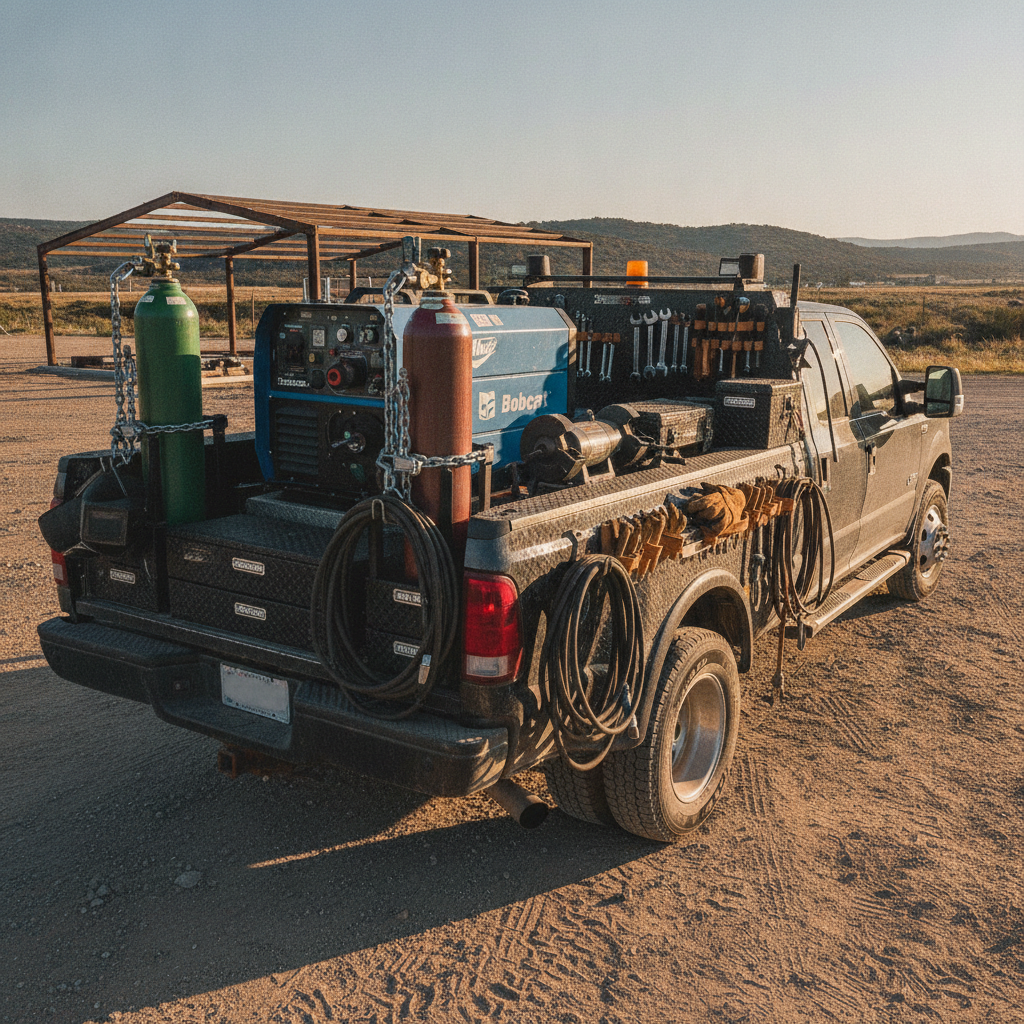
Two separate problems here. First, cylinders rolling around in your truck bed unsecured is a safety issue and a DOT issue. Chain them. Always. This isn’t new advice, but I still see guys loading a cylinder loose and driving off like it’s a bag of groceries.
Second problem: cylinders buried behind other gear so you can’t get to the regulators without unloading half your truck. Your cylinders should be accessible from one side of the rig, regulators facing the same direction, hoses routed cleanly to where your machine sits.
If you’re managing shielding gas across multiple jobs or multiple processes, smart shielding gas management is worth your time to think through properly. Running out of gas on a job because you didn’t check before loading is a rookie mistake that costs you time and customer confidence.
Consider a dedicated cylinder rack mounted to your truck. Purpose-built racks that bolt to a service body or flatbed run a couple hundred dollars and are worth every cent in time saved and liability avoided.
Mistake #4 — Tools Without a Home
Every tool on your rig needs a specific location. Not a general area — a specific spot. Your angle grinder goes in this bracket, your chipping hammer hangs on this hook, your tape measure lives in this pocket. Every time, without fail.
This sounds obsessive. It is. It’s also how experienced tradespeople operate because they’ve learned through hard experience that “I’ll just put it here for now” is how tools disappear, get damaged, or eat twenty minutes of your morning.
Shadow boards work well for frequently used hand tools. These are foam or plywood panels where you cut out the shape of each tool and mount everything visually. You can see at a glance if something is missing before you leave a job. That’s a valuable system on a busy week.
For power tools, consider hook or strap mounts rated for the weight. Tools sliding around in a drawer will develop damage you don’t see until they fail mid-job.
Mistake #5 — No System for Job-Specific Gear
Here’s a scenario most mobile welders know. You get called for a structural repair job and you load everything you own because you’re not sure exactly what you’ll need. Now your truck is a moving warehouse and finding anything specific takes forever.
The better approach is a modular job kit system. You maintain a core loadout that’s always on the truck — your machine, leads, consumables, basic hand tools, PPE, and gas. Then you build separate kits for specific job types that you can load quickly on top of that baseline.
Pipe repair kit. Sheet metal kit. Agricultural equipment kit. Aluminum kit. Each one lives in a labeled bin or bag that you grab as needed. This keeps your core rig lean and fast to work from, while still giving you flexibility.
If you’ve been thinking about building your business around strategic niches, this kind of job-kit approach supports that. Specializing means you’re loading your kit for the same type of job repeatedly — which makes setup even faster over time because it becomes muscle memory.
Mistake #6 — PPE Buried Where You Can’t Reach It Fast
Your helmet, gloves, and jacket should be the first things you can put your hands on, not the last. I’ve watched guys dig through their entire truck to find their helmet while the customer watches. It’s not a good look.
Designate a specific, easily accessible spot for PPE — ideally at the back of the truck near your working area, not buried in a side compartment you have to climb over to reach. Some guys mount a small hook rack right at the work end of their rig. Helmet hangs there. Jacket hangs there. Gloves go in the same pocket every time.
This also matters for compliance on job sites where a foreman is watching to make sure you’re geared up before you touch anything. Fumbling for PPE in front of a safety officer is a situation nobody needs.
Mistake #7 — No Pre-Job and Post-Job Checklist
This is the one most experienced guys skip because they think they don’t need it. They’re wrong. A checklist isn’t a sign that you don’t know your job. It’s what professionals use to make sure nothing gets missed when their brain is running on three hours of sleep and two cups of bad coffee.
Your pre-job checklist should cover: machine settings and condition, gas cylinder levels, consumables stocked, leads and cables checked, tools loaded, PPE ready, and paperwork in order. Two minutes to run through it before you leave saves you driving back for something you forgot.
Your post-job checklist covers: leads coiled and stored, consumables restocked, tools back in their spots, machine secured, cylinders chained. Doing this consistently is what keeps your rig in the same organized state job after job instead of gradually degrading back into chaos.
If you’re building out the business side of your operation — pricing, scheduling, client systems — the same discipline that goes into planning your business with real data applies to how you run your truck. The guys who grow sustainable mobile welding businesses are usually the same guys who are unusually organized in how they operate day to day.
The Truck Itself Might Be the Problem
Sometimes the issue isn’t the habits — it’s that the truck isn’t set up to support good habits. A flat bed with no storage means everything piles on top of everything. A service body with too many identical drawers means you’re opening all of them to find what you want.
If you’re running a flat bed, add a toolbox or utility chest with specific compartments. If you’re running a service body, label every single drawer and compartment clearly. Not a mental map — actual physical labels you can read at a glance.
Think about your workflow when deciding what goes where. The gear you use first on every job should be the easiest to reach. The stuff you use once in a while can live in the harder-to-access spots. Map your truck layout to match the sequence of how you actually work, not just what was convenient when you were loading it the first time.
For guys running newer equipment — hybrid battery-powered welders are changing the weight and space equation on mobile rigs significantly. If you’ve upgraded your machine recently, it’s worth re-evaluating your whole layout rather than just slotting the new gear into the old arrangement.
What Good Mobile Rig Organization Actually Looks Like
Pull up to the job. Open the compartment. Everything is where it should be. Leads come out clean. Consumables are stocked. You’re set up and striking an arc in under ten minutes. The customer sees someone who runs a tight operation and wonders why they ever used the other guy.
That’s not magic. That’s just the result of building systems and maintaining them consistently. It takes discipline to keep up — especially at the end of a long day when you just want to get home. But the morning version of you will be grateful every single time.
The welders who build real businesses out of mobile work — the ones who are booked out weeks in advance and charging what they’re worth — are almost always the ones who run organized rigs. It’s not a coincidence. Organization signals professionalism. Professionalism builds reputation. Reputation drives referrals. That’s the chain.
If you’re still building the foundation of your mobile welding business, take a look at going from a garage to a real shop operation — a lot of the organizational thinking applies whether you’re working mobile or building out a fixed location. The principles are the same. Know where everything is. Have a system. Work the system.
Bottom Line
A disorganized welding truck isn’t a personality quirk. It’s a business inefficiency that’s costing you real money and making you look less professional than you are. Mobile rig organization is one of the highest return-on-effort improvements you can make to your operation, and most of it costs nothing but an afternoon and some discipline.
Fix your consumables zone. Coil your leads properly. Secure and organize your cylinders. Give every tool a home. Build job kits. Make PPE accessible. Run a checklist. Then maintain it — because the system only works if you actually work the system.
Your hourly rate is only worth what you actually bill. Stop giving away hours to a messy truck.