If your mobile rig organization looks like a hardware store after an earthquake, you already know what I’m about to say. You’re losing money before you ever light an arc. Twenty minutes hunting for a tip, ten minutes untangling leads, five minutes wondering where the hell you put that second grinding wheel — that’s not a bad morning, that’s a broken system. And a broken system comes straight out of your pocket.
I’ve been running a mobile rig for over a decade. I’ve made every one of these mistakes personally. Some of them more than once. So consider this the peer-to-peer version of what I wish someone had told me when I was still throwing everything into a milk crate and calling it organized.
Let’s cut through it.
Why Mobile Rig Organization Directly Affects Your Bottom Line
Most guys think efficiency is about welding faster. It’s not. The arc time is almost never your problem. The problem is everything that happens before and after the arc.
Think about a five-job week. If you’re burning fifteen to twenty minutes per job on setup inefficiency — and that’s conservative — you’re looking at over an hour and a half of unbillable time every single week. Multiply that across a year. That’s real money. That’s equipment money. That’s a raise you gave yourself for free just by getting organized.
This isn’t about being neat for neatness sake. It’s about running a tighter operation so you can quote more aggressively, show up faster, and still leave on time. If you’re trying to build a sustainable welding business, efficiency is the foundation everything else sits on. I’ve written about how smart pricing decisions tie back to operational efficiency — check out this breakdown on pricing for certification services if that side of the business interests you too.
Now, let’s talk about what’s actually going wrong in most rigs.
Mistake #1: No Zones, No System
The single biggest mistake I see is treating the truck bed or service body like a storage unit instead of a workstation. Everything gets thrown in, nothing has a home, and every job starts with a treasure hunt.
Fix it with zones. Simple concept. Hard to actually do it and stick with it.
Here’s how I break it down:
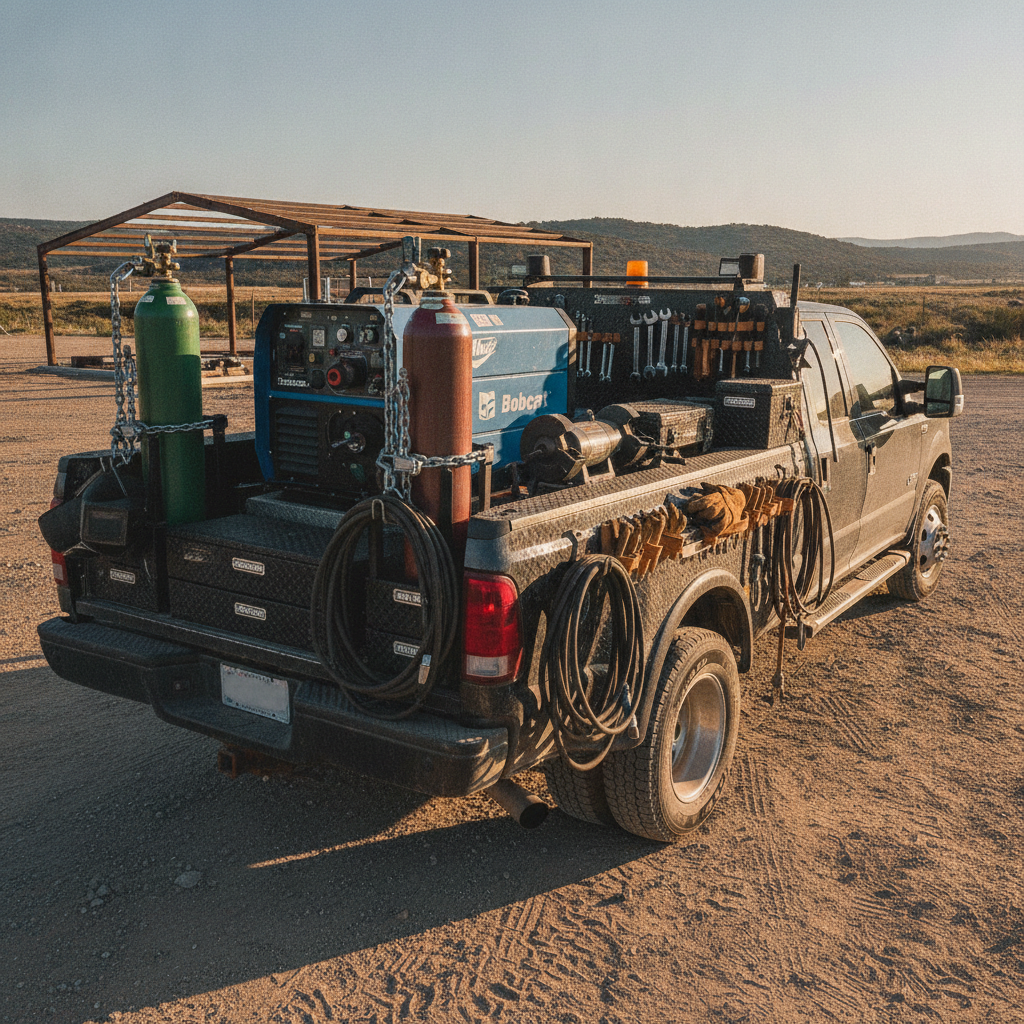
- Zone 1 — First Touch: Everything you need in the first five minutes of any job. Leads, clamps, helmet, hood, angle grinder with a grinding wheel already mounted. This lives at the back of the truck, accessible without climbing in.
- Zone 2 — Process Specific: Wire spools, rod canisters, filler metals sorted by process. If you’re running multi-process, this becomes critical. See my notes on field-ready multi-process welders for how process flexibility impacts your loadout decisions.
- Zone 3 — Repair and Specialty: The stuff you need sometimes but not every job. Plasma consumables, specialty filler, fixture clamps, inspection tools.
- Zone 4 — Admin and Safety: First aid, paperwork, job tickets, PPE spares. Keep it clean, keep it separate from anything greasy.
If you can’t describe where something lives in your truck without opening every drawer, you don’t have a system. You have a pile with a lid on it.
Mistake #2: Leads and Cables Are a Disaster
Tangled leads are a tax on your time. Every time. And yet somehow half the rigs I’ve seen still have welding leads just coiled loosely in the bed like an old garden hose.
Here’s what works: dedicated lead storage with a real method for coiling. Figure-eight coil your leads — not the over-under, not the spin-and-throw method. Figure-eight. It prevents twist buildup, unrolls clean, and doesn’t kink. Mount a pair of hooks or a proper lead rack so they hang instead of pile.
Same goes for your ground cable. A short, coiled ground with a magnetic base that lives on a specific hook means you grab it and go. You don’t dig. You don’t untangle. You go.
Extension cords, work light cords, air hose — same rules apply. Anything with a cord gets its own hook, its own coil method, its own spot. Once. Every time.
This sounds painfully simple. It is. Do it anyway.
Mistake #3: Consumables Are Everywhere and Nowhere
You know the feeling. You need a 6010 1/8″ rod. You have a full box somewhere. Somewhere. Could be the small drawer. Could be behind the rod oven. Could be in that bin you haven’t sorted since March.
Consumables need a permanent home sorted by process and diameter. Label your bins. I know labeling bins sounds like something a kindergarten teacher does, but when you’re muddy, tired, and behind schedule at 4pm on a Friday, you’ll thank yourself for the label.
Keep a running inventory system, even if it’s just a sticky note on the inside of a cabinet door. When you pull the last of something, it goes on the list before you close the drawer. Not when you get back to the shop. Right then.
If you’re running hybrid or battery-powered equipment on some jobs, your consumables situation gets more complex fast — worth reading up on hybrid battery-powered welders to see how that changes your loadout needs.
Mistake #4: The Welder Isn’t Mounted Right
A welder that slides around is a welder that’s about to get damaged, a lead connector that’s going to get bent, or a panel that’s going to crack from vibration. I’ve seen guys just set their machine in the bed and bungee cord it. That’s not a mounting solution. That’s a prayer.
Bolt it down. Weld a proper skid if you have to. Use vibration-dampening mounts if you’re running on rough terrain a lot. The machine should not move. Period.
While you’re at it, think about airflow. A lot of guys mount their welder in a spot that looks good but chokes the intake or exhaust vents. Check your manufacturer specs. Overheating a machine because your mounting position was lazy is an expensive and completely avoidable mistake.
If you’re thinking about what machine to mount in the first place, I covered what actually matters in the field in this post on field-ready battery welders.
Mistake #5: Tools Without Homes
Angle grinders, wire brushes, chipping hammers, flap discs, cutting wheels, wire wheel attachments — all of it needs a spot. Not a general spot. A specific spot.
Angle grinders should be mounted or hung, not floating loose. Lose a grinder to a bad bump on a dirt road and that’s an expensive lesson. Mount hooks, use tool holders, get a service body drawer system if your setup allows for it. Even a basic truck toolbox with foam inserts cut to shape will do the job better than nothing.
One rule that changed how I work: the grinder you use most often lives closest to the work area. The specialty stuff goes deeper. You should never have to dig past frequently-used tools to get to frequently-used tools. That’s just bad logic built into a physical space.
Mistake #6: Gas Cylinders Aren’t Secured Properly
This one goes beyond efficiency. This is a safety issue that doubles as a setup problem.
Unsecured cylinders rolling around in a truck bed are a hazard. They’re also a quick way to damage your regulator, crack a valve, and turn your gas supply into a paperweight mid-job. Chain them down. Use proper cylinder racks. If you’re transporting multiple cylinders, they all get chained individually.
Beyond the safety side, think about access. Your working cylinder should be at the back, easy to connect. Spares go further in. When you swap out an empty, it shouldn’t require you to move three other things to get to it. Plan the access before you plan the storage.
If gas management has ever bitten you on a job, there’s a solid deep-dive worth bookmarking on smart shielding gas management.
Mistake #7: No Pre-Job and Post-Job Checklist
The rig gets disorganized because there’s no reset protocol. You come back from a rough job, you’re tired, you throw stuff back in the general direction of where it goes, and by the third job that week the whole system has drifted into chaos.
A checklist fixes this. Not because you’re going to forget where the grinder goes, but because the checklist is a forcing function. It makes you stop, run through the list, and actually put things back before you park for the night.
Your pre-job check should confirm:
- Leads are coiled and accessible
- Consumables for the day’s job are loaded and located
- Gas levels are checked
- PPE is complete and in Zone 4
- Machine settings are zeroed or set for the first process of the day
Your post-job reset should put everything back. Everything. No exceptions. Even if you’re going to the same customer tomorrow and you think you’ll just grab it in the morning. Put it back tonight.
If you’re building out the business side of your mobile operation, the same discipline that makes a good rig system makes a good business system. Worth checking out the thinking in From Garage to Shop for how this translates at scale.
What Good Mobile Rig Organization Actually Looks Like
I’ll paint the picture. You pull up to a job. You drop the tailgate or open the service body. In thirty seconds you have your leads in hand, your helmet on, your ground clamp on the work, and you’re ready to talk process with the customer. No digging. No hunting. No apology for the mess.
That’s the standard. It’s not impressive once you’ve built the system — it just becomes normal. But to a customer watching you work, it reads as professional. It reads as someone who does this for a living and has done it long enough to have it figured out.
That first impression has real value. Customers talk. Referrals come from the guys who watched you set up clean and get to work without drama.
The Investment Side of This
Getting your rig dialed in costs money upfront. Drawer systems, tool holders, cylinder racks, lead hooks, foam inserts — none of it is free. But here’s the math: if better organization saves you an hour per week, and you’re billing at even a modest field rate, the system pays for itself faster than almost any other tool purchase you’ll make this year.
Before you spend money randomly, though, think through your niche and your actual job types. If you’re in a specialized niche, your loadout looks different than a generalist. I broke down how niche selection changes your entire operation in the post on strategic niches — worth a read before you invest in a full rig buildout.
Final Thoughts
Bad mobile rig organization is one of those problems that feels minor until you actually add up what it costs you. Then it feels like leaving cash on the job site every single day. Because that’s exactly what it is.
The fixes aren’t complicated. Zones. Proper storage. Secured equipment. A reset protocol. That’s it. None of it requires a new truck or a massive budget. It requires deciding that your time is worth protecting and then actually building the system that protects it.
You’ve already put in the years to learn the trade. Put in the afternoon to build the rig that lets you use it properly.
Start with one zone. Get it right. Then do the next one. By the time you’ve worked through the whole truck, you’ll wonder how you ever operated out of the chaos you used to call a setup.
And you’ll stop losing twenty minutes before you ever strike your first arc.