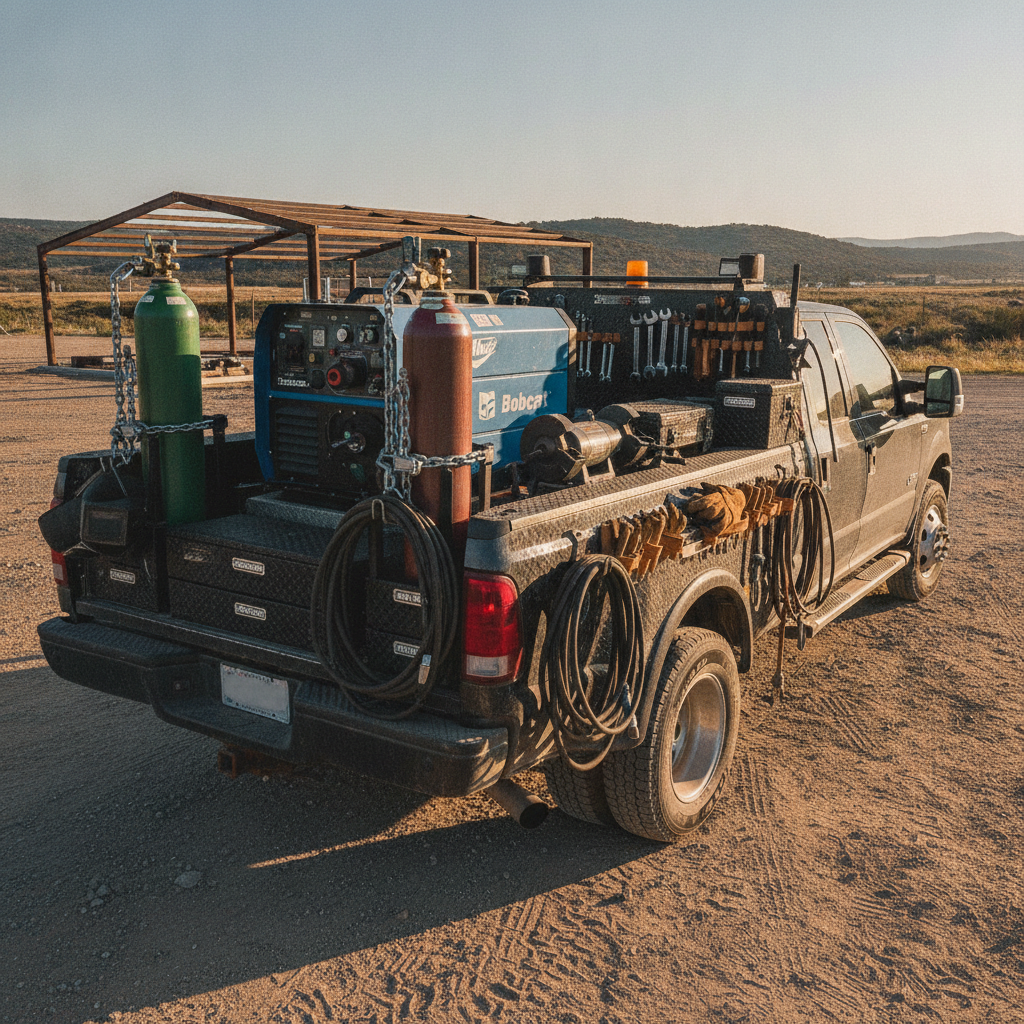
Your Truck Is Costing You Money Before You Even Touch a Stinger
Let’s talk about mobile rig organization — or more accurately, the complete lack of it on most service trucks rolling around job sites right now. You pull up to the job. Customer’s watching. You pop open the side boxes and spend the next fifteen minutes excavating through a archaeological dig of old rod stubs, mystery bolts, three wire brushes with no handles, and a grinder disc from 2019. Real professional look. Really inspires confidence.
Here’s the truth nobody wants to say out loud: a disorganized rig is a tax on your hourly rate. Every minute you’re digging through junk is a minute you’re not billing. If you’re losing even twenty minutes per job to setup chaos, and you’re running five jobs a week, that’s over a hundred hours a year gone. Do the math on what you charge per hour. Now feel bad about it.
This post is about fixing that. Practical stuff. No fluff about buying a $3,000 tool chest or rebuilding your entire rig from scratch. Small changes to how your truck is loaded will shave real time off every single job.
The Most Common Mobile Rig Organization Mistakes
Mistake #1: No Zones, No System
Most welders load their truck the same way they throw gear in after a job — wherever it fits. Box one has some grinding wheels, half a spool of wire, a come-along, and your lunch box from Tuesday. Box two is a mystery even to you.
The fix is zones. It sounds basic because it is basic. But basic works on a job site at 6 AM when you haven’t had coffee yet.
Break your truck into logical zones:
- Consumables zone — rod, wire, tips, nozzles, anti-spatter. All in one spot. Every time.
- Gas zone — cylinders secured, regulators accessible, hoses coiled and not tangled with your power leads.
- Hand tools zone — grinders, wire brushes, clamps, squares. Not mixed in with the consumables.
- PPE zone — hoods, gloves, sleeves, glasses. You should be able to grab this stuff in the dark.
- Machine zone — your welder accessible without moving six other things first.
If you can’t describe where something is on your truck without saying “uh, probably in one of the back boxes,” you don’t have a system. You have organized chaos, and it’s costing you.
Mistake #2: Cables and Leads Stored Like Spaghetti
Tangled cables are a special kind of job site misery. You pull one end, the whole mess comes out. You spend five minutes unspooling it while the foreman watches. Then you have to do it again at the end of the job when you’re already tired and just want to go home.
Get dedicated cable storage. Proper cable reels or even just consistent hand-over-hand coiling with a velcro strap makes an enormous difference. Keep your stinger lead, your work lead, and your ground separate and accessible. Label them if you have to. No shame in it.
While you’re at it — keep your leads off the floor of the truck bed. Every time they get driven over or kinked under something heavy, you’re shortening their life and creating problems you’ll find at the worst possible moment. A few simple hooks or a roller system bolted to the truck wall costs almost nothing and saves the leads.
Mistake #3: Consumables Stored in the Wrong Place
Your consumables should be the easiest things to grab on the truck. You touch them more than anything else. But on most rigs, the rod oven or rod box is buried behind a cylinder, under a tarp, or crammed in the back corner of a deep box where you need a flashlight and a prayer to find a 7018.
Position your consumables at waist height, near the working side of the truck, with a lid or cover that doesn’t require two hands to open. If you run multiple processes — and if you’ve read our post on field-ready multi-process welders, you probably do — keep each process’s consumables grouped together. Stick rod in one spot. Wire spools and tips together. TIG tungstens and filler in a clearly marked container.
Don’t mix processes. You will grab the wrong thing under pressure. It happens to everyone. Set up your storage so it can’t happen.
Mistake #4: Your Machine Isn’t Ready to Run
You get on site. Customer wants to see a quick test bead before they commit. You open up the machine compartment and realize your settings are still dialed in from the last job — different material, different thickness, completely wrong polarity. Now you’re fumbling with the machine while the customer stands there wondering if you know what you’re doing.
Make it a habit: at the end of every job, reset your machine to a neutral starting point. Write your baseline settings on a card taped inside the machine lid if you have to. When you’re running dissimilar metals or unusual materials regularly — check out our piece on dissimilar-metal welding mastery for reference — having those settings documented means you’re dialing in fast, not guessing from memory.
Your machine should be ready to run in two minutes or less when you pull up to a job. If it’s not, figure out why and fix it.
The Hidden Time Killers Nobody Talks About
The “Where’s the Extension Cord” Problem
Power management on a mobile rig is underrated. You roll up to a job that needs a grinder running off 110V shore power and your extension cord is a 50-foot tangle stuffed under your welding machine. Or worse — you don’t have one that’s rated for the load.
Designate a specific spot for every extension cord on your rig. Coiled, labeled by length and amperage, hung or stored consistently. Keep a heavy-duty cord and a lighter-duty cord. Know which is which without reading the label every time.
Same goes for adapters, plug converters, and GFCIs. One small bin, always in the same box. You’ll use them more than you think, and fumbling for them in front of a customer is amateur hour.
The “I’ll Put That Away Later” Trap
Here’s the discipline problem most guys won’t admit to: the rig that started organized gets disorganized fast because nobody wants to put things away properly after a long day. You throw the grinder in whatever box has space. The used wire brush lands on top of the rod oven. The extra ground clamp gets tossed in the cab.
Then you wake up at 5 AM for the next job and your organized system is already broken. The solution isn’t discipline — discipline is unreliable when you’re exhausted. The solution is making it harder to store things wrong than to store them right. Bins with lids that only fit certain items. Hooks that only make sense for the thing they’re designed for. Friction that nudges you toward doing it right.
This is the same principle good businesses use to build reliable processes. If you’re thinking seriously about the business side, our post on strategic niches for mobile welders is worth reading alongside this one.
Bad Lighting Costs More Than You Think
You’d be amazed how many guys are working in the dark in their own truck boxes. A single LED strip in each compartment costs almost nothing and saves you minutes every single job. You can see what you have, you can see what’s missing, and you stop pulling out the wrong thing because you couldn’t see the label.
Magnetic LED work lights that stick to the inside of the box lid are a game changer. No install required. Slap them up there and never dig through a dark compartment again.
Rig Layout That Actually Works
Think Like a Surgeon’s Tray, Not a Junk Drawer
Surgeons don’t root around in a pile of instruments looking for the scalpel they need. Everything is laid out in a predictable order before the procedure starts. You know where things are because they’re always in the same place, arranged for the workflow.
Your truck should work the same way. Walk through your typical job from start to finish. What do you grab first? Where does that need to be? What do you grab second? Build your storage layout around the sequence of how you actually work, not around what fits where.
If you’re regularly running multiple processes in the field — which, if you’ve invested in the right equipment as we cover in our breakdown of field-ready battery welders — your layout needs to account for multiple setups without the truck turning into a disaster.
Secure Everything Like You’re Driving Off-Road
Because sometimes you are. Cylinders that aren’t properly secured become projectiles on rough terrain. Grinders sliding around damage your other equipment and create safety hazards. Rod that shifts and gets wet is wasted money.
Cylinder chains or straps, not optional. Non-slip matting under everything that can slide. Bungee cords are a last resort, not a storage strategy. If it can move, secure it like you’re planning to hit a pothole at 45 mph, because eventually you will.
Inventory Your Consumables Weekly
Running out of 7018 at 10 AM on a job site is embarrassing. Running out of tips in the middle of a mig run and having to drive to the supply house is expensive. Neither should happen if you’re running a tight operation.
Spend ten minutes every Friday going through your consumable stock. Write a short list. Restock before Monday. This is basic logistics and it’s the difference between a professional operation and a guy who’s always borrowing from the other contractors on site.
If you want to get more analytical about how you’re spending your time and where your biggest efficiency losses are hiding, the smart heat maps for startup welding businesses post breaks down some useful approaches for tracking your actual job time vs. your billed time.
What Good Mobile Rig Organization Actually Looks Like
Let’s be real about what we’re aiming for here. You pull up to the job. You open your boxes and you can see everything clearly. You grab what you need in order. Your cables are coiled and ready. Your machine is set to a baseline. Your consumables are stocked and in their spot. You’re striking your first arc within ten minutes of parking the truck.
That’s not fantasy. That’s just having a system and maintaining it. The guys who do this look like professionals from the moment they show up. That matters for referrals. It matters for repeat business. It matters for what you can charge.
Speaking of what you can charge — if you’re also offering certified welding services out of your rig, being organized and professional directly supports your ability to command higher rates. Our post on pricing for certification services goes into the specifics of how to structure that.
The Bottom Line on Truck Organization
Mobile rig organization isn’t glamorous. Nobody’s going to post a YouTube video about their cable storage system and get a million views. But it’s one of the highest-leverage improvements you can make to your mobile welding business right now.
Every job you run, you’re either losing time or not losing time. Over a full year of work, the difference between a disorganized truck and a well-organized one can easily add up to fifty, a hundred, or more hours of productive time that you either bill or waste. At your hourly rate, that’s real money.
Go look at your truck right now. Be honest with yourself about what you see. Then start fixing one thing at a time. You don’t need to overhaul the whole rig in a weekend. Pick the biggest time-waster — usually cables or consumables — and fix that first. Then move to the next one.
It’s a trade. We don’t get paid to look organized. We get paid to weld. But being organized is what lets you weld faster, look more professional, and go home on time. That’s worth fifteen minutes of work at the end of every day to maintain.
Get your rig tight. Stop leaving money in the parking lot before the job even starts.