If your mobile rig setup looks like a hardware store exploded in the back of a pickup truck, you already know what I’m talking about. You pull up to the job, customer’s watching, and you spend the next twenty minutes digging through leads, tripping over your grinder, and hunting for the one rod holder you know you brought. Meanwhile, the clock is ticking — and that time isn’t coming back. Your hourly rate just took a hit before you even struck an arc.
I’ve been running a mobile welding rig for over a decade. I’ve made every one of these mistakes myself. Some of them more than once, which is embarrassing to admit but here we are. The good news is that none of this requires a fancy new truck or a five-thousand-dollar custom build. Most of it comes down to making a few deliberate choices about how your gear is loaded and where it lives on the rig.
Let’s get into it.
Mistake #1: No Zones on Your Truck Bed
The number one mobile rig setup mistake I see from guys just starting out — and honestly from some veterans too — is loading the truck with no system. Everything just gets thrown in at the end of the day wherever there’s space. It seems fine until you’re at a job site at 6 AM trying to find your chipping hammer.
Your truck bed needs zones. Think of it like a kitchen. You wouldn’t store your spatula in the fridge. Same logic applies here.
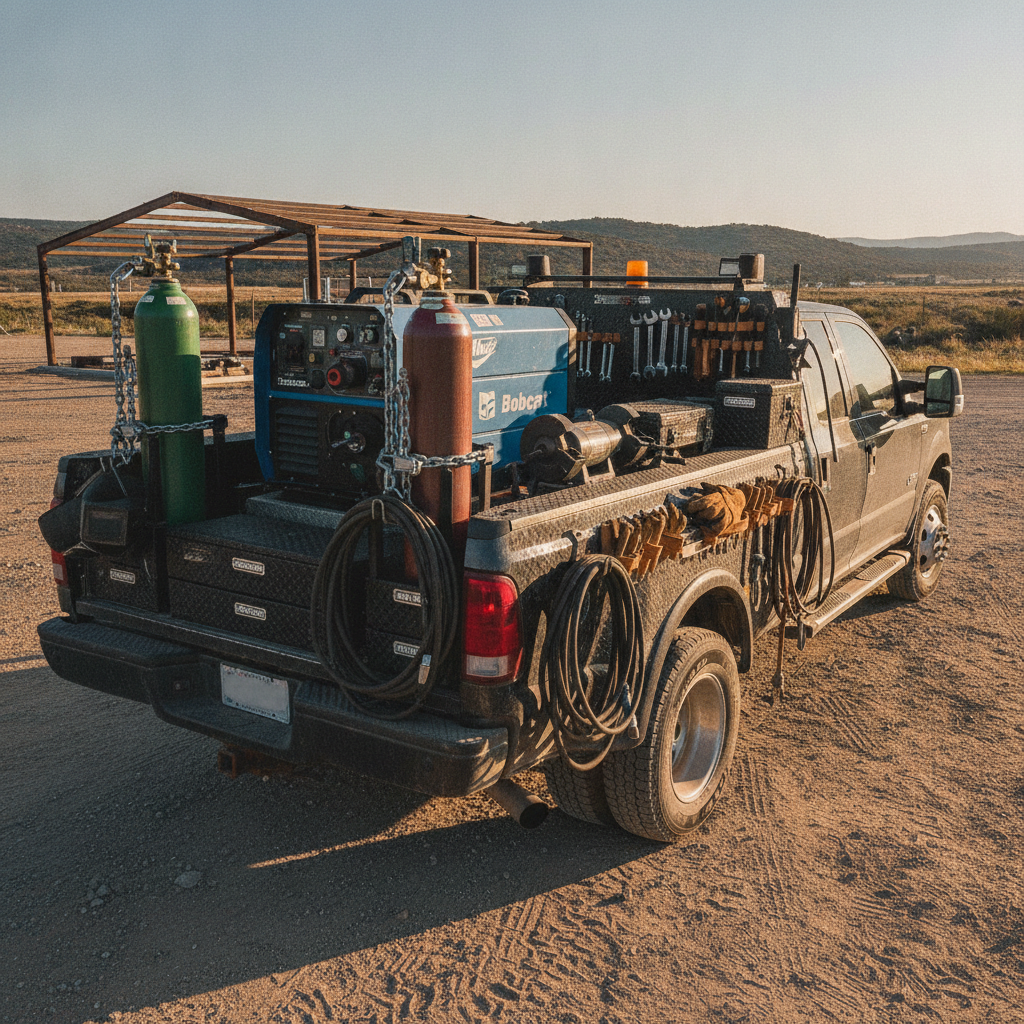
Here’s a basic zone breakdown that works for most mobile rigs:
- Zone 1 — Consumables: Rods, wire, tips, contact tips, grinding discs. Everything you burn through. Keep it close to the back of the truck so you’re not crawling in.
- Zone 2 — Power and Process: Your welder, leads, and gas. Centered on the truck for weight balance, cylinders chained upright near the cab.
- Zone 3 — Hand Tools and Fab: Grinders, clamps, squares, markers, magnets. A dedicated toolbox or drawer unit, not loose in a milk crate.
- Zone 4 — Safety and PPE: Helmet, gloves, fire blankets, first aid. Right at the tailgate. You shouldn’t have to dig for this stuff ever.
When everything has a zone, you stop making decisions at the job site. You just reach and grab. That’s the whole point.
Mistake #2: Your Leads Are a Disaster
Tangled welding leads are a tax on your time that you’re paying every single day. A guy with thirty feet of lead piled up in the back of his truck is going to spend five to ten minutes untangling it every job. That’s an hour a week. Over a year, you’ve worked a full day and a half just fighting your own cable.
Get yourself some lead hooks or a simple wall-mount reel on the side of your rig box. Coil your leads properly — over-under, not arm coils, before you give me grief about it. Label them. Keep the stinger and ground lead separate so you’re not playing which-end-is-which at the job site.
If you’re running multiple processes, color-code your leads. Red for stick, blue for MIG, whatever makes sense to you. You’ll thank yourself later, especially on the jobs where you show up tired and the last thing you want to do is think.
Speaking of running multiple processes on a mobile rig — if you’re still hauling separate machines for every process, check out what I wrote about field-ready multi-process welders. Consolidating your equipment footprint is one of the fastest ways to clean up your rig.
Mistake #3: Consumables Stored Like a Yard Sale
Open a toolbox on an unorganized rig and you’ll find rods rolling around loose, half-empty boxes of wire tips, and grinding discs mixed in with drill bits and somebody’s old work gloves. That’s not a storage system. That’s a junk drawer with sparks nearby.
Consumables need to be stored consistently so you always know what you have and where it is. Here’s what works:
For stick rods: A dedicated rod box or tube holder mounted to the rig. Label them by type — 6010, 7018, whatever you run. Don’t mix rods unless you enjoy scrapping test pieces because you grabbed the wrong one.
For wire and MIG consumables: A small drawer unit or a parts organizer with labeled compartments. Contact tips, nozzles, liners — all separated. Running low on something? You’ll see it before it becomes a problem at the job site.
For grinding discs: A dedicated flat rack or a section of your toolbox lined with foam. Discs get damaged when they’re loose. A cracked disc is a liability, not just an inconvenience.
Keeping tight inventory habits out of the truck also helps when you’re trying to price jobs accurately. If you want to think more about how supply costs affect your numbers, the post on pricing for certification services has a framework that applies to field work too.
Mistake #4: Gas Cylinders Stored Wrong — Or Just Barely Legal
This one isn’t just about efficiency. It’s about not getting yourself killed or cited.
Cylinders that aren’t chained up are a problem. A cylinder that tips over and shears a valve becomes a torpedo. That’s not hyperbole — that’s physics. Chain your cylinders, every time, no exceptions.
Beyond safety, cylinder placement matters for your workflow. If your Argon is buried behind your welder and three toolboxes, you’re going to skip the purge step because it’s too much hassle to get to. And that’s when you start making welds that look fine until they don’t.
Mount a proper cylinder rack or use a dedicated cylinder cage on the truck. Keep regulators protected — a regulator that gets knocked around will start reading wrong, and you won’t know it until your welds start acting weird. Keep caps on cylinders when they’re not connected. This is basic stuff, but I’ve seen guys with ten years on the tools skip it because they’re in a hurry.
If you’re doing any work that involves shielding gas management at scale, the deeper breakdown in smart shielding gas management is worth a read.
Mistake #5: No Dedicated Spot for Your PPE
Here’s a scenario. You’re on-site. Customer is standing next to you. You reach for your helmet and it’s not where you thought it was. Now you’re rummaging through the truck, the customer is watching you not work, and you look like you’ve never done this before. Not a great look.
Your PPE needs a fixed home at the back of the rig, accessible immediately. Helmet on a hook. Gloves in a pouch. Sleeves and jacket folded in a designated bin. Fire blankets in a roll mount. You put your PPE on before you touch anything. That process should take thirty seconds, not five minutes of searching.
Same goes for your first aid kit and fire extinguisher. Know where they are before something goes wrong, not after.
Mistake #6: Your Welder Has No Real Mount
A welder sliding around in the truck bed is a problem waiting to happen. The vibration alone is going to shake connections loose, rattle control knobs, and eventually cause you a repair bill you didn’t budget for. It also means every job starts with you repositioning the machine before you can run leads.
Bolt your welder down. Use rubber isolator mounts if you can — it cuts vibration significantly. Run your leads through proper anchors so they’re not dragging on the frame or getting pinched. If you’re running a generator-welder combo, the weight distribution matters even more. Get it centered, get it secured, and get a cover for it so you’re not wondering why your control panel is full of road grime.
If you’re looking at newer equipment that’s built to handle the abuse of field use — including hybrid and battery-powered options that sit well on a mobile setup — the post on hybrid battery-powered welders covers what’s currently worth looking at.
Mistake #7: No Pre-Job and Post-Job Routine
The most organized truck in the world still falls apart if you don’t maintain the system. That means a pre-job check and a post-job reset, every single day.
Pre-job takes five minutes. You’re confirming your consumables are stocked, your cylinders are at pressure, your PPE is in place, and your leads are untangled. You’re not doing this at the job site in front of the customer — you’re doing it before you leave in the morning.
Post-job is when you reset. Everything goes back to its zone. Consumables that ran low get noted. Anything that broke or needs replacing gets written down so you handle it before the next job. This is also when you coil your leads properly instead of throwing them in the truck and promising yourself you’ll sort it out later. You won’t. You never do.
Building these habits early is part of running a mobile operation like a business instead of like a side hustle. If you’re still figuring out the business side of going mobile, the post on going from garage to shop covers the mindset shift that makes the operational stuff click.
Mistake #8: Ignoring Weight Distribution
This one affects your truck, your fuel economy, and your tires — none of which are cheap. A rig loaded heavy in the rear with nothing up front kills your handling and wears out your suspension faster than the work will.
Heavy items — welder, generator, cylinders — should sit over or just ahead of the rear axle. Lighter stuff goes further back. Keep your heaviest toolboxes low and centered. If you’re running a flatbed or a service body, distribute weight side to side too. A truck that pulls to one side is a truck that’s about to need alignment work.
This sounds like truck maintenance advice, but it directly affects your mobile rig setup decisions. How you organize your gear determines how your truck handles. Handle it poorly and you’ll spend money on repairs instead of equipment upgrades.
The Time Math Nobody Talks About
Let’s put some numbers on this. Say you waste fifteen minutes per job on disorganized setup — finding gear, untangling leads, hunting for consumables. If you’re running five jobs a week, that’s over an hour a week. Over fifty weeks, that’s more than fifty hours a year.
At even sixty dollars an hour, you just lost three thousand dollars to a messy truck. That’s not a rounding error. That’s a new welder, a set of tires, or three months of insurance. The mobile rig setup conversation is a money conversation, not just an organization conversation.
And it compounds the other way too. When your rig is tight and you show up looking like you know what you’re doing, customers notice. They refer you. They call you back. A professional-looking setup communicates that you’re a professional operation — and that justifies the rates you should be charging.
If you’re working on the business strategy side of your mobile operation — figuring out which markets to focus on and how to position yourself — the post on strategic niches for mobile welders is worth your time.
What a Tight Mobile Rig Setup Actually Looks Like
To wrap this up without getting too fluffy about it — a good mobile rig setup is one where you can pull up to a job, have your PPE on, welder positioned, leads run, and arc struck in under ten minutes. Every time, not just on your best day.
That requires zones, secured equipment, organized consumables, properly stored gas, and a daily reset habit. None of it is complicated. It’s just not the path of least resistance, especially at the end of a long day when you want to throw everything in the truck and go home.
Do it anyway. Your future self is billing by the hour.
And if you’re at the stage where you’re building out your mobile operation from scratch and want to make smart equipment investments before you’re in too deep, the framework in measure twice, invest once applies directly to how you spec out your rig.
Quick Reference: Mobile Rig Setup Checklist
Before you head out tomorrow morning, run through this:
- Welder bolted down, connections tight, cover in place
- Cylinders chained upright, regulators protected, caps on spares
- Leads coiled properly, stinger and ground separated
- Consumables stocked and organized by type
- PPE at the tailgate — helmet, gloves, jacket, fire blanket
- Hand tools in their zone — not loose in the bed
- First aid kit and extinguisher accessible
- Weight distributed properly — heavy over the axle
- Post-job reset done — everything back in its place
That’s it. That’s the whole system. It’s not sexy. It doesn’t require a YouTube build series. It requires about forty minutes to set up properly and about five minutes a day to maintain. And it will absolutely, without question, make you more money than a truck that looks like a parts bin with wheels.
Get your rig sorted. Then go weld something.