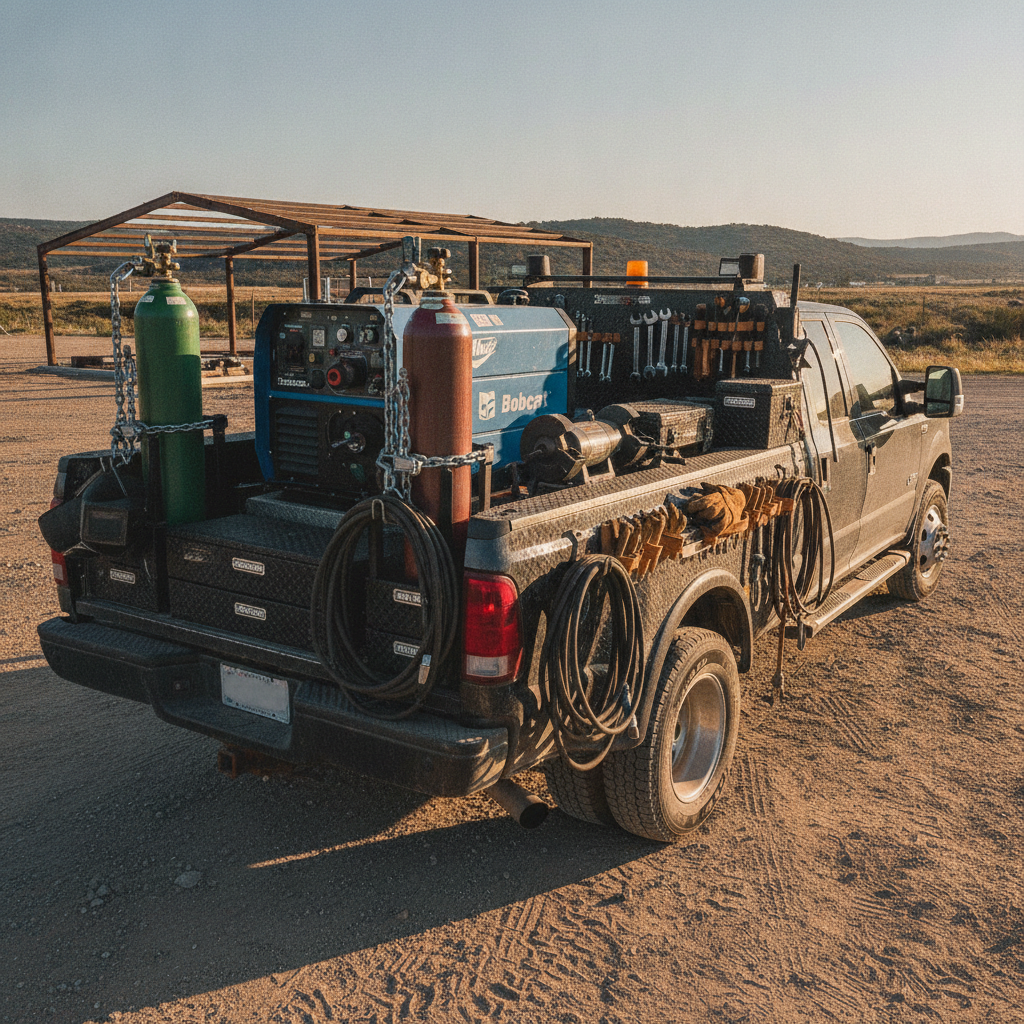
If your mobile rig organization looks like a hardware store dumpster after a windstorm, you already know the problem. You roll up to a job, swing open those truck doors, and spend the next twenty minutes digging past dead grinder discs, mystery cables, and that one vice grip you forgot you owned. Meanwhile, the customer is watching. And every minute you spend rooting around is a minute you’re not billing. That wasted time adds up fast, and it’s coming straight out of your pocket — not theirs.
This isn’t about being neat for neatness’s sake. This is about money. This is about looking like you know what you’re doing. And honestly, this is about not wanting to throw your back out lunging over a cylinder at seven in the morning.
Let’s talk about the truck setup mistakes that are slowing you down, and what you can actually do about them.
Why Mobile Rig Organization Is a Business Problem, Not Just a Tidiness Problem
New guys think a sloppy rig is a personal quirk. Guys who’ve been doing this a while know it’s a liability. When you can’t find your filler rod, you’re not just annoyed — you’re paying for that confusion at whatever your hourly rate is.
Here’s a number worth thinking about: if you waste 15 minutes per job digging through your rig, and you run five jobs a week, that’s over an hour of lost productivity every single week. Fifty weeks a year, that’s fifty-plus hours you didn’t bill. At $100 an hour, that’s five grand a year you handed back to the universe because your truck looks like a yard sale.
And it’s not just time. A disorganized rig means you’re more likely to show up somewhere missing something. That means a second trip, or worse, a delay that makes you look unprofessional to a customer you were trying to impress.
If you’re building a mobile welding business from the ground up, you already know there are a hundred things competing for your attention. Don’t let your truck be one of them. We’ve talked before about the bigger picture of going from garage to shop — but long before you get there, your daily rig needs to work for you, not against you.
Mistake #1: No Zones, No System
The biggest sin in mobile rig organization is treating your truck bed or service body like a single big drawer. Everything goes in, nothing has a place, and you find things by feel and memory. That system fails the second you hire a helper, get tired, or add one more piece of gear.
The fix is zones. Simple, obvious, permanent zones.
Think of your rig the way you’d think about a shop layout. You wouldn’t put your angle grinder in the same spot as your filler rod. Same logic applies in the truck. Break your storage into categories:
- Welding leads and power cables — coiled, tied, stored separately
- Consumables — rod, wire, tips, nozzles, all in one labeled location
- Cutting and grinding gear — discs, guards, grinders together
- Hand tools — one spot, always the same spot
- PPE — helmet, gloves, jacket, not buried under a spool of wire
- Gas cylinders — secured, always in the same position
Label things if you need to. There’s no shame in a label maker. Shame is showing up to a job and telling the customer you need to run to the supply house because you can’t find your contact tips.
Mistake #2: Unsecured Gear That Migrates Around the Truck
Stuff that isn’t secured will end up in the wrong spot. Guaranteed. A grinder slides under the welder. A bag of rod rolls behind the cylinder. Your helmet ends up upside down under a come-along. By job three, your zones are fiction.
Bolt things down. Use drawer dividers. Use bungee straps if you have to. Mount frequently used tools on a panel or pegboard if your service body allows it. Whatever your rig looks like — flatbed, enclosed trailer, service truck — the principle is the same. Everything needs a physical home it can’t escape from when you go around a corner doing forty.
This matters more when you’re running a machine that’s also bouncing around. Field-ready multi-process welders are built tough, but even they don’t love rolling around loose in a truck bed. Protect your equipment and protect your layout at the same time.
Mistake #3: Consumables Buried or Disorganized
Consumables are the thing you reach for most often on any job. Tips, nozzles, rod, wire, gas lenses — if you have to excavate to find them, you’ve built yourself a recurring time tax on every single job.
Consumables need to be front and center, accessible without bending over, digging, or moving anything else. A lot of guys use a dedicated drawer or a small parts organizer mounted at arm’s reach. Separate by type and by process. If you’re running stick, your rod box shouldn’t be behind your MIG wire.
Stock your consumables properly too. Running out of tips on a job site is embarrassing and costly. Do a quick consumables audit at the end of each week. Know what you’ve burned through. Restock before Monday. Make it a habit the same way you check your fuel.
While you’re at it, get your shielding gas situation under control. If you haven’t thought hard about gas management on a mobile rig, the post on smart shielding gas management is worth reading. Running low or wrong on gas mid-job is a costly mistake that’s entirely avoidable.
Mistake #4: Leads Coiled Like Spaghetti
Nothing announces “amateur hour” like a pile of welding leads tangled in the truck bed. Beyond the optics, it’s a practical nightmare. You pull one lead and drag everything else with it. You spend five minutes sorting cable before you can even start your pre-job walk-around.
Properly coil your leads every single time you pack up. Wrap them the same way, every time. Use velcro straps or loop-and-lock straps — not zip ties that you cut and throw on the ground. Store them in a consistent position. If your leads are long enough to warrant it, mount a cable reel. That’s not overkill; that’s smart.
The same discipline applies to your ground cable, your extension cords, and any auxiliary power cables. If it’s a cord, it has a coil, it has a home.
Mistake #5: Your Most-Used Gear Is the Hardest to Reach
This one is just physics working against you. You load the truck based on what fits, not based on what you grab first. So your helmet is in the back corner and your angle grinder is under the welder. Every morning you do a circus act to get set up.
Think about frequency of use when you design your layout. The stuff you touch on every single job goes closest to the doors, at the most accessible height, in the easiest position to grab. The stuff you rarely need — specialty clamps, backup parts, your pipe standoff collection — goes deep in the rig where it won’t be in your way.
Walk through a typical job in your head. What do you grab first? That’s what goes in front. What do you grab last, or only sometimes? That goes in the back. It’s basic ergonomics, but most guys never think about it when loading a truck.
Mistake #6: No End-of-Day Restock Routine
The best-organized rig in the world falls apart without a consistent close-out routine. You finish a job, you throw everything back in roughly where it goes, and you call it good. By Friday, the organization you built on Monday is already gone.
Build a five-minute close-out checklist. It doesn’t need to be fancy — it can literally be a sticky note on your dashboard. Same tasks, same order, every job:
- Leads coiled and stowed
- Consumables back in their spot
- Tools wiped and returned
- Cylinders checked and secured
- PPE in its place
- Trash out of the truck
That last one matters more than you think. Garbage accumulates in a work truck faster than anywhere else on earth. Empty cups, rod stubs, packaging, tape scraps — all of it becomes clutter that buries your gear and makes the whole thing worse. Clean rig, clear head. Not being poetic here, that’s just true.
Mistake #7: Ignoring How Your Machine Affects Your Workflow
Your welder itself is part of your rig setup. If your machine is a pain to access, adjust, or connect, it adds time and frustration to every job. If you’re still running a machine that needs a forklift and a prayer to get in and out of the truck, that’s a workflow problem, not just an equipment problem.
The right machine for a mobile rig is compact, versatile, and reliable in field conditions. We’ve covered the landscape of field-ready battery welders and also gone deep on hybrid battery-powered welders if you’re evaluating what your next machine should look like. A machine that fits your rig layout and your workflow is part of your organization strategy.
Also consider where your machine sits relative to your other gear. If your welder is in the middle of everything, every job starts with a shuffle. Ideally, it’s accessible without moving anything else, the leads have a clear path out, and adjustments are easy to make while the machine is in its working position.
Mistake #8: Not Thinking About the Customer’s Perspective
Here’s the uncomfortable one. When you open your truck at a job site, the customer is often watching. What they see tells them something about how you operate. A clean, organized rig says you run a tight operation. A chaos truck says something else entirely, and it affects their confidence in you before you’ve struck a single arc.
This matters especially when you’re trying to win repeat business or referrals. People talk. “He showed up and his truck was a disaster but the weld was good” isn’t the story you want them telling. You want them to notice that you looked like you knew what you were doing from the moment you pulled in.
Presentation is part of your pricing power. If you want to charge professional rates, you need to look like a professional operation. We’ve talked about pricing for certification services and finding the right strategic niches for your business — but all of that positioning gets undercut if your first impression is a truck that looks like it was organized by a golden retriever.
Practical Steps to Fix Your Rig This Week
You don’t need to spend a weekend and a thousand dollars to fix your mobile rig organization. Here’s a practical, realistic approach to getting your truck sorted without losing a full day to it.
Day one: Pull everything out. Seriously, everything. This is the only way to see what you actually have versus what you think you have. You’ll find duplicates, dead consumables, and gear you forgot about. Toss the trash, set aside duplicates, and start with a clean slate.
Day two: Group things by category before you load anything back. Lay it all out on the ground or a work table. See how much space each category actually takes. This is where you figure out if your current storage solution is even the right one.
Day three: Load with intention. Frequency of use drives placement. Lock things down. Label drawers if that helps you keep it straight. Build in the close-out checklist before you use the truck again.
Then give yourself two weeks to run the new system. You’ll find things that don’t work and adjust. That’s fine. The goal isn’t a perfect system on day one. The goal is a system that’s better than what you had, that you’ll actually maintain.
The Bottom Line on Rig Organization
A well-organized rig is not a luxury. It’s a profit center. Every minute you save on setup and teardown is a minute you can bill, or a minute you get back in your day. Over the course of a year, that’s real money.
More than that, good mobile rig organization is a habit that reflects how you run your whole business. If you’re thinking carefully about how your truck is loaded, you’re probably also thinking carefully about job planning, equipment maintenance, and customer communication. It’s all connected.
If you’re building a mobile welding business and you want to operate at a higher level, start with what’s in your truck. Fix the obvious problems. Build the systems. Show up to jobs looking like you’ve done this before — because you have.
And if you want to keep thinking bigger picture about your operation, take a look at how measuring before you invest applies to your equipment and business decisions. Small improvements in how you work add up to big differences in what you earn.