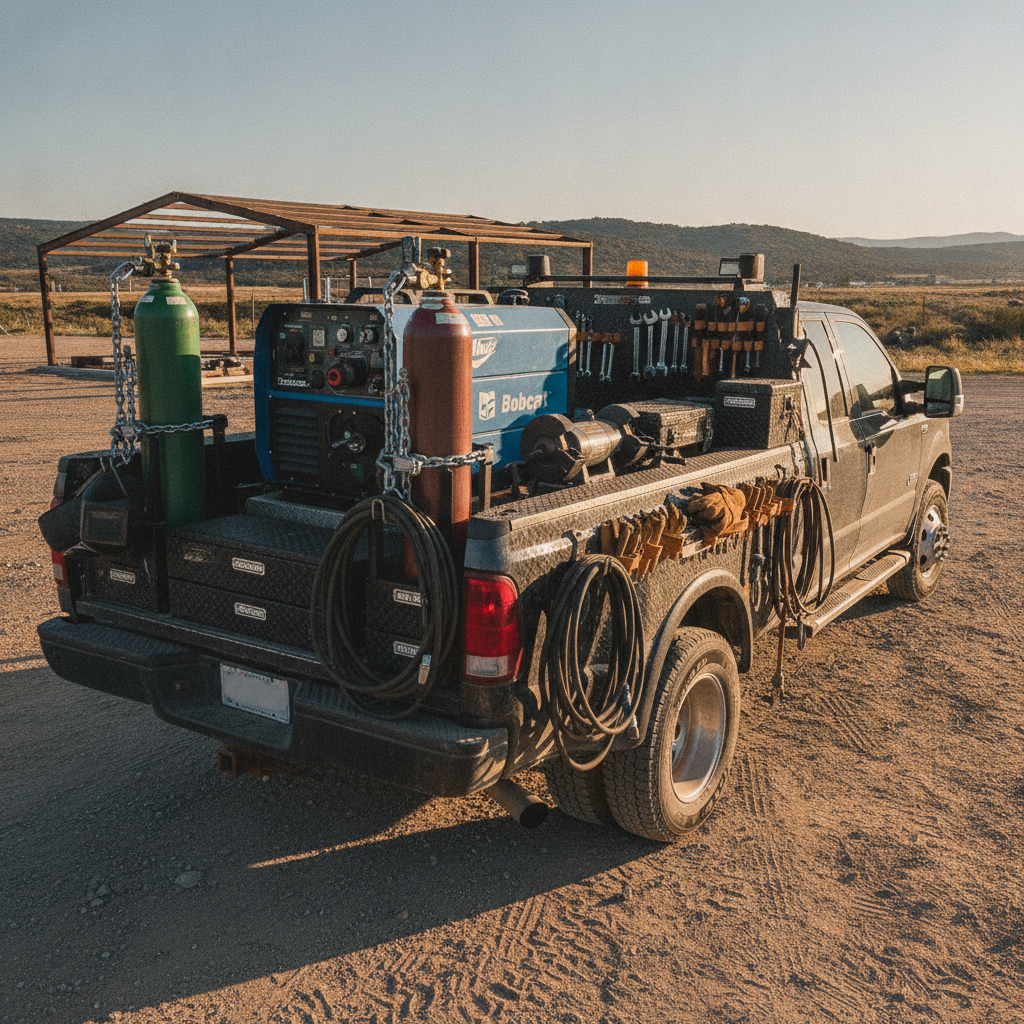
Let’s talk about truck setup mistakes that are quietly bleeding you dry. You roll up to a job, the customer’s already watching, and you spend the next twenty minutes digging through a pile of leads, half-empty rod cans, mystery fittings, and that grinder disc you’ve been meaning to throw away since March. You look like a mess. You feel like a mess. And every minute of that circus is time you’re not billing for — or worse, time you’re billing for while looking completely incompetent. Neither is good for business.
Mobile welding is a game of efficiency. The whole value proposition is that you show up, get it done fast, and get out. A disorganized rig destroys that. So let’s go through the mistakes that most guys make when they’re setting up their first — or fifth — mobile rig, and what to actually do instead.
Mistake #1: No Dedicated Home for Every Single Item
This is the big one. The root cause of almost every disorganized rig is simple: stuff doesn’t have a permanent address. You threw the striker in that drawer last week. Or was it the toolbox? Or did you set it on the bumper and it bounced off on the highway? Nobody knows. You don’t know. That’s the problem.
Every single item on your truck needs one home. Not “around here somewhere.” One specific spot. Rod ovens go here. Leads coil and hang here. Angle grinders live in this drawer. Clamps on this hook. When everything has a place, it goes back to that place at the end of every job. No exceptions.
This sounds stupidly simple. It is. But most guys never sit down and actually map it out. They just throw stuff on the truck and figure it out as they go. That’s how you end up with a drawer that has three different things in it and none of them make sense together.
Take an afternoon before your next busy week. Lay everything out on the ground next to your truck. Look at what you actually use every day versus what you use once a month. Organize accordingly. Daily-use items go in the easiest-to-reach spots. The rarely-used stuff goes in the back corner.
Mistake #2: Leads and Cables That Live in a Tangle
If your leads aren’t coiled and stored properly, you’re already losing. A tangled lead takes two to three minutes to sort out every single time. Doesn’t sound like much. Multiply that by four jobs a day, five days a week. That’s over an hour a week you’re spending fighting your own cables.
Over a work year? That’s multiple full days of labor you’re burning on stupid cable management. Days you could’ve billed or gone home early.
Get dedicated lead hangers or a cable reel system mounted to your rig. Coil your leads the same way every time — the over-under method if you actually want them to not kink. Stow them after every single job. Not when you feel like it. Every job.
Your ground clamps and electrode holders should hang where you can grab them in under five seconds without looking. If you’re hunting for your stinger, something has gone wrong in the organizational hierarchy.
Mistake #3: Consumables Scattered Everywhere
You’ve got 7018 in the cab, some 6011 in the toolbox, a partial box of wire in the back, and you’re not actually sure where the 309 stainless rod went. This is a real problem when a customer asks if you can handle a quick stainless repair and you spend ten minutes auditing your own inventory on their clock.
Dedicate one compartment — and only one — to consumables. Organize it by process and rod type. Use a label maker. Yes, a label maker. You’re a business owner now, not just a welder. Labels aren’t soft, they’re efficient. Know exactly what you have, where it is, and when you’re running low.
While you’re at it, build a simple restocking habit. End of the week, check your consumables. Order what’s low. Show up Monday with a full truck. This matters more than people think — running out of rod on a remote job because you didn’t check your inventory is an embarrassing phone call to make to a customer.
If you’re expanding into more complex material work and need to think through what consumables to carry for different metals, check out Dissimilar-Metal Welding Mastery — it’s worth thinking through before you start taking on more varied field work.
Mistake #4: Gas Bottles That Aren’t Secured or Organized
Unsecured bottles are a safety issue first and an organization issue second. We won’t dwell on the safety lecture — you know this. Chain your bottles. Full stop.
But beyond safety, think about how your bottles are positioned. Can you read the labels without moving anything? Do you know at a glance which ones are full and which are empty? A lot of guys waste time at the start of a job discovering they grabbed a mostly-empty bottle. Mark your bottles. Full bottles get a tag or tape. Empties get turned upside down or marked clearly.
Also consider which processes you’re running most. If you’re running MIG and TIG regularly, your shielding gas should be front and center. If you want to get smarter about your gas management overall, Smart Shielding Gas Management covers the logistics side of this in detail. Worth a read if you’re burning through gas faster than you’d like.
Mistake #5: Your Welder Isn’t Matched to How You Actually Work
This one stings a little because it involves money. But if your machine doesn’t match the work you’re doing, you’re fighting your setup every single day. A welder that can’t handle the material diversity you’re running, or that needs 20 minutes to warm up, or that’s just too heavy to move efficiently — that’s a truck setup mistake at the equipment selection level.
If you’re doing varied field work — structural, pipe, sheet metal, whatever comes your way — you need a machine that can handle it without dragging you down. Field-Ready Multi-Process Welders breaks down what to look for if you’re evaluating your current machine or shopping for an upgrade. Don’t skip this conversation just because your current machine “works fine.” Fine isn’t efficient.
Also worth considering: battery-powered options are getting genuinely capable for field work. If you haven’t looked at them recently, Hybrid Battery-Powered Welders covers the current state of that technology. Not the right fit for every guy, but worth knowing about.
Mistake #6: No System for Hand Tools
Grinders, wire brushes, chipping hammers, clamps, squares, levels, markers — they all need a home. The guys who have it figured out have a specific drawer or panel for hand tools, organized by frequency of use. The guys who don’t have it figured out are the ones asking their helper to “grab the die grinder from wherever it is.”
A simple approach: dedicate one service body drawer entirely to grinding and finishing tools. Another for measuring and layout tools. Keep it consistent. The moment you start just throwing things “back in there somewhere,” the system breaks down.
Magnetic tool bars mounted inside compartment doors are underrated. You can see everything at a glance, grab what you need in two seconds, and put it back just as fast. Takes about an hour to set up and saves you time every single day after that.
Mistake #7: Ignoring Setup Time When You Price Jobs
Here’s where disorganization hits your wallet hardest and most invisibly. If you’re not accounting for setup and breakdown time in your pricing, you’re working part of every job for free. A well-organized truck means your setup time is genuinely short — ten minutes or less to be striking an arc. A disorganized truck means you’re at 25-30 minutes before you’ve done anything billable.
Track this honestly for a week. Time yourself from arrival to first arc on a few jobs. If that number is ugly, fix the rig. If you’re still figuring out how to price your mobile work to actually make money, Pricing for Certification Services covers the broader conversation about making sure your rate reflects your real costs and time. And Measure Twice, Invest Once is worth reading if you’re making bigger decisions about your business setup and want to think through the numbers before you spend.
Mistake #8: Forgetting the “End of Day” Reset
Everything above falls apart if you don’t have an end-of-day habit. After every job — or at the end of every day — do a five-minute reset. Leads coiled and hung. Tools back in their spots. Consumables checked. Bottles secured. Truck locked and ready to roll tomorrow morning.
This isn’t optional. This is what separates the guys who look professional from the guys who spend their first twenty minutes of every job doing the housekeeping they skipped yesterday. It takes discipline at first. After a few weeks, it’s just what you do.
Think of it this way: your truck is your shop. A guy who runs a shop lets it get trashed and then wonders why production is slow. Same principle on wheels.
Making Your Rig Part of Your Brand
Here’s the part nobody talks about enough. Customers see your truck before they see your welds. First impressions happen in the parking lot. An organized, clean rig signals that you’re professional, that you’ve done this before, and that you’re worth what you’re charging.
A disaster of a truck signals the opposite — regardless of how good your welds actually are. Perception matters in this business. If you’re trying to build a legitimate mobile welding operation, your truck setup is part of your marketing whether you think about it that way or not.
If you’re earlier in the process of figuring out how to position your mobile welding business, Strategic Niches is worth reading. Understanding where you fit in the market affects everything downstream — including what you need on your truck and how you present yourself at the job site.
The Short Version
Truck setup mistakes are costing you real money, real time, and real credibility every week. None of this is complicated. It just requires you to actually stop, think about how your truck is laid out, and fix the obvious problems you’ve been tolerating.
Every item needs a home. Leads stay coiled and hung. Consumables live in one organized place. Gas bottles are secure and clearly marked. Hand tools have dedicated storage. Your machine matches your work. And you reset the rig at the end of every day.
Do that consistently and you’ll shave real hours off your week. Those are hours you bill, or hours you get back. Either way, you win.
Stop digging through junk before your first arc. Your hourly rate deserves better than that.