Let me paint you a picture. You pull up to a job site, client’s watching, and you spend the next twenty minutes digging through your truck like you’re looking for a lost dog. Rods buried under a tarp, your grinder cord wrapped around your rod oven, and your chipping hammer has apparently gone on vacation. That right there is the real cost of truck setup mistakes — and it’s coming straight out of your pocket, not the client’s.
I’ve been running a mobile rig for over a decade. I’ve made every one of these mistakes myself. Some of them more than once, which is embarrassing to admit but here we are. The good news is that none of this is complicated to fix. You don’t need a $40,000 custom service body. You need a system, and you need to actually stick to it.
This post is about practical rig organization that saves real time. We’re talking measurable hours over the course of a week. If you’re billing by the hour, every minute you’re not welding is money you worked for that you’re not collecting.
Why Truck Setup Mistakes Cost More Than You Think
Let’s do some quick math. Say you lose fifteen minutes per job to disorganization. You’re running four jobs a day. That’s an hour of wasted time. At $95 an hour — and if you’re not charging at least that, we need to have a different conversation, go read this post on pricing your services properly first — that’s $95 a day, $475 a week, just gone. Vanished into the black hole of a messy truck.
And that’s the conservative estimate. Some days it’s worse. Some days you’re hunting for a specific rod diameter for ten minutes while the client stands there doing the slow burn. That costs you repeat business on top of the hourly rate.
Disorganization also causes safety issues. Cables across the floor. Tanks not properly secured. Tools falling out when you open a door. A messy truck isn’t just inefficient — it’s a liability.
The Most Common Truck Setup Mistakes in the Field
1. No Dedicated Zone for Consumables
This is probably the number one offender. Rods, wire, tips, nozzles, and contact tips all piled together in a general “consumables” bin that looks like a yard sale reject pile. You need dedicated zones for each process you run.
If you’re running stick and MIG on the same rig, those consumables need to live in completely separate locations. Your 7018 shouldn’t be rolling around next to your .030 wire spools and your MIG tips. Label your bins. Use small stackable containers. This alone will cut your setup time significantly.
Also — keep your rods in a rod oven or a sealed container. Not loose in a toolbox where they pick up moisture and you wonder why your welds look like garbage on a cold morning.
2. Power Cords and Ground Cables Have No Home
Every cable on your rig needs a specific place it lives when it’s not in use. Not “somewhere in the back.” A specific spot. If you have to untangle cables before you can even set up, you’ve already lost five minutes and your mood for the day.
Use proper cable reels if your budget allows. If not, at minimum use velcro straps — not zip ties you have to cut every time — and hang cables on dedicated hooks. Your stinger goes here. Your ground cable goes there. Your extension cord lives in this spot. Every time. Without exception.
The guys who say “I know where everything is” are the same guys digging through the truck for twenty minutes. You don’t know where everything is. You know where you last threw everything. Those are different things.
3. Tools Mixed With Equipment
Your hand tools and your welding equipment need to be separated. Your angle grinders, wire brushes, chipping hammers, and clamps should not be floating around in the same compartment as your machine, your leads, or your gas setup.
Think about workflow. You pull up to a job. What do you grab first? Probably your leads and your machine connections, then your grinder for prep. Set up your truck so that sequence flows naturally. The stuff you grab first should be the most accessible. The stuff you grab last should be further back or higher up.
This is basic 5S stuff if you’ve ever worked in a shop environment. Sort, set in order, shine, standardize, sustain. It works in a truck just as well as it works on a shop floor.
4. Gas Setup Is an Afterthought
Your shielding gas management matters more than most guys give it credit for. Cylinders need to be properly secured — this is not optional, this is law. But beyond the safety angle, your regulator setup should be ready to go without a fifteen-minute rigging job every time.
If you’re constantly swapping regulators between cylinders or hunting for your hose fittings, you’re losing time. Dedicate your regulators to specific cylinders or specific processes. Keep your hose connections organized and accessible. If you want to go deeper on this topic, smart shielding gas management for mobile welders is worth your time.
Also — keep a running count of your cylinder levels. Showing up to a job and running out of gas mid-weld is the kind of thing that follows you around in the client’s memory forever.
5. No Pre-Job Checklist, Ever
I know, I know. Checklists sound like something your project manager makes you do. But hear me out. A pre-job checklist doesn’t have to be a formal document. It can be a laminated card zip-tied to your visor. It can be a note on your phone. It can be five things you run through in your head every morning before you leave the yard.
Rods stocked? Machine functional? All cables present? Gas level checked? PPE loaded? That’s it. Five questions. Thirty seconds. Prevents the situation where you show up to a job without a full face shield because it’s sitting on your workbench at home.
How to Actually Organize a Mobile Welding Rig
Start With a Full Unload
Here’s the thing about reorganizing your truck. You can’t do it by just shuffling stuff around. You need to pull everything out. Everything. Lay it all on the ground where you can see it. Then throw away the garbage — and there will be garbage. Empty containers, busted brushes, mystery hardware from three jobs ago.
Once you can see what you actually have, you can start making decisions about where things should live. Not where they currently live. Where they should live based on how you actually work.
Think in Zones, Not Compartments
Most service bodies have fixed compartments. That’s fine. But think about them as zones based on function, not just physical location.
Zone 1 — Daily Access: Everything you touch on every job. Leads, stinger, ground clamp, grinder, chipping hammer, welding hood, gloves. This stuff should be at arms reach. If you have a service body, this is your front compartments.
Zone 2 — Process Specific: Consumables and equipment for each specific process. Organized by process, not by type. All your stick stuff together. All your MIG stuff together. If you’re running multiple processes — and if you want to know what machines can handle that efficiently, check out this breakdown of field-ready multi-process welders — keep them clearly separated.
Zone 3 — Job Specific: Specialty items, fitment tools, clamps, magnets, squares. You don’t need these on every job but you need them to be findable when you do.
Zone 4 — Maintenance and Backup: Spare tips, spare nozzles, spare contact tips, extra rods, small repair parts for your machine. You want this accessible but not in the way of daily use items.
Secure Everything for Road Travel
This matters more than aesthetics. Your equipment is getting beat up on rough roads, in and out of job sites, over railroad tracks and gravel drives. If things aren’t secured, they’re moving. Moving means damaged equipment, tangled cables, and broken consumables.
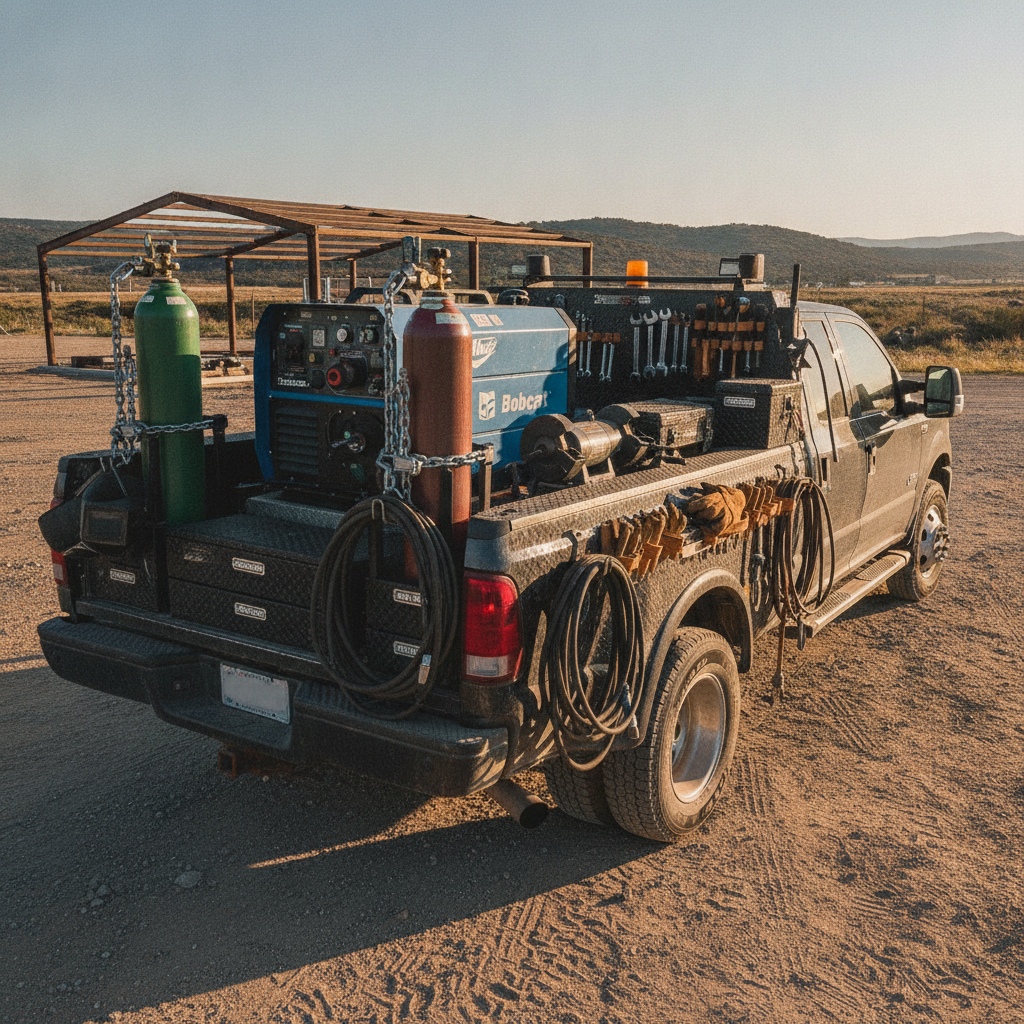
Use foam inserts, rubber matting, bungee systems, or proper racking. Your grinders should not be rolling around loose. Your rod oven should have a fixed mount. Your cylinder should be chained — always, no exceptions, ever.
The Machine Placement Question
Where your welder lives on the truck is a bigger deal than most guys think. It needs to be accessible without requiring you to climb completely into the truck. It needs adequate ventilation. And it needs to be positioned so your leads can reach your typical work area without you maxing out your cable length on a routine job.
If you’re running a newer multi-process machine — and the technology in these units has gotten genuinely impressive, especially for mobile work — placement matters even more because these machines have more connections and settings to manage. A machine that’s buried in the back of a crowded compartment is a machine you’re fighting with before you even start working.
Think about where you most commonly park relative to where you most commonly weld. Your machine placement should minimize lead runs, not maximize them.
Small Details That Make a Big Difference
Label Everything
This sounds simple because it is simple. Label your bins, label your compartments, label your cable reels. If someone else ever has to grab something off your truck — a helper, a second guy on a big job — they shouldn’t have to ask where anything is. And when you’re tired and running on your fifth job of the day, labels mean you don’t have to think. You just look.
Keep a Trash System
A small trash bag or bucket in the truck. Sounds obvious. Most guys don’t have one. Stub ends, empty packaging, used wire — it all ends up on the floor of the truck or stuffed in a compartment. Build a trash system into your rig and actually use it.
Lighting Inside Compartments
If you work early mornings, late evenings, or in any kind of low-light condition — which is basically always in the field — LED strip lights inside your service body compartments are one of the best $30 investments you’ll ever make. Seeing what you’re grabbing beats guessing every time.
How Rig Organization Connects to Your Business
Here’s the thing that guys miss when they think about truck organization. It’s not just about efficiency. It’s about perception. When a client watches you walk up to your truck and immediately grab exactly what you need without digging around, you look like a professional. You look like you’ve done this before. That builds confidence, and confidence is what gets you repeat calls and referrals.
I’ve talked before about the importance of finding and owning a strategic niche in mobile welding. A big part of owning a niche is showing up like you belong there. Your truck is part of that presentation. A sloppy rig tells a client you might be sloppy on the weld. A tight rig tells them the opposite.
If you’re in the earlier stages of building your mobile operation and trying to figure out where to invest, this post on measuring before you invest is worth a read before you spend money on equipment upgrades when your real problem is organization.
And if you’re thinking about growing beyond just a one-truck operation — the jump from garage to proper shop setup covers a lot of the business infrastructure thinking you’ll need.
A Simple Weekly Truck Reset Routine
Once your truck is organized, the goal is to keep it that way. The easiest way to do that is a weekly reset. Friday afternoon or Monday morning, whichever works for how you run your schedule. Takes about twenty to thirty minutes.
Restock consumables. Coil and hang cables properly. Pull out any trash. Check your cylinder levels. Wipe down your machine. Make sure your PPE is all present and functional. That’s it. Twenty minutes a week keeps the whole system working the way it should.
The guys who skip the weekly reset are the same guys who find themselves in a bad situation mid-job. It snowballs fast. One week of not resetting turns into a month, and now you’re back to digging through junk before every arc.
Bottom Line on Truck Setup Mistakes
The truck setup mistakes we’ve covered here aren’t glamorous problems. They’re not exciting to fix. But they’re costing you real money and real credibility every single day you let them slide. Organization isn’t a personality trait — it’s a system. You don’t have to be a naturally tidy person to have a tight rig. You just have to build the system once and maintain it.
You started your mobile welding business to make good money doing work you’re good at. Don’t let a disorganized truck be the reason you’re leaving that money on the table. Fix the truck setup mistakes, tighten up your rig, and start every job ready to weld instead of ready to dig.
The arc doesn’t wait on your mess. Get your truck sorted and get to work.