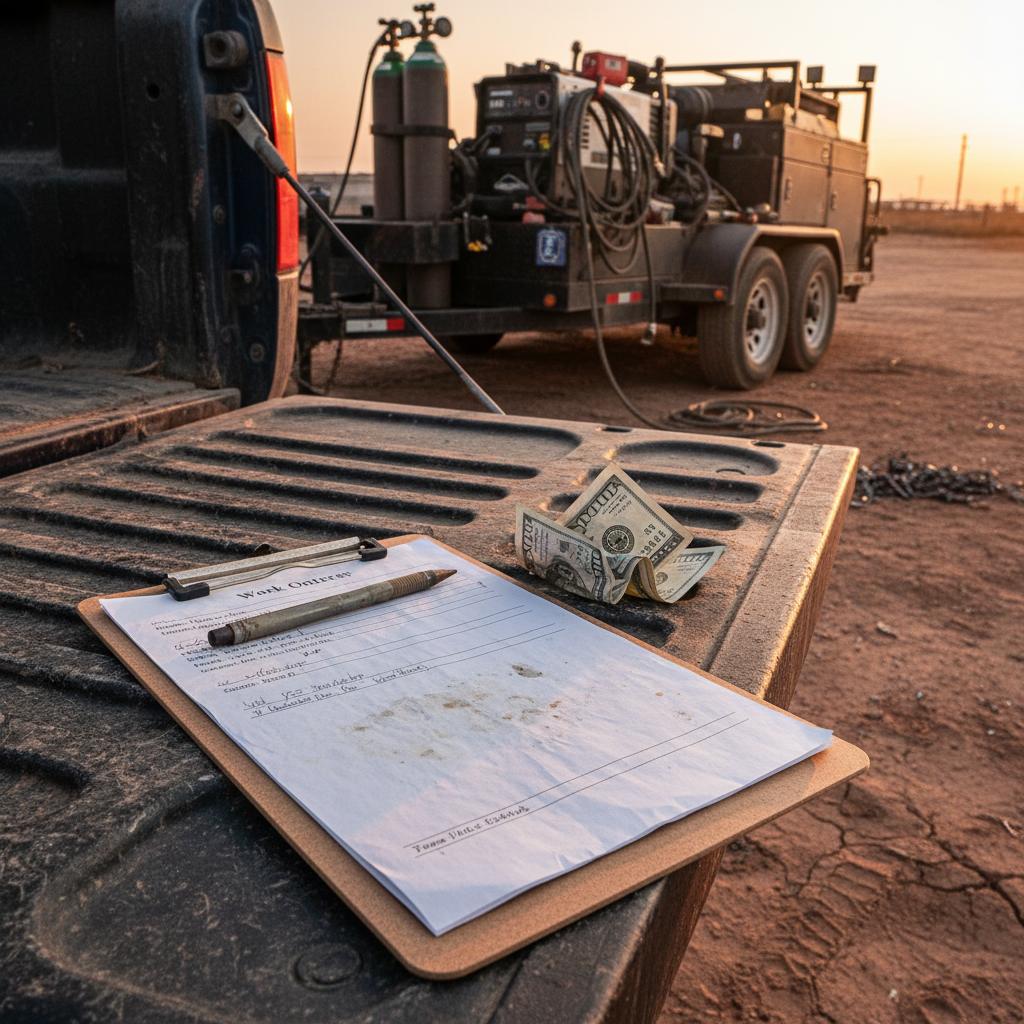
Let me tell you something about customer payment terms that took me longer to learn than it should have. Net-30 is a fantasy. It’s a polite fiction that big corporations invented so they could float their cash flow on your back. When you’re a mobile welder or small fabrication shop, giving a sketchy GC 30 days to pay you is basically handing him a free loan – one he’ll probably default on while he’s sipping coffee in Cancun.
I’ve been burned. You’ve probably been burned. Let’s talk about how to stop getting burned.
Why Net-30 Payment Terms Are a Trap for Field Welders
Net-30 works fine when you’re dealing with a Fortune 500 company with an accounts payable department and a legal team. Those guys will pay you. Maybe slowly, maybe after three phone calls, but they’ll pay you because their reputation is on the line.
Small contractors? Different animal entirely.
Here’s what actually happens with Net-30 on a small job. You finish the work. You send the invoice. The contractor says “got it, we’ll process it.” Day 15 rolls around – nothing. Day 30 – nothing. You call. He’s “waiting on his customer to pay him first.” Day 45 – now his number goes to voicemail. Day 60 – you’re drafting a letter to small claims court and explaining to your wife why you worked for free for two weeks.
Sound familiar? That’s because it happens constantly in this trade. The moment your torch goes cold and you drive off that job site, your leverage disappears with you. Customer payment terms need to be structured around that reality – not around what feels polite.
Structure Your Payment Schedule Around the Work, Not the Calendar
The fix isn’t complicated. It’s just uncomfortable to enforce until you’ve gotten stiffed enough times to stop caring about being uncomfortable.
Here’s the basic structure that works for most field welding and fabrication jobs:
Jobs Under $1,000 – Cash or Card Before You Leave
Small jobs are the worst for getting paid late. The dollar amount isn’t scary enough for the customer to feel obligated. They’ll drag their feet forever on a $600 invoice. On anything under a grand, collect payment before you pack up your gear. Period. If they argue, explain that this is your standard policy. If they walk, they were probably going to stiff you anyway.
Jobs $1,000 to $10,000 – 50% Deposit, Balance on Completion
This is your bread and butter range. Get half upfront before you show up, or at minimum before you order materials. Get the other half on the day you finish – not when you send the invoice. The day you finish. Bring your card reader. Have a payment link ready. Make it easy for them to pay you on the spot because humans are lazy and if you make them do paperwork later, they’ll procrastinate forever.
Your deposit also protects you on materials. I’ve talked about investing smart in your business before, and nothing burns cash faster than buying materials for a job that falls through because the customer walked when you asked for money upfront. The deposit separates real customers from tire-kickers instantly.
Jobs Over $10,000 – Progress Payments Are Non-Negotiable
Big jobs need milestone billing. Don’t wait until a $40,000 fabrication project is complete before you start seeing money. That’s insane. Break it into phases: mobilization deposit, rough fabrication complete, fit-up and welding complete, final inspection passed.
Each milestone triggers a payment. You don’t move to the next phase until the previous payment clears. This isn’t rude – it’s how construction has worked forever. Any legitimate contractor knows this. Anyone who fights you on progress payments for a large job is waving a red flag so big you can see it from orbit.
How to Figure Out Which Customers Get Credit
Not every customer is a flight risk. Some of them are legitimate businesses with real payment processes. Being rigid with established clients is how you lose good relationships. So here’s how I think about who gets credit and who pays upfront.
The Green Light Customers
These are companies with verifiable history. They have a real office, a real website, someone in accounting you can call by name. You’ve worked with them before and they paid on time. Large general contractors with bonding requirements, municipalities, established manufacturers – these folks can usually get Net-15 or even Net-30 from me because the risk is low. I’ve also found that customers who invest seriously in their equipment and operations – like the guys running proper hybrid battery-powered welding setups – tend to run tighter, more professional operations overall. Tools reflect habits.
The Yellow Light Customers
New customers. Small contractors. Referrals you haven’t worked with before. These folks get the 50/50 treatment regardless of how nice they seem at the estimate. Nothing personal – it’s just policy. Once they pay on time two or three jobs in a row, they can earn credit terms. Trust is built by behavior, not by a handshake and a friendly smile.
The Red Light Customers
Cash or card upfront, full stop. This category includes anyone who’s already given you a bad check, anyone who’s been weirdly resistant to signing a contract, anyone who’s complained about your pricing before the job even starts, and anyone operating from a PO box with no verifiable business address. Also: anyone who contacts you from a job they fired the last welder on. I’m not saying it’s always their fault – but I am saying collect the money before you start burning rod.
Put Your Payment Terms in Writing Every Single Time
A verbal agreement is worth exactly nothing in small claims court. Your customer payment terms need to live in a written contract or at minimum a signed estimate that spells out exactly when payments are due and what happens if they’re late.
Late fees are your friend. I charge 1.5% per month on overdue invoices. Does everyone pay the late fee? No. But it gives you something to negotiate with, and it reinforces that you’re a business – not a charity. Add a line that says you retain the right to stop work if payments are more than 7 days late. Then actually do it if needed. Stopping work is awkward. Not getting paid is worse.
If you’re still figuring out the broader business side of running your own welding operation, the post on going from garage to shop covers a lot of the foundational stuff – including why your paperwork matters as much as your puddle.
The Tools That Make Getting Paid Easier
Half the battle is making payment as frictionless as possible. If collecting money is inconvenient for the customer, they’ll delay it. Remove every excuse.
Mobile Payment Processing
Get a card reader. Square, Stripe, PayPal Here – pick one and keep it in your truck. Being able to run a card on the job site the second you finish is worth the 2.9% processing fee a hundred times over. The fee on a $2,000 job is $58. The cost of chasing a slow-pay for three months is your sanity and your cash flow.
Invoicing Software with Payment Links
QuickBooks, Wave, FreshBooks – again, pick one. Send invoices with a payment link embedded. One click and they can pay by card or bank transfer. The easier you make it, the faster it happens. Send the invoice the same day you finish the job, not a week later when you finally get around to it.
Automated Invoice Reminders
Set up automatic follow-up reminders so you don’t have to manually chase every invoice. Most invoicing software does this. A friendly automated reminder at day 7 and day 14 takes the awkwardness out of following up. By the time it hits day 21, you can personally call – because now it’s past the “forgot to pay” stage and into the “avoiding you” stage.
What to Do When a Customer Refuses Your Payment Terms
Some customers will push back. They’ll say their company policy is Net-30 or Net-60. They’ll say the owner needs to approve it. They’ll say every other welder works differently.
Here’s how you handle it: stay calm, stay firm, and be prepared to walk away.
You can negotiate. Maybe you meet a legitimate company halfway – a smaller deposit, Net-15 instead of Net-30. But if someone refuses any deposit on a large job, that’s a deal-breaker. Legitimate customers understand deposits. Only the sketchy ones act offended by them.
Walking away from bad payment terms isn’t losing a job. It’s avoiding a collection nightmare. The jobs that are the hardest to get paid for are usually the ones that were trouble from the first conversation. Your gut usually knows. Listen to it.
Knowing which customers to pursue in the first place also matters. If you’ve read the piece on strategic niches for your welding business, you know that chasing the right customer type beats fighting for every low-margin job that comes across your phone. That applies to payment risk too – some niches pay reliably, others are perpetual headaches.
Lien Rights: Your Nuclear Option
Most welders don’t use this and most don’t even know about it. In most states, if you perform work on someone’s property – real property, not just their equipment – you have the right to file a mechanic’s lien if you don’t get paid. A lien attaches to the property title, which means they can’t sell or refinance without clearing your debt first.
This is powerful. Use the threat of it strategically. You don’t always have to actually file – sometimes mentioning it in a letter is enough to get a suddenly unavailable customer to return your call. But know the deadlines in your state. Most states require you to file within 90 to 120 days of completing work. Miss the deadline and the right evaporates.
Look up your state’s lien laws. Talk to a local attorney who handles construction law for an hour-long consultation. It’s worth the investment. Pricing your services correctly in the first place also factors in – if you’re undercharging and getting stiffed, that’s a double loss. The pricing guide for welding services breaks down how to price so you’re not working for free even when everything goes right.
Build a Reputation as Someone Who Takes Payment Seriously
Here’s the long-game truth about customer payment terms: how you handle money signals how seriously you run your business. Welders who are sloppy about collecting get treated like hobbyists. Welders who have clear terms, contracts, and professional invoicing get treated like contractors.
Word gets around both ways. The GCs who know you don’t mess around on payment also know you’re serious about your craft. There’s a correlation there. The same discipline that keeps your business finances sharp shows up in the quality of your work – because chaos on the business side bleeds into chaos everywhere else.
Customers who respect your payment terms are usually the customers who respect your time, your expertise, and your work. The ones who fight you on deposits are usually the ones who’ll also fight you on the final bill, add scope without asking, and call you at 10pm on a Friday.
Choose your customers like you choose your jobs. Not every dollar is worth taking.
The Bottom Line on Getting Paid
Stop giving strangers 30 days to disappear with your money. Structure your customer payment terms around risk – big deposit for new customers, progress payments for big jobs, cash on the spot for small jobs. Put everything in writing. Make paying easy. Know your lien rights. Walk away from customers who won’t agree to reasonable terms.
It’s not complicated. It just requires you to act like a business owner instead of an employee waiting for payday.
You did the hard part – you went out on your own. Don’t let slow-pay customers undo that by treating your cash flow like their personal line of credit.