If you’ve ever cracked open a fresh can of 7018 rods on a Monday morning and realized half your stock from last week is already garbage, you know exactly why welding rod storage matters. Moisture-contaminated electrodes aren’t just an annoyance – they’re cash walking out the door. And when you’re running a field welding business on tight margins, that’s not a problem you can afford to ignore.
This isn’t theory from a catalog. This is hard-won knowledge from years of working out of a service truck in every kind of weather imaginable. Let’s talk about what actually works in the field.
Why Moisture Destroys Your Low-Hydrogen Electrodes
Low-hydrogen electrodes – your 7018s, 7016s, 8018s – are called low-hydrogen for a reason. The flux coating is specifically formulated to keep hydrogen out of your weld puddle. That’s the whole point. Hydrogen causes porosity, underbead cracking, and weld failure. Not ideal when you’re staking your reputation on structural welds.
The problem is that flux coating is hygroscopic. It pulls moisture from the air like a sponge. Leave a sleeve of 7018 sitting in a humid truck bed overnight and you’ve got electrodes that will introduce hydrogen into your welds – the exact thing the coating was designed to prevent.
Here’s what moisture-damaged rods actually cause on the job:
- Excessive spatter that wastes time on cleanup
- Porosity and slag inclusions that fail inspection
- Worm-track porosity in X-ray welds
- Underbead hydrogen cracking in high-strength steel
- Rod stub waste when you pull them and toss them halfway through a run
Any one of those issues can cost you a job, a callback, or your reputation. All of them together? That’s a business-ending scenario waiting to happen.
The Real Cost of Poor Welding Rod Storage
Let’s get honest about money for a second. Premium low-hydrogen electrodes aren’t cheap. A 50-pound can of quality 7018 runs anywhere from $60 to $100 depending on the brand and spec. If you’re running a busy mobile operation, you might burn through two or three cans a week.
Now imagine losing 20% of that inventory to moisture absorption. That’s $25-$60 per week thrown away. Over a year, you’re looking at $1,300 to $3,000 in ruined consumables. That’s not a rounding error – that’s a new rod oven, a better storage system, and still money left over.
If you’re serious about building a profitable field welding business, consumable management is part of the equation. I’ve written about choosing strategic niches and how pricing your services correctly impacts profitability – but none of that matters if you’re bleeding money on ruined rod stock before you even strike an arc.
Understanding Electrode Moisture Limits
AWS D1.1 and most electrode manufacturers give you specific exposure time limits before low-hydrogen electrodes need reconditioning. For most 7018 electrodes, that window is 4 hours maximum at ambient conditions after opening the sealed can. In high humidity – say, a coastal job site or a rainy Pacific Northwest morning – you might have less than two hours before they’re compromised.
Different electrode classifications have different tolerances:
- EXX18 (7018, 8018, etc.): Most sensitive, strictest storage requirements
- EXX16: Slightly more tolerant but still low-hydrogen
- EXX10 / EXX11 (Cellulosic): Actually need some moisture – don’t bake these
- EXX13 / EXX12: More forgiving, but still worth protecting
Know your rod classifications. Treating all electrodes the same is how you ruin a sleeve of E6010 by baking it when it doesn’t need it, or ruin your 7018 by leaving it loose in a tool bin for a week.
Rod Ovens: Your First Line of Defense
A portable rod oven is non-negotiable for serious low-hydrogen work. Full stop. If you’re not running one, you’re gambling every time you strike an arc with those rods.
Holding Ovens vs. Reconditioning Ovens
There are two types and they do different things. Don’t mix them up.
Holding ovens keep your electrodes at the right temperature after opening – typically 250°F to 300°F (120°C to 150°C) for most low-hydrogen rods. They’re not designed to bake moisture out of already-wet electrodes. Think of them as maintenance, not repair.
Reconditioning ovens run much hotter – 500°F to 800°F (260°C to 425°C) – and are designed to drive moisture out of electrodes that have been exposed. You need to check manufacturer specs for each rod type because overbaking at too high a temp can also damage the flux coating.
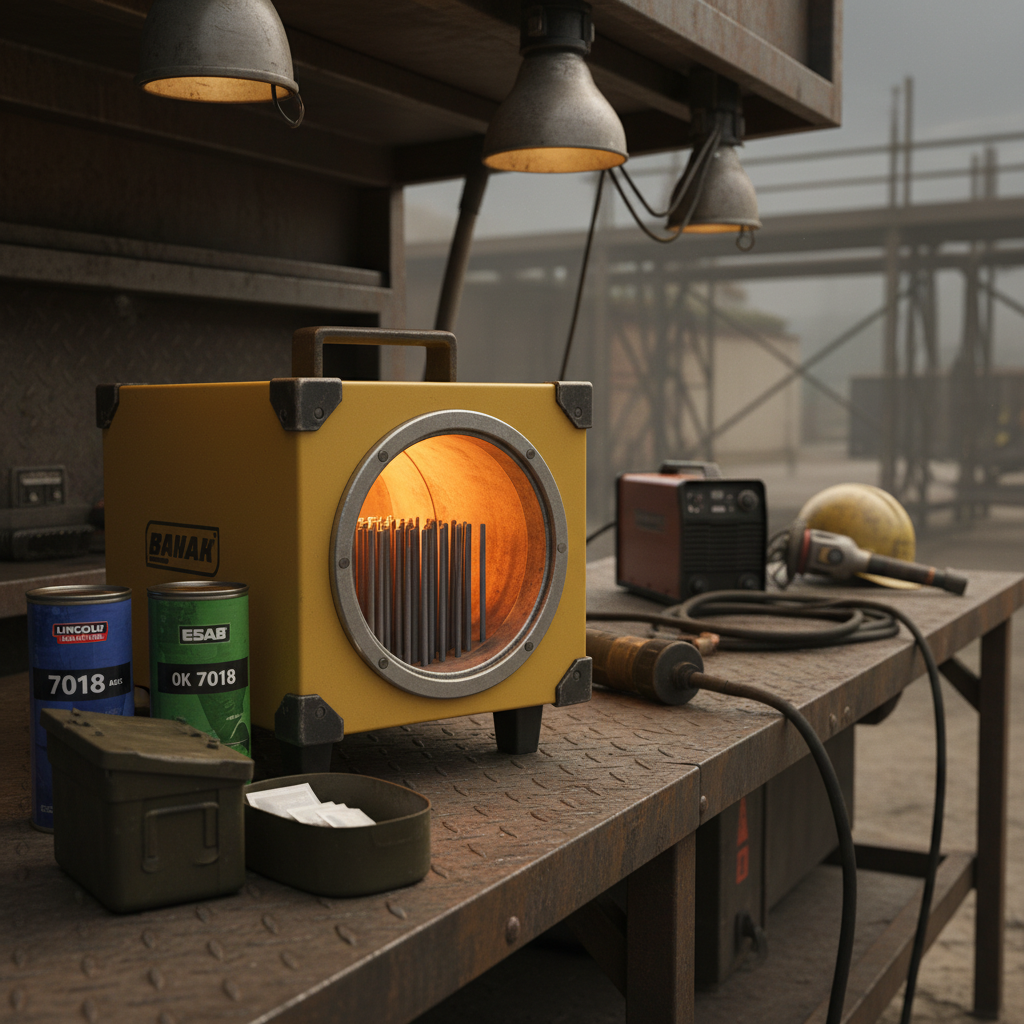
For a mobile operation, a good portable holding oven that fits in your truck is the priority. There are 10-pound capacity portable units that run on 120V or 240V that will keep your working stock in spec all day long.
Portable Rod Oven Setup for Field Work
Here’s a practical field setup that actually works:
- Keep your sealed factory cans in an airtight storage container in the truck – a metal job box with a rubber seal works fine
- Load only what you need for the day into the portable holding oven – don’t open four cans when you’ll use one
- Run the portable oven at 250-300°F starting an hour before you need those rods
- Only pull rods from the oven as you need them – don’t dump a full sleeve in your rod bag at the start of the day
- Any rods that have been out more than four hours in normal conditions go back in the oven for reconditioning or get scrapped
This workflow adds maybe ten minutes to your morning setup. That ten minutes can save you from a callback or a failed weld inspection later in the week.
Field Storage Solutions That Actually Work
Not every job has a 240V outlet waiting for your rod oven. That’s field welding reality. So here’s how you bridge the gap when you’re on a remote site or working off a generator with limited power budget.
Sealed Cans and Airtight Containers
Never open a can of low-hydrogen rod until you’re ready to use them. Sounds obvious. You’d be amazed how many guys crack a can open, grab what they need, and leave it sitting in the bed with the lid off all day.
Once opened, if you’re not putting the rods straight into a holding oven, get them into an airtight container. Military surplus ammo cans are outstanding for this – they’re cheap, tough, seal tight, and fit perfectly in a truck tool box. Throw a handful of silica gel desiccant packets in there and you’ve bought yourself significantly more working time.
Desiccant Rod Tubes
Some electrode manufacturers sell desiccant-lined storage tubes. They’re basically airtight rod holders with moisture-absorbing material built in. For smaller quantities – a dozen rods or so – these are a solid option when you’re between the oven and the job.
Replace or recharge the desiccant regularly. A saturated desiccant pack does nothing. Check them weekly if you’re working in humid environments.
Your Truck Setup Matters
Think about where your electrodes live in your service vehicle. A tool bed that’s exposed to rain, temperature swings, and humidity all day is a bad home for low-hydrogen rod. If you’re serious about building a professional operation, invest in sealed, insulated storage in your truck layout.
Speaking of truck and equipment setups – if you’re still dialing in your mobile rig, check out my breakdown of field-ready multi-process welders and the newer hybrid battery-powered welding units that are changing how mobile guys operate. Your power source setup affects everything downstream, including how you manage your rod storage.
Reconditioning Wet Rods: When It’s Worth It and When It’s Not
Can you save moisture-damaged electrodes? Sometimes. It depends on how wet they are and what you’re welding.
Mild exposure (a few hours in moderate humidity): Yes, reconditioning at manufacturer-specified temps will usually restore these rods to serviceable condition. Follow the time and temperature specs – don’t guess.
Heavy exposure (left out overnight, rained on, stored in a cooler with ice melt): Don’t bother for code work. You can try to recondition and use them for practice welds or non-critical fabs, but don’t put them on structural work or anything that gets inspected. The risk isn’t worth it.
For critical work – structural, pressure vessel, pipe – if there’s any doubt about rod condition, scrap them. The cost of a callback, a repair, or a failed inspection dwarfs the cost of a new sleeve of 7018. This is one of those areas where cutting corners bites you hard.
If you’re doing certified work, certification day tactics and maintaining proper consumable condition are directly linked. Inspectors look for this stuff. Don’t hand them an easy reason to fail your weld.
Building a Simple Rod Inventory System
Most field guys have zero inventory system for consumables. They buy a bunch of rod, throw it in the truck, and hope for the best. That’s how you end up buying rod twice because you can’t remember what you have, or discovering you’re out of 7018 on a Saturday afternoon job.
You don’t need fancy software. Here’s a basic system that works:
- Minimum stock level: Set a number for each rod type you regularly use. When you hit that number, you order more. Simple.
- Date your cans: When you open a can, put the date on it with a paint marker. First in, first out.
- Weekly check: Every Monday, do a 60-second walk through your stock. What’s open? What needs to go in the oven? What needs to be scrapped?
- Match rod to job: Don’t open a can of specialty rod for a job that doesn’t need it. If the job calls for E6011, don’t crack your 7018 because it’s easier to grab.
Proper consumable management pairs directly with smarter job costing. If you’re not already tracking your material costs job-by-job, you’re flying blind on your actual margins. I talked about this in detail in my post on measuring before you invest – the same logic applies to consumables as it does to equipment purchases.
Other Electrodes You Need to Handle Differently
Not everything is 7018. Here’s a quick rundown for common electrodes you might carry:
E6010 and E6011 (Cellulosic)
These rods need some moisture in the coating to run properly. Never bake them. Store them in a cool, dry place – not bone dry – and they’ll be fine. If you accidentally dry them out, some manufacturers say you can restore them by storing in a slightly humid environment, but honestly it’s not always consistent.
Stainless and Nickel Alloy Electrodes
Treat these like low-hydrogen rod – they’re sensitive to moisture and contamination. Store sealed, in a holding oven if possible, and handle with clean gloves. These rods are expensive enough that you definitely don’t want to ruin them through sloppy storage. If you’re doing any dissimilar metal welding, you likely have a few specialty rods on hand – treat them accordingly.
Hardfacing and Build-Up Rods
Check manufacturer specs. Most prefer dry storage similar to low-hydrogen rods, but there’s variation. When in doubt, sealed storage with desiccant and away from temperature extremes.
The Bottom Line on Welding Rod Storage
Proper welding rod storage isn’t complicated, but it does require discipline. You need a portable holding oven for low-hydrogen work – that’s the baseline. You need airtight storage for everything else. You need a basic system so you’re not flying blind on your inventory. And you need to stop rationalizing using questionable rod on work that matters.
Here’s the math one more time because it’s worth repeating: even if a proper portable rod oven costs you $150 to $200, it pays for itself in one month of prevented rod waste. After that, it’s pure savings – and cleaner welds, fewer callbacks, and a lot less frustration on the job site.
You’re building a business, not just burning rod. Treat your consumables like the profit center they are. The guys who run tight, professional operations pay attention to details like this. The guys who wonder why they can’t get ahead don’t.
Get your storage dialed in. It’s one of the cheapest ways to immediately improve your bottom line.