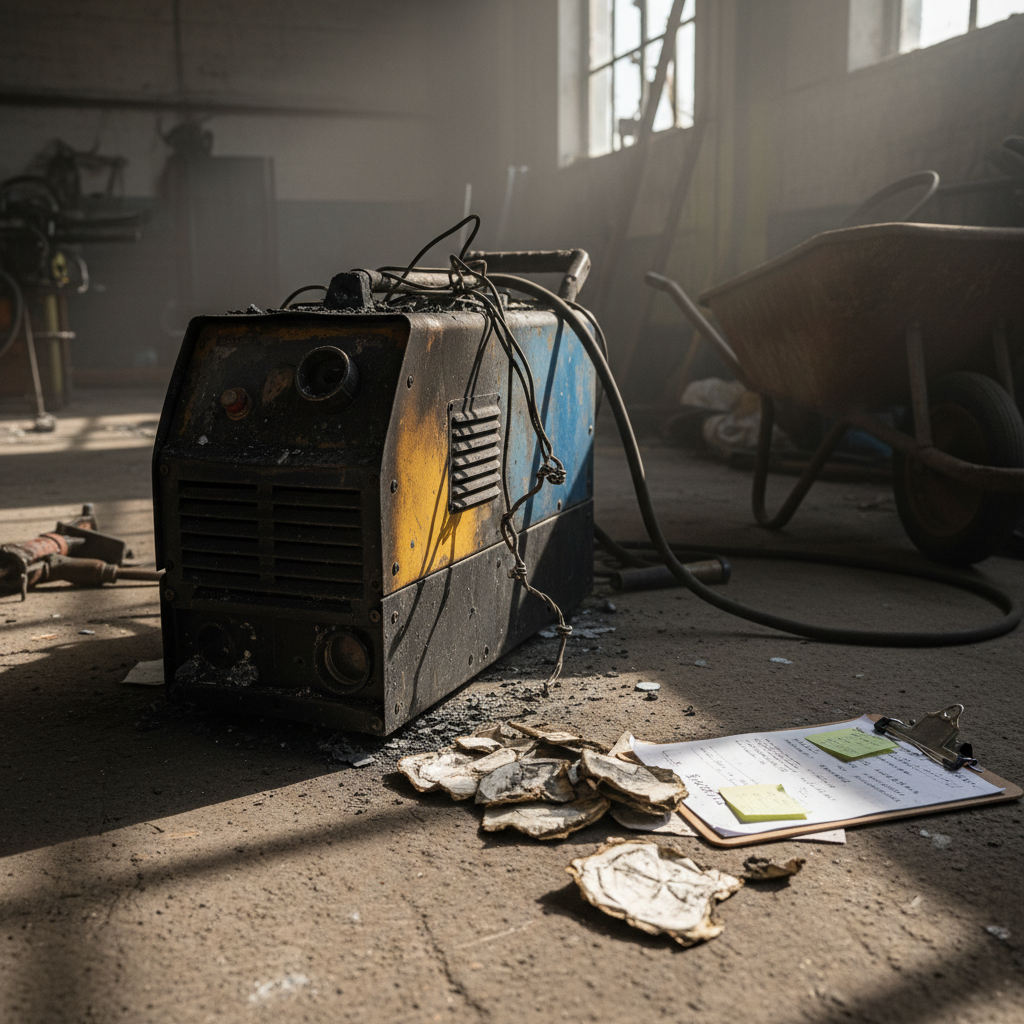
Your welder just got torched in a shop fire, or some idiot on a forklift turned your Lincoln Electric into a $200 paperweight. First instinct is to call your insurance company, expect a check, and get back to work. Then the adjuster shows up and lowballs you so hard you want to throw your helmet through a wall. Welcome to equipment damage claims – where the insurance company’s job is to pay you as little as possible, and your job is to make sure that doesn’t happen.
This isn’t a legal guide. I’m a welder, not a lawyer. But after dealing with two equipment losses in ten years – one fire, one theft – I learned some hard lessons about how to document, argue, and fight for what your gear is actually worth to your business. Let’s get into it.
Why Adjusters Low-Ball Equipment Damage Claims
Here’s the thing about insurance adjusters. They’re not evil. They’re just doing their job, and their job is to settle your equipment damage claim for as little as the policy allows. They look up your 2004 Lincoln Invertec on some salvage database, find that similar units are selling at auction for $600, and write you a check for that minus your deductible.
Never mind that your Lincoln runs perfect. Never mind that you’ve got $2,000 in aftermarket upgrades on it. Never mind that replacing it with an equivalent field-ready unit today costs $3,500 or more. That’s not their problem – until you make it their problem.
The key word you need to understand is actual cash value (ACV) versus replacement cost value (RCV). Most commercial equipment policies default to ACV, which means they account for depreciation. A 20-year-old machine, in their eyes, is worth almost nothing. If you didn’t specifically buy a replacement cost endorsement, you’re fighting uphill. But you can still fight – and win.
Start the Documentation Before You Ever Need It
I know. You’re reading this after something already went wrong. We’ll get to that. But if nothing’s happened yet, stop reading and go photograph every piece of equipment you own right now. Seriously. Put the phone down after this paragraph and do it.
Good documentation before a loss is the single biggest thing you can do to win an equipment damage claim later. Here’s what that looks like:
- Photos and video of every machine, from every angle, including serial number plates and any custom modifications
- Purchase receipts or invoices – even if you bought it used, keep that bill of sale
- Maintenance records showing the machine was well-maintained and operational
- Upgrade documentation – if you added a water cooler, a better wire feeder, or any aftermarket parts, keep those receipts
- Revenue records tying specific equipment to specific jobs and income
Store copies off-site or in the cloud. A fire that destroys your welder shouldn’t also destroy the paperwork that proves what it was worth. If you’re running a serious field operation, this documentation habit applies to everything – from your truck to your grinders to the field-ready multi-process welders you depend on every day.
What to Do Immediately After Equipment Damage
Okay. Something happened. Here’s the sequence, and the order matters.
Step 1: Secure the Scene and Document Everything
Before anyone touches anything, photograph the damage. Every angle. Wide shots showing context. Close-ups showing the specific damage. If it was a fire, photograph the machine in place before it gets moved. If a forklift hit it, photograph the machine, the forklift, and the surrounding area. Get photos of any bystanders or workers who witnessed it while they’re still on site.
Don’t let anyone haul away damaged equipment before you document it. That’s your physical evidence.
Step 2: Notify Your Insurer – In Writing
Call them, sure. But follow up every single phone conversation with an email or written letter summarizing what was said. Keep a claim diary. Write down the date, time, name of who you spoke to, and what they told you. This creates a paper trail that protects you if the story changes later. And sometimes the story changes later.
Step 3: Get Your Own Estimate
Do not rely solely on the insurance company’s appraiser. Find a reputable welding equipment dealer or repair shop and get an independent written estimate for either repair or replacement. Make sure the estimate reflects current market pricing, not auction salvage values.
If they say the machine is totaled, ask for a written explanation of why repair isn’t feasible. That report becomes part of your claim file.
How to Argue Equipment Value – And Actually Win
This is where most welders lose the fight. They accept the adjuster’s number because they don’t know how to counter it. Here’s how you build your argument.
Comparable Sales – On Your Terms
The adjuster found your machine selling for $600 at auction. You go find the same machine – or the closest equivalent – listed by dealers, on Craigslist, on Facebook Marketplace, on eBay in working condition. Print those listings. A running, well-maintained 2004 Lincoln Invertec might be listed for $1,800 to $2,500 in private sales. That’s the real market. Present those comps in writing.
Replacement Cost Argument
Even on an ACV policy, you can argue that the depreciation applied is excessive if the machine was well-maintained. Document the service history. Show that the machine had significant useful life remaining. An adjuster cannot apply maximum depreciation to a machine that was clearly in above-average condition.
Business Income Impact
Here’s one most welders completely forget. If your policy includes business interruption coverage, or if you’re pursuing a third-party liability claim against whoever caused the damage, document the income you lost while your equipment was out of service. Show the jobs you had to turn down or subcontract. Show the revenue gap. That’s real money on top of the equipment value. If you’ve been using smart heat maps for startups or any kind of business tracking tool, pull that data. It’s your ammunition.
Modifications and Upgrades
If you added a better wire feeder, cooling unit, or any other upgrade to a machine, that equipment has more value than the base model. Every modification you can document with a receipt adds to your claim. Don’t leave that money on the table.
When the Insurance Company Still Won’t Budge
Sometimes you do everything right and the adjuster still comes back with a garbage number. You have options, and they’re worth knowing about before you cash that check.
Request the Appraisal Process
Most commercial property policies have an appraisal clause. This lets both sides hire their own appraiser, and if they disagree, a neutral umpire decides. This costs money, but it forces a fair process. If the adjuster’s offer is significantly below what you can document, invoke this clause. Just doing so sometimes shakes loose a better settlement offer without going all the way through the process.
File a Complaint
Your state insurance commissioner’s office handles complaints against insurers. Filing one doesn’t automatically get you paid more, but it creates a record and sometimes motivates the insurer to resolve things faster. Insurance companies don’t like regulatory attention.
Talk to a Public Adjuster
Public adjusters work for you, not the insurance company. They take a percentage of your settlement – typically 10 to 15 percent – but they know how to maximize claims. On a big equipment loss, that fee can absolutely be worth it. Get referrals, check credentials, and make sure they have experience with commercial equipment claims, not just residential property.
Consult an Attorney
If the loss is large enough, and the insurer is acting in bad faith – meaning they’re deliberately delaying or lowballing without legitimate reason – an insurance bad faith attorney might be your move. Many work on contingency. This is the nuclear option, but sometimes it’s the right one.
Don’t Make These Mistakes
A few things that will hurt your equipment damage claim, just so we’re clear:
- Don’t sign anything quickly. Once you cash that check and sign the release, the claim is closed. Period.
- Don’t dispose of damaged equipment before the adjuster inspects it. That’s spoliation of evidence and will kill your claim.
- Don’t exaggerate. Inflating a claim is insurance fraud. Document what’s real and fight for what’s real. That’s plenty.
- Don’t miss deadlines. Policies have notice requirements and proof of loss deadlines. Miss them and you can forfeit coverage entirely.
The Business Angle – Know Your Policy Before You Need It
Look. The best time to deal with this stuff is before anything happens. If you’re building a welding business – especially if you’re hauling specialized equipment to job sites – your standard commercial auto and general liability policies probably don’t cover your tools and equipment adequately. You need an inland marine policy or a dedicated equipment floater.
Know whether you have ACV or RCV coverage. Know your deductibles. Know if you have business interruption coverage. Know the policy limits per item. You might think your $5,000 machine is covered, but if the per-item limit is $2,500, you’re out half the value before the depreciation argument even starts.
If you’re just getting off the ground and figuring out what equipment to insure, it helps to know what you’re buying. Check out the breakdown on hybrid battery-powered welders and the field-ready battery welders guide – knowing the replacement cost of modern units helps you set coverage limits that actually make sense. And if you’re still building out your business infrastructure, the from garage to shop post covers the foundational business setup stuff worth knowing before you’re dealing with a claim.
Also worth thinking about: specialty equipment. If your business runs on specialized capability – like doing certification-level work with machines that took years to calibrate and set up – the replacement cost argument is even stronger. Generic replacement isn’t always equivalent replacement. Make that case to your adjuster in writing.
The Bottom Line on Equipment Damage Claims
Insurance companies are not charities. They’re businesses, and their interest is in paying out as little as possible on every equipment damage claim. That’s not a conspiracy theory – it’s just how it works. Your job as a business owner is to document everything, know your policy, and be willing to push back with evidence.
The welders who get paid fairly aren’t the ones who get lucky. They’re the ones who treated their equipment inventory like a business asset – documented, valued, and insured correctly. And when something went sideways, they didn’t just accept the first number they were handed.
Your equipment is your livelihood. Fight for it like it is.