Liability Waivers for Welders: Stop Using That Free Template You Downloaded
You found a waiver online. It looked official enough. You slapped your business name on it, printed a stack, and figured you were covered. Then a customer’s trailer hitch failed three weeks after you welded it, and suddenly their lawyer is calling. That free waiver you downloaded from some random legal template site? It just became very expensive toilet paper.
This is the reality most welders running their own operation don’t want to think about until it’s too late. Liability waivers for welders aren’t just paperwork formalities. They’re the difference between a dispute that goes away quietly and one that drains your bank account for the next two years.
Let’s talk about what actually works, what doesn’t, and why most of what’s floating around the internet will get laughed out of a courtroom before the judge finishes his coffee.
Why Most Welding Waivers Are Basically Useless
Generic liability waivers fail for a few specific reasons. Judges and opposing counsel have seen them all. Courts don’t exactly roll out the red carpet for boilerplate language that clearly wasn’t written with any specific trade in mind.
Here’s what sinks most of them:
- Vague scope of work. If the waiver doesn’t clearly define what work was done, a customer’s attorney will argue the waiver doesn’t apply to the specific failure point.
- No acknowledgment of risk. A waiver that doesn’t explain what risks the customer is accepting is essentially meaningless. Courts want to see informed consent, not just a signature on a form nobody read.
- Missing state-specific language. Waiver enforceability varies dramatically by state. What holds up in Texas might get thrown out in California before you finish explaining yourself.
- No witness or notarization requirement. Depending on your state and the dollar value of the work, a witnessed signature matters more than you think.
- Gross negligence carve-outs aren’t addressed. Almost every jurisdiction refuses to enforce waivers that try to waive liability for gross negligence or intentional misconduct. If your waiver tries to cover everything including the kitchen sink, it may void the entire document.
In short — a bad waiver can actually be worse than no waiver because it gives you a false sense of protection while the actual gaps remain wide open.
What Strong Liability Waivers for Welders Actually Include
A waiver that holds up isn’t magic. It’s just specific, clear, and written like someone with a brain drafted it. Here’s what you need in there.
1. A Detailed Description of the Scope of Work
Don’t write “welding services.” Write exactly what you did. “Welded rear receiver hitch to 2018 Ford F-250 frame using E7018 electrode, SMAW process, per customer specifications and direction.” The more specific, the harder it is for opposing counsel to argue the waiver doesn’t apply to the exact thing that went wrong.
This matters especially for mobile welders. When you’re doing field repairs on equipment you didn’t design, didn’t spec, and sometimes can barely inspect properly, the scope description becomes your first line of defense. It proves you did exactly what was asked — nothing more, nothing less.
2. An Explicit Assumption of Risk Statement
The customer needs to acknowledge — in plain language — that welding on existing structures, equipment, or materials carries inherent risk. They need to understand that weld quality can be affected by base metal condition, previous repairs, hidden contamination, and factors outside your control.
If you’ve been thinking about expanding into more complex materials, the legal exposure grows with the complexity. Dissimilar-metal welding work in particular creates situations where base material behavior is unpredictable — your waiver needs to reflect that reality explicitly.
3. A Clear Limitation of Liability Clause
This is where most cheap templates wimp out. A limitation of liability clause caps what you can be sued for. Typically, this limits your liability to the cost of the original services performed. So if you charged $400 to weld a piece of equipment, your maximum exposure is $400 — not the $40,000 in consequential damages the customer claims when that equipment later failed during a job.
Courts will often enforce these caps. They won’t always, but having one is infinitely better than having none.
4. A Consequential Damages Exclusion
Separate from the limitation of liability, you want explicit language excluding consequential, incidental, and punitive damages. This means lost income, equipment downtime costs, replacement rental costs — the stuff that multiplies a $500 repair into a $50,000 lawsuit. Get this language in there clearly and specifically.
5. A “Customer-Directed Work” Acknowledgment
If the customer told you what to weld, how to weld it, or insisted on skipping proper prep — you need them to acknowledge that in writing. This one saves mobile welders constantly. Customers who demand fast field fixes on questionable material, then act shocked when it doesn’t hold forever, are a very specific breed. Document their direction. Make them own it.
6. Inspection and Acceptance Language
The waiver should include a statement that the customer inspected the completed work, found it acceptable, and accepted delivery. This closes the loop. It prevents the “I never approved this” defense three months later when something unrelated to your weld becomes your problem.
The Gross Negligence Problem — Don’t Overreach
Here’s where welders get greedy with their waivers and torpedo the whole thing. You cannot — in any jurisdiction — waive liability for your own gross negligence. Period. Courts will void that provision, and in many states, voiding one provision voids the entire agreement.
So don’t try to waive everything. Be surgical. Waive ordinary negligence, limit liability to the job value, exclude consequential damages, and document customer-directed decisions. That’s a defensible waiver. Trying to absolve yourself of absolutely everything is a red flag to any judge.
Your waiver should be the thing that protects a legitimate dispute. It shouldn’t be your plan for getting away with shoddy work. Those are very different documents.
State Law Matters More Than You Think
This isn’t the part where I tell you which states are friendly and which aren’t — because that changes with case law and I’m not your attorney. But what I will tell you is this: if you’re running a welding business and operating across multiple states, you need a lawyer in each state where you do significant volume to review your waiver language.
California, for example, has courts that are notoriously skeptical of broad liability waivers. Texas gives you a bit more room. Louisiana operates under a completely different legal framework than the other 49 states. What works in Montana might not work in New Jersey.
Spend the $300-500 on a local attorney to review your waiver. Do it once. You’ll use that document for years. Compare that to the cost of even a small civil lawsuit — attorneys’ fees alone start at $5,000 before you get anywhere near a courtroom. The math isn’t complicated.
How to Actually Get Customers to Sign It
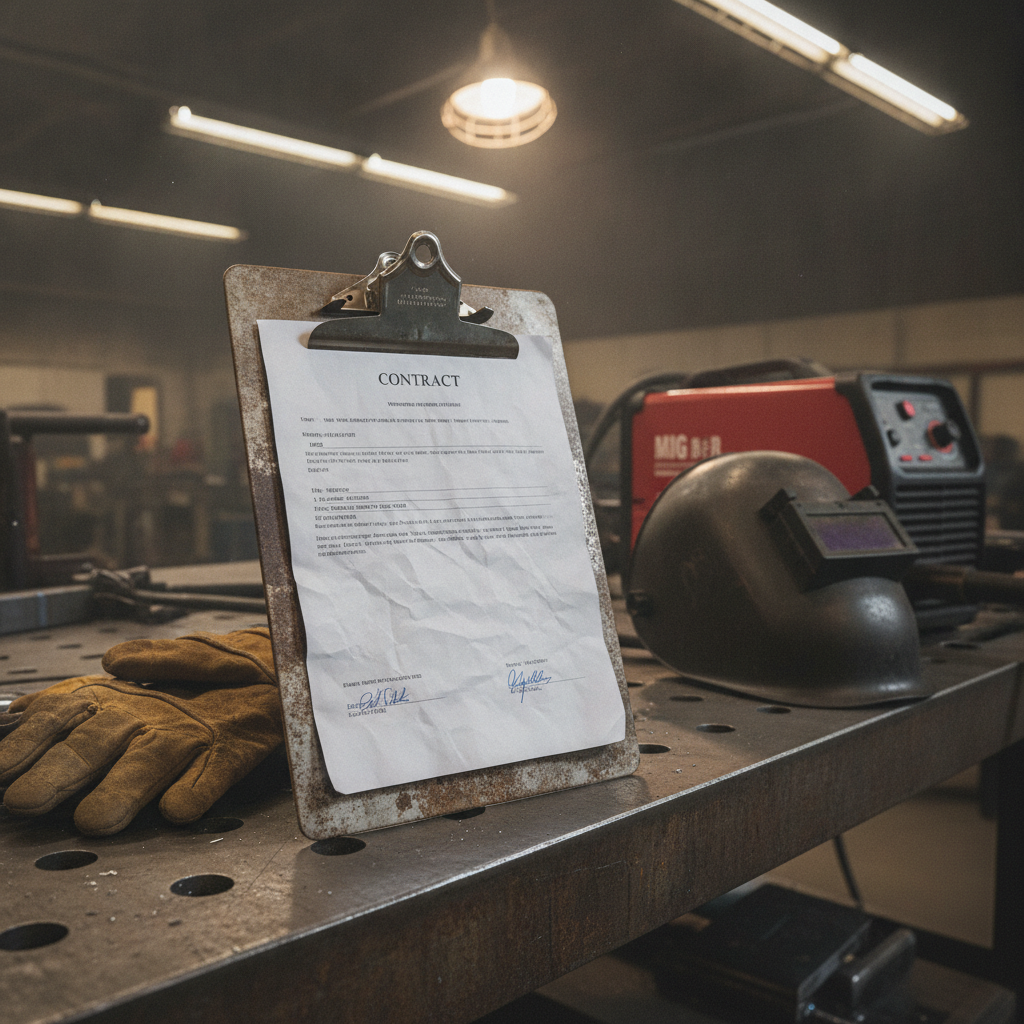
A waiver that never gets signed is a Word document on your laptop, not legal protection. Getting customers to sign without creating friction is a skill unto itself.
First, make it part of your standard quoting process. When you’re still figuring out how to price your certification services and general work, build the waiver review into your intake process. It becomes normal. It’s not something you spring on people after they’ve already agreed to hire you.
Second, frame it professionally. “This is my standard service agreement that covers both of us” lands better than “I need you to sign this liability waiver before I’ll touch your equipment.” One sounds like business. The other sounds like you already expect something to go wrong.
Third, use digital signature tools. DocuSign, HelloSign, or even a basic PDF signature on a phone. When you’re in the field — and if you’ve built the kind of mobile operation that runs efficiently, like the setups I’ve covered when talking about getting your shop off the ground — you need paperwork that moves as fast as you do. Email the document before you arrive. Have it signed before you unload the truck.
Don’t accept verbal agreements on jobs with any meaningful liability exposure. Just don’t. The customer who seemed reasonable when he agreed on the phone is a completely different person when something goes wrong and his buddy told him he could sue you.
What to Do When Work Has Already Started
This is an uncomfortable situation. You’re halfway through a repair, customer hasn’t signed anything, and now you’re thinking about it. First — stop getting into this position. But if you’re already there, here’s your play.
Pause the work. Tell the customer you need to complete paperwork before continuing. Yes, this is awkward. Yes, they’ll be annoyed. That annoyance costs you nothing. An unsigned job that results in a lawsuit costs you everything.
Some welders think that because work has started, a signed waiver after the fact doesn’t apply to work already done. That’s partially true. But a signed document acknowledging the work completed, its condition, and customer acceptance still provides meaningful protection — especially combined with photos of the completed work and any pre-existing conditions you documented before starting.
Speaking of documentation, photos are your backup waiver. Date-stamped photos of the material condition before you touched it, the completed weld, and anything unusual you noted. These won’t replace a proper waiver but they’ll save you more times than you’d want to count.
When You’re Working Specialized Niches, The Waiver Gets Specialized Too
If you’ve followed my take on strategic niches for welding businesses, you know that specialization increases your revenue potential significantly. But it also changes your liability exposure in ways a generic waiver won’t address.
Structural welding on trailers, lifts, or load-bearing equipment carries different risk than cosmetic fabrication on a truck bumper. Agricultural equipment repairs on harvesting machinery during peak season carries consequential damage exposure that’s enormous if something fails during a critical window. Motorsport fabrication carries personal injury risk profiles that are a different category entirely.
Your waiver language needs to reflect the specific risks of the work you actually do. A roll cage builder’s waiver is not the same document as a farm equipment repair waiver. If you’re using one generic form across every type of job, you’ve already got a problem. Get specific language drafted for each service category where your liability profile is meaningfully different.
The Waiver Doesn’t Replace Carrying Real Insurance
Let me be blunt about this: a liability waiver is not a substitute for general liability insurance. It’s a layer of protection on top of your insurance, not instead of it. Any mobile welding business operating without GL coverage is gambling with everything they’ve built.
Good insurance plus a solid waiver gives you overlapping protection. The waiver reduces the chances a claim ever reaches your insurance. The insurance protects you if a claim gets past your waiver. Together, they’re how real businesses operate. Separately, either one alone leaves gaps you do not want to find out about the hard way.
Think of your business the same way you’d think about the equipment you run in the field. The guys who read up on field-ready multi-process welders aren’t carrying redundant gear for fun — they’re carrying it because jobs don’t wait for equipment failures to be convenient. Your business protection works the same way. Redundant layers aren’t paranoia. They’re professionalism.
The Bottom Line on Liability Waivers for Welders
You’ve spent years getting good at the actual work. Don’t let the paperwork side of your business be an afterthought. The jobs that go sideways aren’t always your fault — base metal fails, customers misrepresent what they need, previous repairs hide problems you couldn’t have known about. None of that matters if you don’t have documentation that protects you when fingers start pointing.
Liability waivers for welders that actually work are specific, state-appropriate, professionally reviewed, and signed before work begins. They don’t try to do too much, they don’t waive gross negligence, and they document exactly what was done and who directed it.
Get a real attorney to look at yours. Do it this week, not after the first time you need it. The welding business is hard enough without losing a fight you could have won with $400 worth of legal review and a PDF file.
You’re good enough at the work to be running your own operation. Be just as serious about protecting it.