Let me ask you something. Every job you finish, what happens to the cutoffs? The steel drops, the pipe stubs, the aluminum shavings, the stainless offcuts? If your honest answer is “they go in the dumpster” or “they get kicked under the trailer,” then congratulations — you’re running a scrap metal side hustle for free. For someone else. The scrap yard down the road thanks you for your generosity.
I’ve been doing mobile welding and fabrication work for over a decade. One thing I figured out embarrassingly late in the game is that the metal you’re already generating on every single job is worth real money. Not life-changing money. But beer money, truck payment money, “pay the insurance without crying” money. And you don’t have to do any extra work to generate it. It already exists. You just have to stop throwing it away like an amateur.
This post is going to walk you through exactly how to run a proper scrap metal side hustle as a working welder — without it becoming a second job or a fire hazard in your driveway.
Why Most Welders Leave Scrap Money on the Table
There are a few reasons welders don’t bother with scrap, and every single reason is bad logic.
Reason one: “It’s not worth the trip.” That one depends entirely on whether you’re being smart about accumulation. One job’s worth of cutoffs? Sure, probably not worth driving across town. Three weeks of sorted, separated metals? Now you’re talking $80–$200 depending on what you’ve got and your local market. That’s a real trip worth making.
Reason two: “I don’t have space.” You have a work truck or a trailer. You have a shop, even if it’s a garage. Space is a solvable problem and I’ll get into that shortly.
Reason three: “It’s too much hassle to sort.” This one I actually understand. But the trick is to sort as you go, not all at once at the end. Spend 60 seconds at the end of every job separating your metals. That’s all it takes. Doing it all at once at the end of the month is what makes it feel like work.
The bottom line is that most welders ignore scrap because it feels small. But small adds up. If you’re already interested in finding ways to pad your monthly margins, check out how to identify strategic niches that can push your shop into higher-paying territory overall.
Know What You’ve Got: Metal Types and What They Pay
Not all scrap is created equal. This is the part most people get wrong. They throw everything into one bin, haul it to the yard, and get paid the lowest blended rate on the entire load. Don’t do that.
Here’s a rough breakdown of what you’re likely generating as a working welder and what the scrap yard actually values:
Steel and Iron
This is your bread and butter volume metal. Structural steel drops, angle iron offcuts, pipe stubs — all of it goes in the steel pile. Prices fluctuate but you’re typically looking at $0.05–$0.15 per pound on a good day. Not glamorous, but it’s heavy. A truck bed full of steel adds up fast.
Aluminum
Now we’re talking. Aluminum scrap typically pays $0.40–$0.80 per pound and sometimes higher depending on alloy and market conditions. If you’re doing any aluminum fabrication work — trailer builds, toolboxes, marine stuff — you want to separate every piece of aluminum immediately. Don’t let it contaminate your steel pile. Keep a dedicated bin just for aluminum.
Stainless Steel
Even better. Stainless is one of the best-paying metals at the scrap yard, often $0.50–$1.00+ per pound. Food service equipment, exhaust work, marine fabrication — if you’re touching stainless, you should be treating every offcut like it’s worth something. Because it is. If you’re doing dissimilar-metal welding work, you’re probably already handling stainless and aluminum on the same jobs. Keep them separated from day one.
Copper and Brass
Welders don’t generate a ton of copper, but if you do HVAC work, plumbing, or electrical enclosure fabrication, you might have more than you think. Copper scrap regularly pays $2.50–$4.00 per pound. A small amount goes a long way. A coffee can of copper wire scraps is worth real money. Treat it accordingly.
Mixed/Contaminated Metal
This is what you get paid the worst rate for. Painted steel, metal with rubber gaskets still attached, mixed metals thrown together — the yard will take it, but you’ll get pennies. Take the time to clean up your loads. Pull out the garbage. It costs you nothing but a few minutes and it directly affects your payout.
The Storage System That Doesn’t Eat Your Shop
Here’s the real reason welders don’t run a proper scrap metal side hustle — they don’t have a system, so the scrap just becomes chaos. Piles of random metal everywhere, taking up space, becoming a tripping hazard. I’ve been there.
The fix is simple and it costs almost nothing.
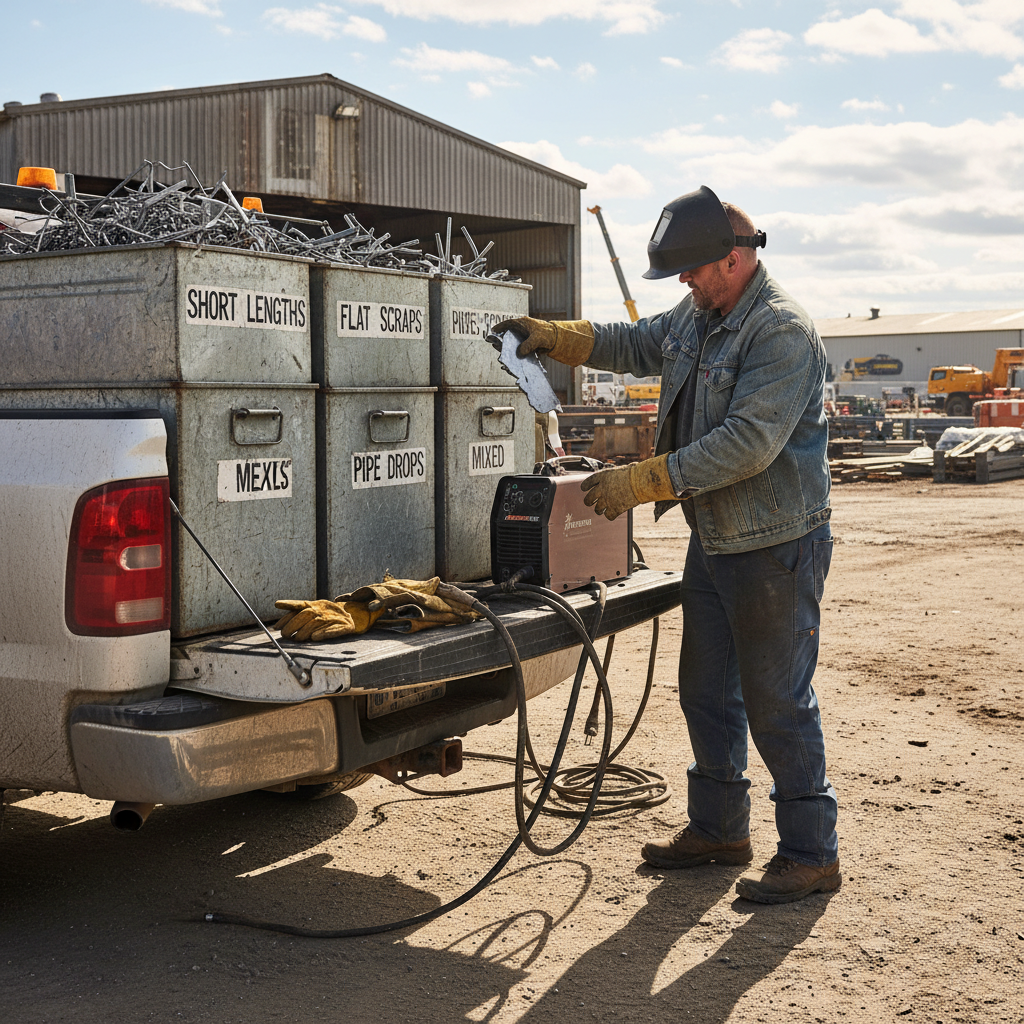
Get yourself three to five dedicated containers. These don’t need to be fancy. 55-gallon drums cut in half work great. Old steel trash cans. Plastic totes for lighter materials. Label them clearly: Steel, Aluminum, Stainless, Copper/Brass, and one catch-all for “figure it out later.”
Put these in one corner of your shop or in a designated spot on your trailer. Make it a habit — every job, before you pack up, the scraps go in the right bin. Not on the floor. Not in a random pile. In the right bin.
When a bin is full, it goes to the yard. That’s it. That’s the whole system.
If you’re working out of a garage and space is tight, think vertical. Stack bins, use a corner shelf system, or mount collection points on walls. If you’re transitioning from a garage setup into something bigger, the post on going from garage to shop has some good thinking on how to set up your space as a real operation.
Scrap Yard Basics: Don’t Show Up Like a Tourist
If you’ve never sold scrap before, here’s what you need to know before you roll up to the yard looking confused.
Bring your ID. Every legitimate scrap yard requires government-issued ID to sell. They’re required by law in most states to track purchases. No ID, no sale. Don’t forget it.
Call ahead on pricing. Scrap metal prices change daily. Before you make a trip, call the yard and ask for current prices on what you have. Takes two minutes. Saves you from getting surprised.
Weigh your loads at home if you can. If you have a truck scale or even a bathroom scale for smaller loads, weigh your materials before you go. Know roughly what you’re bringing. This helps you verify you’re getting paid correctly at the yard.
Build a relationship with one yard. Just like any business relationship, regulars get treated better. If you show up consistently with clean, sorted loads, the guys at the yard notice. Some yards offer slightly better rates to regular commercial customers. It doesn’t hurt to ask.
Keep records. This is income. Write it down. If you’re running a legitimate welding business, your scrap income is taxable and it should show up in your books. On the flip side, it’s also a small offset to material costs. Talk to whoever handles your business accounting.
Maximizing Your Scrap Metal Side Hustle Without Extra Work
The whole point here is that this doesn’t become a second job. Here are a few habits that keep the money coming without the headache.
Negotiate Material Ownership on Big Jobs
On larger fabrication contracts, offcuts legally belong to whoever owns the material — often the customer. But on many jobs, especially custom fabrication work, the customer doesn’t want the scraps. Ask upfront. Get it in writing or at minimum acknowledged verbally. “Any material cutoffs — those stay with me, that alright?” Most customers say yes without thinking about it. Now you’ve legitimately claimed the metal before the job even starts.
Offer Scrap Removal as a Selling Point
Some customers — contractors, small manufacturers, farms — generate their own metal scraps and have no system for dealing with them. You can offer to haul their scrap as part of your service or even as a separate arrangement. You become their scrap removal solution. You get free metal to sell. Everyone wins. This is especially easy to work into your pitch if you’re already thinking about how to price your services in a way that adds value beyond just the weld itself.
Track Your Scrap Income Monthly
Start keeping a simple log. Date, metal type, weight, price per pound, total payout. Doesn’t need to be complicated — a notes app on your phone works fine. After three months you’ll have real data on how much your scrap hustle is actually generating. Most welders who start tracking this are surprised. $100–$400 per month is realistic for a busy mobile welder. Some guys doing heavy fabrication with lots of aluminum and stainless are clearing more than that.
Know When to Sell vs. Stockpile
Scrap metal prices are commodity-driven. They go up and down with steel markets, manufacturing demand, and even global economic conditions. If you have storage space and you’re seeing unusually low prices, it’s not the worst idea to hold your aluminum or stainless and wait for a better market. Steel is heavy and low-value enough that you probably just want to move it regularly. But higher-value metals are worth a little patience.
The Bigger Picture: Every Revenue Stream Matters
Running your own welding operation means every dollar counts. The margins on mobile work aren’t always fat. Fuel costs, consumables, equipment wear, insurance — it all eats into what you bring home. A scrap metal side hustle isn’t going to make you rich, but it’s genuinely free money from work you’re already doing.
Think about the bigger picture of how you’re running your business. Are you using your equipment efficiently? Are you tracking where your costs are going? If you’re doing a lot of multi-material work and burning through consumables faster than you’d like, reading up on adaptive multi-material welding approaches might help you cut waste on the process side too.
Similarly, if you’re investing in newer equipment, knowing what tools actually deliver ROI on the job site matters. Posts like the breakdown on field-ready multi-process welders can help you make smarter equipment decisions — and better equipment means less rework, less waste, and cleaner cutoffs that are actually worth more at the yard.
And if you’re working toward certifications to open up higher-paying work, every bit of extra monthly income helps you stay financially stable during the slower periods. The certification readiness calendar is worth bookmarking if you’re planning that path.
Start This Week. Seriously.
You don’t need to overthink this. Here’s what to do before your next job:
Go find three containers. Label them Steel, Aluminum, and Stainless. Put them somewhere you’ll actually use them. Then on your next job, take 60 seconds at pack-up to sort your cutoffs into the right bins instead of the dumpster.
That’s the whole start. Do it consistently for a month, haul your first load to the yard, and see what you get. My bet is you’ll never go back to kicking your scraps under the trailer.
Running a scrap metal side hustle alongside your welding business isn’t a hustle in the grind-culture sense. It’s just not being wasteful. It’s treating your operation like a real business where every input has value and nothing leaves the job site without earning something first.
The metal’s already there. You already did the work to buy it, cut it, and generate it. Might as well get paid for it twice.