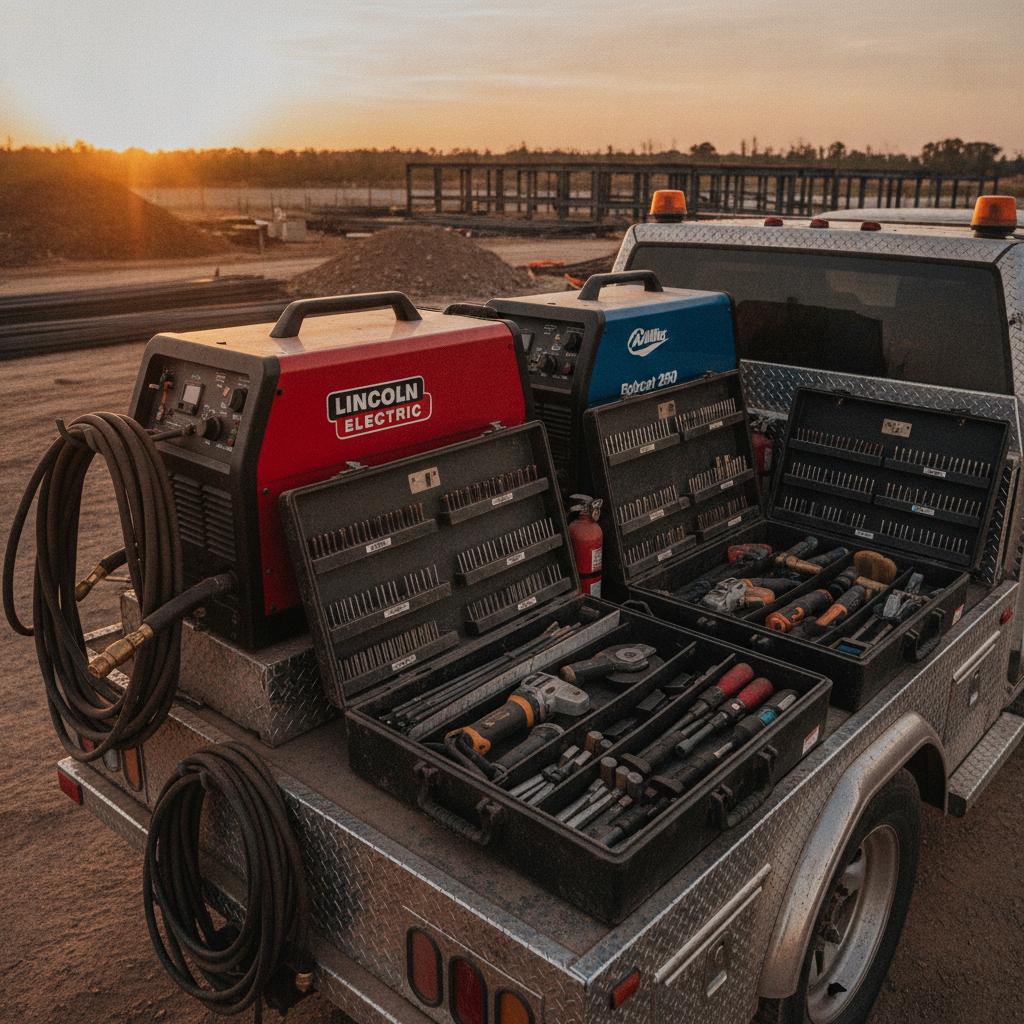
Let’s talk about truck setup mistakes — specifically the ones that make you look like you rolled out of bed, threw your gear in the bed, and hoped for the best. Because if you’re digging through a pile of cable, loose fittings, and last week’s lunch wrapper just to find a 3/32 rod holder, you are not running a business. You’re running a yard sale on wheels. And every minute you spend rooting around in that truck is a minute you’re not billing for.
I’ve been doing this for over a decade. I’ve seen rigs that would make a shop foreman cry. I’ve also seen setups so tight and organized that the welder was striking an arc ten minutes after pulling up on site. The difference between those two guys isn’t talent. It’s not even experience. It’s how they loaded the truck that morning.
This post is about fixing the dumb stuff. The stuff that’s costing you real hours every single week.
Why Truck Setup Mistakes Are a Business Problem, Not Just an Annoyance
Here’s the math nobody wants to do. Say you’re billing $95 an hour. You spend 20 minutes per job digging around for gear, reconfiguring your setup, or realizing you loaded the wrong consumables. That’s about $32 a job. Do five jobs a week and you just handed $160 back to the customer without knowing it. That’s over $8,000 a year in lost billing time.
That’s not a rounding error. That’s a truck payment.
Organization isn’t about being neat for the sake of it. It’s about making sure every minute on that job site counts. If you’re serious about building a mobile welding business — and I’m guessing you are since you’re reading this — then your rig is your shop floor. Treat it like one.
If you’re still figuring out how to price your time right, take a look at this breakdown on pricing for certification services. Same principles apply: your time has a number on it, and wasted time subtracts directly from your profit.
Mistake #1: No System for Cable Management
This is the big one. Tangled lead cable is the number one time killer on a mobile rig. You pull up, pop the lid, and spend the first fifteen minutes of your job untangling 50 feet of welding lead like you’re unwrapping Christmas lights in December.
Fix it. Get a reel. Mount it properly. If you can’t afford a powered cable reel right now, at least get a manual crank reel bolted down where it won’t slide around. The goal is: one motion to deploy the lead, one motion to retrieve it. That’s it.
A few things that actually work:
- Mount your lead reels on the side of the truck or on a swing-out bracket — not loose in the bed.
- Run your ground cable on a separate reel from your stinger lead. Mixing them is how you get tangles.
- Label both ends of every cable. Sounds stupid until you’re working in the dark and grabbing the wrong one.
If you’re running a multi-process machine, cable organization gets even more critical. More processes means more leads, and more leads means more opportunities to create a rats nest. Check out the field-ready multi-process welder guide for some notes on how different machines handle lead routing in mobile setups.
Mistake #2: Consumables Stored Like a Junk Drawer
Your rods, wire, tips, nozzles, and liners shouldn’t be living in a plastic grocery bag at the bottom of a toolbox. That’s not a consumables system. That’s a treasure hunt.
Set up dedicated storage for consumables and don’t deviate from it. Here’s what that looks like in practice:
- A dry rod oven or airtight rod tube mounted in a fixed, easy-access spot — not rattling around loose.
- Wire spools stored upright, protected from moisture and road grime. A spool cover costs almost nothing and saves you from feeding contaminated wire into a root pass on a structural job.
- Tips, nozzles, and contact tips in labeled bins. One bin per process. Not one pile of everything.
You should be able to reach in and grab the right consumable in under 30 seconds. If you can’t do that, something is wrong with the layout.
Also — and I cannot stress this enough — know what you have before you leave the shop. Running out of 6010 at the end of a job because you didn’t check your stock is a beginner mistake. If you’re doing structural work or running multiple processes in the field, keep a job-specific consumables kit ready to grab as a unit. Pre-staged, pre-counted, pre-labeled.
Mistake #3: Gas Cylinders Not Secured or Accessible
Two separate problems here. First: unsecured cylinders are a safety issue and a liability. If you’re driving around with a loose CO2 tank rolling around your truck bed, you’re one hard brake away from a serious problem. Chain them. Always. Two points of contact minimum.
Second: cylinders that are technically secure but buried behind everything else. You shouldn’t need to unload half the truck to swap out a cylinder. Think about your access when you load. Cylinders that get used most should be easiest to reach.
If you’re working with mixed gases or running TIG alongside MIG on the same truck, your gas management setup needs to be deliberate. Smart shielding gas management has some solid thinking on this — worth a read if you’re juggling multiple processes on the road.
Mistake #4: Your Machine Is Too Hard to Get To
The welder itself needs to be accessible from the side or rear of the truck without climbing in or moving other gear. If you’ve got your machine wedged in a corner under a tarp under your grinders under your toolbox, you’ve made a mistake in the load plan.
Machine placement should account for:
- Access to the wire feed or rod compartment without bending yourself in half
- Panel visibility — you need to read the settings without a flashlight and a contortionist act
- Ventilation — machines sitting in enclosed spaces with no airflow run hot and fail faster
- Power cable routing — clean, short runs to your generator or truck power
If you’re running a battery-assisted or hybrid machine, placement matters even more because of battery heat management. The hybrid battery-powered welder breakdown covers some of the specifics around placement and airflow that translate directly to truck setup.
Mistake #5: Tools Scattered Instead of Staged
Every job has a set of tools you use every single time. Angle grinder. Wire brush. Chipping hammer. Measuring tape. Clamps. Markers. These shouldn’t be in five different places on the truck. They should be in one spot, staged as a kit, ready to grab as a single unit.
Think about it like a paramedic kit. When they show up on a call, they’re not hunting around the ambulance for the defibrillator. Everything is staged and in its place because seconds matter. Your setup time might not be life-or-death, but the principle is the same.
Build a go-kit. A single bag or tote that has your everyday hand tools, ready to carry to the work site. You shouldn’t have to make three trips to the truck before you can start fitting up a joint.
Mistake #6: No Layout Logic — Just Loading Whatever Fits
This is the root cause of most other mistakes. People load their trucks the same way they pack for a camping trip — just throw it in and figure it out later. That works for camping. It does not work when someone is standing there watching you dig through your rig for ten minutes.
Good load logic follows one rule: the order you unload should match the order you work. First thing you need should be last thing loaded. Here’s a rough sequence most mobile welders follow:
- Safety gear (glasses, gloves, helmet) — always accessible, always in the same spot
- Grinder and prep tools — out first, used before any welding starts
- Clamps and fit-up tools — needed during fitup, before you run leads
- Leads and cables — deployed once fitup is done
- Consumables kit — at the machine, ready when the arc starts
- Cleanup tools — back at the end, put away last
This isn’t complicated. But it requires you to think about the workflow before you load, not after you arrive. That fifteen minutes of planning at the shop saves you thirty minutes of fumbling on the job.
Mistake #7: Ignoring the Wear-and-Tear Audit
Your truck setup isn’t static. It gets beat up. Bins crack. Mounts loosen. Bungees dry out and snap. If you’re not doing a regular walk-around and check of your rig setup, you’ll slowly drift back into chaos without noticing it.
Once a week, spend ten minutes. Check that everything is where it belongs. Replace anything that’s broken. Tighten anything that’s loose. It takes less time than the alternative, which is spending twenty minutes on a job site figuring out why your rod tube fell apart somewhere on the highway.
This same discipline applies to your whole business operation. Knowing where you are, what’s working, and what needs fixing is how you stay profitable. The smart heat maps for startups post talks about tracking business efficiency in a similar way — identifying where time and money are actually going versus where you think they’re going.
The Setup That Makes You Look Like a Pro
Here’s the truth: customers notice your rig. They don’t know enough about welding to judge your bead from twenty feet away. But they absolutely notice whether you pulled up organized and got to work, or whether you spent half an hour getting your act together before you touched any metal.
Perception matters in this business. Especially when you’re new to it or trying to grow. A tight, organized rig signals that you’re competent, professional, and worth what you’re charging. A rolling junk pile signals the opposite, even if your weld quality is excellent.
If you’re building a mobile operation from scratch or trying to figure out how to position yourself, the strategic niches post has some good thinking on how mobile welders differentiate themselves. Your rig presentation is part of that brand, whether you think about it that way or not.
Quick Wins You Can Do This Weekend
You don’t have to rebuild the whole rig in one shot. Start with these:
- Label everything. Every bin, every drawer, every spot on the truck where something lives. Thirty minutes with a label maker changes everything.
- Consolidate consumables. Pull everything out and reorganize into labeled bins by process. Throw away anything expired or damaged.
- Fix one cable problem. If your cables are a mess, pick the worst one and solve it this weekend. One reel, one bracket, one proper solution.
- Build your go-kit. Gather your everyday hand tools into a single bag. That’s it. Stop making multiple trips.
- Do a timed dry run. Pull up somewhere, set a timer, and see how long it actually takes you to be arc-ready. That number will motivate you.
Bottom Line on Truck Setup Mistakes
Your rig is your livelihood. How it’s organized directly affects how much money you make per hour. Fixing truck setup mistakes isn’t about being fancy or buying a bunch of new gear. It’s about thinking through your workflow and loading accordingly.
The welders making real money in the field aren’t necessarily the best welders. They’re the ones who show up ready, get set up fast, and get back in the truck before the customer has time to second-guess the invoice. That efficiency starts with how you loaded the truck the night before.
Sort your rig out. Your bank account will notice.
And if you’re still figuring out the bigger picture of running a mobile welding business — the equipment, the pricing, the positioning — don’t miss the from garage to shop breakdown. It covers a lot of the same thinking, just applied to the business side rather than the truck side.