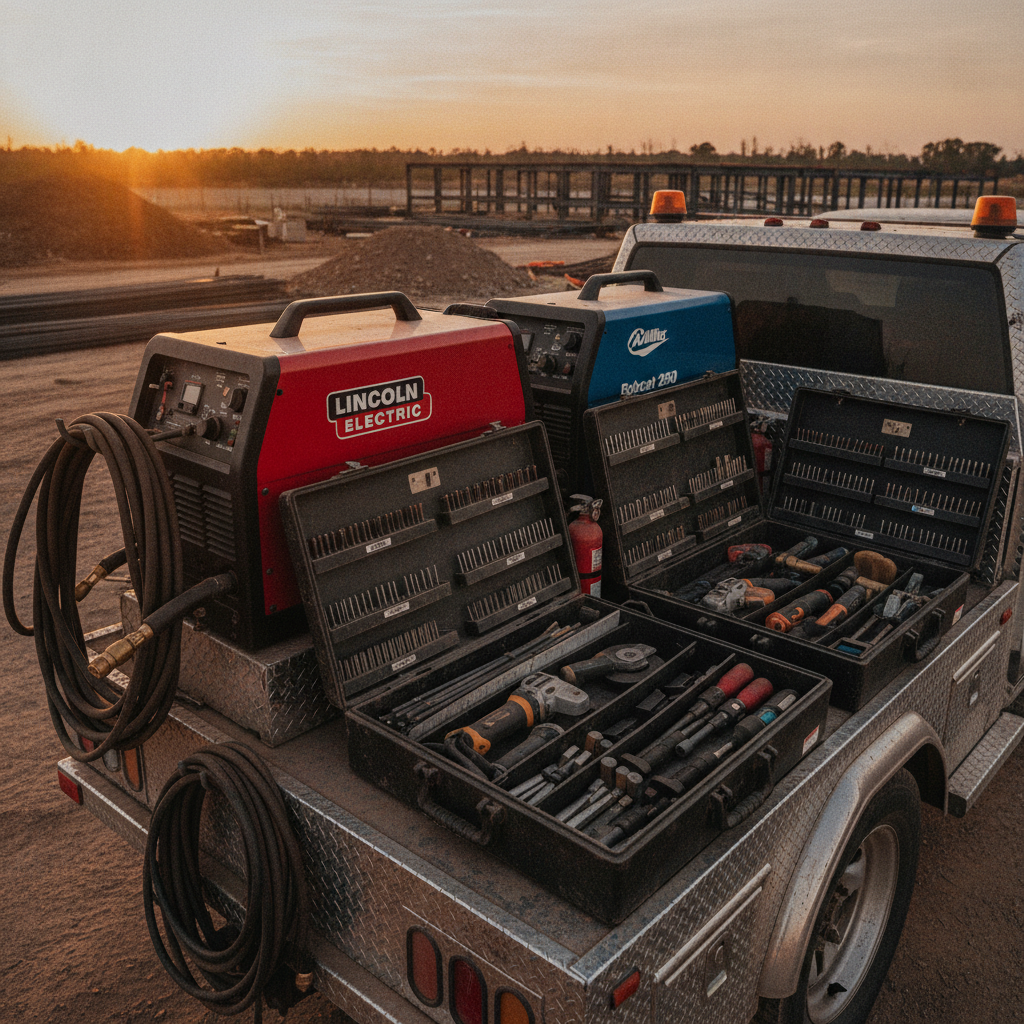
Let me paint you a picture. You pull up to a job site at 7 AM. The foreman is already giving you that look. You drop the tailgate, and for the next twenty-two minutes you’re moving grinders to find your stinger leads, digging past three empty rod cans to get to the fresh box, and trying to remember where you threw your second ground clamp last Tuesday. Your mobile rig setup is a rolling junk drawer, and every minute you spend digging is a minute you’re not billing. That’s money you already earned going straight back to the job site gravel.
I’ve been running a mobile rig for over a decade. I have made every single one of these mistakes. Some of them twice. So take what’s useful here and ignore the rest — but if your setup time is killing your day, keep reading.
Why Mobile Rig Setup Time Actually Matters
Most guys don’t track their setup time. They know it’s “a few minutes” and they write it off. But let’s do the math real quick.
If you’re losing 25 minutes per job to digging around and getting organized, and you’re running three jobs a day, that’s 75 minutes gone. Five days a week, that’s over six hours. At $95 an hour — and you should be charging at least that — you’re throwing $570 a week in the dirt. Every. Single. Week.
That number hits different when you write it out, doesn’t it.
A tight mobile rig setup isn’t about being fancy or impressing anyone. It’s about protecting your hourly rate. If you’re still figuring out what that rate should look like, go read the post on pricing for certification services — same principles apply to how you value your time in the field.
Mistake #1 — No Zones on Your Truck Bed
Random loading is the enemy. When everything has a “somewhere around here” location instead of a fixed spot, you’re training your brain to search instead of reach. That’s slow. It gets slower when you’re tired, rushing, or it’s dark.
Set hard zones on your truck bed. Here’s how I break mine down:
- Hot zone (front of bed, driver side): Leads, stinger, ground clamps, arc accessories — the stuff you touch on every single job.
- Consumables zone: Rod, wire, tips, nozzles, anti-spatter. One box, one location, always restocked before you leave a job.
- Grinder zone: Angle grinders, cut-off wheels, flap discs. All of it in one tray or drawer. Not under the leads. Not behind the gas bottle.
- Misc/overflow zone (tailgate side): Clamps, chain, straps, random fabrication stuff. This is the zone you allow to get a little chaotic — but only this zone.
The goal is simple: you should be able to reach for anything critical without moving something else first. If you’re moving stuff to get to stuff, your zones are wrong.
Mistake #2 — Your Leads Are Always Tangled
Tangled leads are the number one time killer I see on rigs. Guys just throw them in after a job because they’re tired and they’ll “deal with it tomorrow.” Tomorrow never comes. Then you’re standing there unwrapping 50 feet of lead like you’re trying to de-Christmas-tree a string of lights at 7 AM.
Get a lead rack or build one. A couple of heavy-duty hooks or a simple pipe bracket mounted to the side of your service body works fine. Coil your leads the same way every time — over-under if you want them to last, at minimum the same circular coil every time. Hang them up. Done.
This sounds stupid simple. It is. But I guarantee half the guys reading this are not doing it consistently.
Also — label your leads. Both ends. When you’re running multiple processes or multiple machines on the same job, unlabeled leads turn into a guessing game real fast. A piece of tape and a marker takes thirty seconds.
Mistake #3 — Consumables You Can’t Find or Don’t Have
Running out of 6010 at a job site is one thing. Not being able to find the box you definitely loaded is another. Both are avoidable.
Build a consumables checklist and run it before every workday. Not a mental checklist — an actual list, laminated, stuck to the inside of your toolbox lid. Check it. Every. Morning. This is not a suggestion, it’s a discipline that pays for itself the first time it saves you a 45-minute round trip to the supply house mid-job.
Your consumables zone should have a par level. When you pull the last of something, you put it on the list. Not when you run out — when you pull the last one. That’s the difference between a guy who always has what he needs and a guy who’s always scrambling.
If you’re running multiple processes — MIG, stick, TIG — keeping consumables organized gets more complicated fast. I’ve written about running field-ready multi-process welders before, and the consumables management piece is half the battle with those setups.
Mistake #4 — Your Machine Placement Is Wrong
Where your welder sits on the truck matters more than most guys think. You want it accessible without becoming a liability. Here’s what kills me on rigs I see in the field:
- Machine mounted so the lead connections face the cab — you’re walking around the truck every time you adjust anything.
- Machine too high up with no step — you’re climbing to read settings or adjust wire speed.
- Machine right at tailgate level with no tie-down — one hard stop and that thing moves.
Mount your machine so the control panel and lead connections face the work side of the truck. Secure it properly — four-point tie-down minimum on any machine that rides on the bed. If you’re running a generator-style setup, make sure exhaust isn’t blowing back into your work area or toward your consumables storage.
If you’re running newer battery-assisted or hybrid machines, placement gets even more important for heat management. I covered some of that in the post on hybrid battery-powered welders — worth a read if you’re looking at upgrading your machine setup.
Mistake #5 — Your PPE Has No Home
Helmet’s on the seat. Gloves are in three different places. You haven’t seen your second pair of safety glasses since March. This is standard chaos on most rigs, and it’s costing you time and money.
Your PPE needs fixed storage just like your tools. A dedicated hook for your helmet — not the seat, not the floor, not balanced on the welder. A single designated pocket or drawer for gloves. One spot for glasses. When you’re done with a job, those things go back to their spots before you start the truck.
It also protects your gear. A helmet that lives on the floor of your cab gets stepped on, sat on, and knocked around. A $300 auto-darkening lid doesn’t need that kind of life.
Mistake #6 — No Pre-Job Checklist at All
I talked about a consumables checklist earlier. But your pre-job checklist should cover more than just supplies. Every morning before your first job, run through this:
- Leads connected and functional
- Ground clamp clean and tight
- Machine settings from last job cleared or noted
- Gas bottle level checked
- Consumables stocked to par
- PPE in its spots
- Tools in their zones
- Tie-downs secure
This takes four minutes. It saves you twenty. It also makes you look like a professional when you show up and go straight to work instead of spending the first half hour getting your act together while the foreman watches.
If you’re running a newer operation and still building out your systems, the post on going from garage to shop covers some of the operational foundation stuff that applies directly to field rigs too.
Mistake #7 — Ignoring the End-of-Day Reset
Here’s where most rigs fall apart. You finish a job, you’re tired, you just throw everything in and drive home. Tomorrow-you will handle it. Tomorrow-you is furious about this every single morning.
The end-of-day reset is non-negotiable if you want a tight rig. It doesn’t have to be a full reorganization. It just has to be a restore-to-baseline routine:
- Leads coiled and hung
- Consumables checked against par
- Tools back in zones
- PPE on hooks
- Truck bed clear of scrap and garbage
Ten minutes max. Do it while the machine’s cooling down. Build it into your wind-down habit the same way you bill out your hours. Speaking of which — if your billing and business systems are as disorganized as some rigs I’ve seen, check out the post on smart heat maps for startups for a different angle on running your operation tighter.
The Stuff Nobody Talks About — Lighting and Access
Two underrated factors in mobile rig setup: lighting and physical access to your equipment.
If you’re doing any work before sunrise or after sunset — and you will — you need work lighting on your rig that doesn’t require digging for a flashlight. Magnetic LED strips on your service body, a light bar, a portable work light that lives in a fixed spot. Set it up once, use it forever.
Physical access means thinking about what you grab in what order. If the first thing you always do is connect your ground, your ground clamp should be the easiest thing to reach. If you always grab a grinder before you start, the grinder should be at the front of its zone, not buried behind other tools. Sequence your access based on your actual workflow — not based on what fit where when you were loading in a hurry.
What a Well-Organized Rig Actually Does for Your Business
Beyond saving time, a tight mobile rig setup does something less obvious: it builds client confidence. When a customer watches you pull up, drop the tailgate, and go straight to work without the twenty-minute circus, they assume you know what you’re doing. That assumption leads to repeat calls, referrals, and less pushback on your rate.
Perception matters in this business. You can be the best welder in the county, but if your rig looks like a tornado hit it, customers notice. And they talk.
If you’re building a mobile welding business from scratch or trying to sharpen your positioning, the post on strategic niches for welding businesses is worth your time. Knowing what work you go after is just as important as being ready to go after it efficiently.
Quick Reference — The Rig Setup Mistakes to Stop Making
Let’s run through the list one more time so it’s easy to reference:
- No zones on your truck bed — everything needs a fixed home.
- Tangled leads — hang them, coil them the same way, label them.
- Consumables you can’t find — par levels, morning checklist, one designated spot.
- Wrong machine placement — panel facing the work side, secured properly.
- PPE with no fixed storage — dedicated hooks and drawers, restored after every job.
- No pre-job checklist — four minutes in the morning, twenty minutes saved on the job.
- Skipping the end-of-day reset — ten minutes max, non-negotiable.
- No work lighting — fixed, accessible, not dependent on finding a flashlight.
Bottom Line on Mobile Rig Setup
A good mobile rig setup isn’t about having the nicest truck or the most expensive service body. It’s about running your operation like you mean it. Every minute of setup time you eliminate is another minute you’re billing, resting, or moving to the next job.
You spent years learning to weld. You invested serious money in your machine and your rig. Don’t let a disorganized truck bed be the thing that bleeds your hourly rate dry every single week.
Fix the zones. Hang the leads. Run the checklist. Do the reset. It’s not glamorous work, but neither is handing back $500 a week in lost time because you couldn’t find your ground clamp.
Your rig is your business on wheels. Treat it that way.