You show up to a job. Client’s waiting. You pop open the toolbox and spend the next twenty minutes digging through a pile of slag, old stubs, three grinders with no discs, and a come-along you haven’t used since 2019. That’s your mobile rig setup working against you. Every minute you spend looking for something is a minute you’re not getting paid for — or worse, a minute the client is watching you look incompetent. Neither one is good for business.
I’ve been running a mobile welding rig for over a decade. I’ve made pretty much every organizational mistake there is to make. I’ve also watched other guys show up to jobs looking like they ransacked a scrap yard to load their truck that morning. So let’s talk about the stuff nobody tells you when you’re starting out — the practical, boring, unglamorous work of getting your rig dialed in so it doesn’t eat your time alive.
Why Mobile Rig Setup Actually Matters for Your Bottom Line
Here’s the thing most guys don’t track: setup time. They’ll spend hours negotiating a rate or shopping for consumables to save three bucks, but they lose forty-five minutes per job just getting organized on site. Do that math across a five-day work week and you’ve given away several billable hours you’ll never get back.
Your mobile rig setup is either a system or a pile. There’s no in-between. A system means everything has a place, you can find it in the dark, and you don’t have to think about it. A pile means you’re always doing triage before you even strike an arc.
If you’re still in the early stages of figuring out your business model, the bigger picture of how you position yourself matters too. Picking the right strategic niche for your mobile operation will also shape what tools and equipment you need to carry — and how you organize them.
But right now, let’s focus on the rig itself. Because even the best niche won’t save you if you’re fumbling around your truck bed like it’s a garage sale.
Mistake #1: No Zones on Your Truck Bed
This is the biggest one. Most guys just load their truck. Stuff goes where it fits. Heavy things in the back because that’s where you can hoist them. Cables everywhere. Gas bottles wherever. Toolboxes stacked on top of each other.
That’s not a rig. That’s a storage unit on wheels.
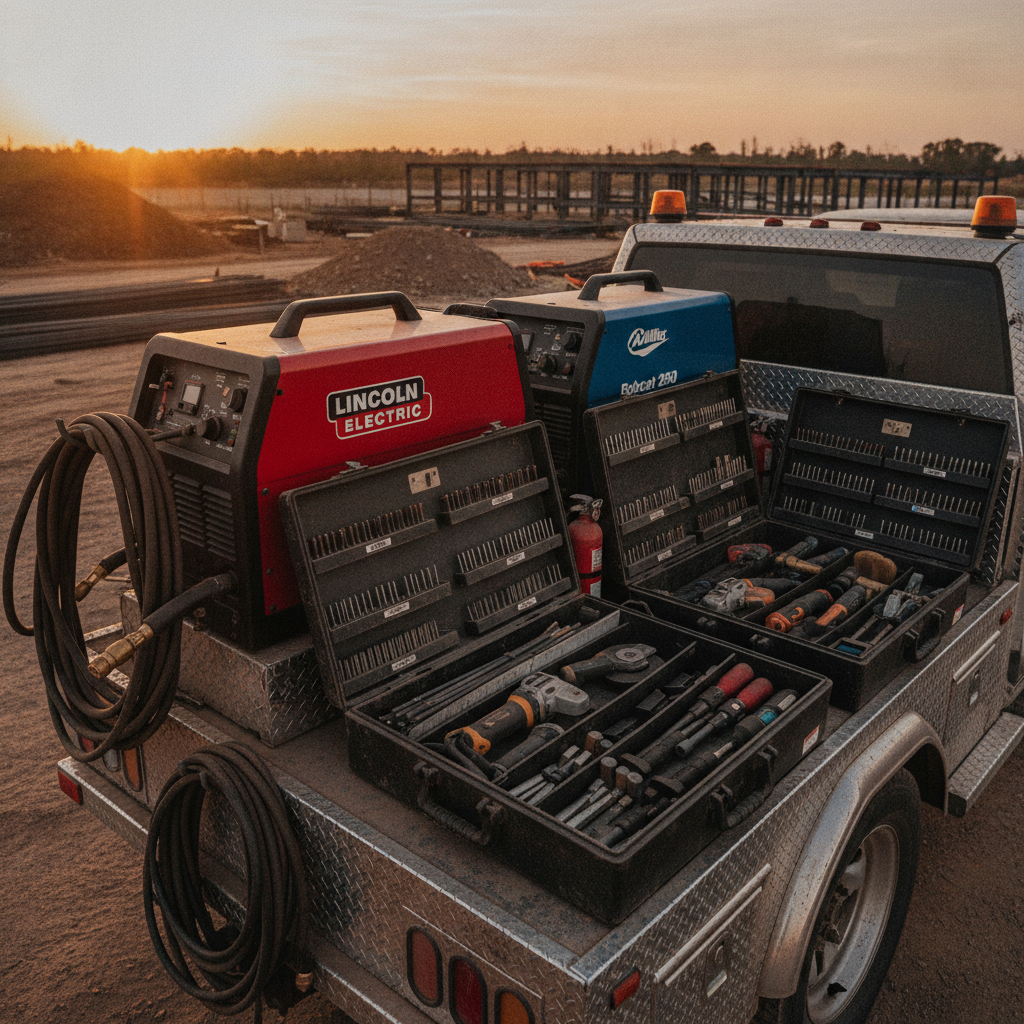
A properly organized mobile rig setup has defined zones. Think about it like a kitchen — prep area, cooking area, plating area. Each one has a purpose. Your rig should work the same way.
The Basic Zone System
Here’s how I break it down:
- Power zone: Your welder, cables, leads, and ground clamps. Everything needed to make an arc lives here.
- Gas zone: Cylinders secured upright, regulators, hoses, and fittings. Nothing loose, nothing rolling around.
- Hand tool zone: Grinders, wire brushes, chipping hammers, clamps, magnets, squares. Stuff you grab constantly.
- Consumables zone: Rods, wire, tips, nozzles, contact tips. Organized by process if you’re running multi-process.
- PPE zone: Helmet, gloves, sleeves, ear protection. Right at the back gate so it’s the first thing you grab.
When you have zones, you stop thinking about where things are. You just go to the zone. It sounds simple because it is. Simple works on a job site.
Mistake #2: Loose Cables and Leads Going Everywhere
Nothing slows down a job like a cable rat’s nest. You’re pulling lead and it’s tangled around a tie-down, looped under a toolbox, and somehow wrapped around your generator exhaust pipe. Now you’re spending ten minutes unraveling something that should take thirty seconds.
Cable management on a welding rig is not glamorous work. Nobody’s going to write a blog post about how great your cable hooks look. But you will feel the difference every single day.
What Actually Works for Cable Management
A few things that have made a real difference on my rig:
- Cable reels or hooks mounted to the truck: Bolt them down. Keep them in the same spot every time.
- Color-coded lead ends: Simple heat shrink or tape. Red for positive, black for ground. You know which end is which without thinking.
- Velcro straps, not zip ties: Zip ties are one-time use and you’ll cut them every job. Velcro is reusable and takes five seconds.
- Coil your leads properly: Over-under method. Not the “throw it in a pile” method. Your leads will last longer and tangle less.
If you’re running a multi-process setup — which a lot of mobile guys are doing now — cable organization becomes even more critical. Field-ready multi-process welders are powerful, but they come with more leads, more connections, and more potential for a tangled mess if you’re not intentional about how you store them.
Mistake #3: Consumables All Over the Place
I’ve seen guys with 7018 rods loose in a toolbox drawer rattling around with grinder discs and a tape measure. That’s a special kind of chaos. Contaminated rods, broken discs, and a tape measure that now has a dull blade. Everybody loses.
Your consumables need their own dedicated storage. This is non-negotiable if you want a mobile rig setup that runs efficiently.
Consumable Storage That Makes Sense
Here’s the system that works for me:
- Rod oven or rod vault mounted on the rig: For low-hydrogen electrodes, this is a must in humid climates. Don’t argue, just do it.
- Wire spools in a sealed drawer or cabinet: Moisture kills wire. Keep it dry and off the truck bed floor.
- Grinder discs by type and size in labeled slots: Cutting discs, grinding discs, flap discs — all separate. You know what you’re grabbing.
- MIG tips and nozzles in a small parts organizer: The cheap plastic ones from the hardware store work fine. Label the compartments.
If you’re doing work on dissimilar metals or specialty materials, keeping your consumables separated by application isn’t just organization — it’s weld quality. Dissimilar-metal welding mastery starts with having the right filler metal for the job in hand, not hunting through a junk drawer hoping you grabbed the right stuff.
Mistake #4: Your Gas Setup Is an Accident Waiting to Happen
Cylinders rolling around in the back of a truck are a problem in about four different ways. Safety, obviously. But also efficiency. If your cylinder falls over and bends a regulator, your day just got a lot more expensive. And if you’re scrambling to find the right cylinder for the job because they’re all mixed together, that’s more time wasted.
Gas Organization Done Right
Every cylinder needs to be secured upright. Period. I don’t care if you’re only driving a quarter mile. Bolt in cylinder racks or use a purpose-built cylinder holder. This isn’t optional.
Beyond safety, organize your gas by process. Keep your CO2/argon mix for MIG in one spot. Straight argon for TIG in another. Acetylene and oxygen for oxy-fuel — if you run it — away from everything else and chained separately.
Label your cylinders. Full, partial, empty. You don’t want to drive to a job with what you think is a full bottle and find out it’s the one you forgot to swap out last week. Smart shielding gas management covers this in more depth — worth reading if you’re burning through gas faster than you think you should be.
Mistake #5: Your Welder Is the Last Thing You Can Access
This one sounds obvious, but I’ve seen rigs where the welder is buried under a pile of gear, rigging hardware, and what appears to be someone’s lunch from last Tuesday. Your welder is your money machine. It should be the most accessible thing on your rig.
Think about workflow. What do you touch first when you pull up to a job? Your welder. Then your leads. Then your gas. Then your hand tools. Your rig should be loaded in reverse workflow order — last thing needed goes in first, first thing needed comes out first.
This is especially true if you’ve invested in newer equipment. Hybrid battery-powered welders are changing how mobile rigs operate, but they still need to be accessible. A fancy machine buried under gear is no better than an old clunker buried under gear.
Mistake #6: No Checklist, No System
You’d be surprised how many guys have been welding mobile for years and still forget something on almost every job. A tip for the MIG gun. The right grinding disc. An extension cord. Their helmet. (Yes, their helmet. More than once.)
A pre-job checklist is not for rookies. It’s for professionals who want to stop making rookie mistakes. Write it down. Laminate it. Stick it inside a toolbox lid or on the back window of the cab.
What a Basic Rig Checklist Looks Like
Your checklist should cover at minimum:
- Welder powered and cables connected
- Gas cylinders checked and valve wrench on board
- Consumables for the specific job (confirm process before you leave)
- PPE — helmet, gloves, sleeves, boots
- Hand tools — grinder, wire brush, chipping hammer, clamps
- Measuring and layout tools — tape, square, soapstone
- Fire watch gear if required — extinguisher, fire blanket
- Paperwork — work order, certifications if needed on site
If your work includes certified welds or you’re operating in environments that require documented procedures, your checklist should include your certs. Speaking of which — staying current and organized on the certification side of things will also keep you from scrambling. A certification readiness calendar is one of those boring-but-necessary tools that serious mobile welders actually use.
Mistake #7: The Truck Itself Isn’t Set Up for Mobile Work
This one’s more of a long-game mistake, but it’s worth saying. A lot of guys start mobile welding with whatever truck they have and just throw gear in the bed. That works for a while. Then it doesn’t.
Purpose-built service bodies — the ones with the side compartments and the flat bed — exist for a reason. They give you organized, lockable storage at waist height so you’re not climbing into the bed of a pickup every five minutes. They keep tools out of the weather. They separate your gear.
If you’re not there yet financially, that’s fine. But plan for it. Build toward it. Think about how your current setup limits your efficiency and what a proper service body would fix. Going from a garage to a real shop setup covers some of this thinking — the same logic applies to building out a professional mobile rig over time.
The Bottom Line on Mobile Rig Setup
None of this is complicated. That’s the point. A solid mobile rig setup isn’t about having the newest gear or the most expensive truck. It’s about having a system that works every time, doesn’t slow you down, and doesn’t make you look like you’re figuring it out on the fly.
Every minute you spend searching for a tool or untangling a lead is a minute that’s coming out of your pocket. You’re not billing for that time. The client isn’t going to pay extra because your rig was disorganized. That loss is entirely yours.
Set up your zones. Manage your cables. Organize your consumables. Secure your gas. Run a checklist. Do it every time until it’s automatic.
The guys who look like pros on a job site didn’t get that way by accident. They built systems. You can too — and it doesn’t require a whole new truck or a big equipment budget. It just requires some intentional thought about how your rig is loaded and why.
If you’re still building out the business side of your operation — figuring out what to charge, what work to pursue, how to grow — some of the groundwork thinking in Measure Twice, Invest Once is worth your time. Because a well-organized rig is part of a well-organized business. And a well-organized business is what keeps the lights on.
Now go clean out that truck bed. You know it needs it.