Let’s be honest. If you’re spending the first twenty minutes of every job digging through a pile of leads, hunting for a tip you know you packed, or untangling a cable that somehow tied itself into a square knot overnight — those truck setup mistakes are costing you real money. Not hypothetical money. Actual dollars subtracted from your hourly rate while the customer watches you rummage around like you lost your keys in there.
This isn’t about having a pretty truck. Nobody on a job site cares how clean your rig looks. This is about moving fast, looking like you’ve done this before, and not eating twenty minutes of unpaid chaos before you even strike an arc.
After ten years of running a mobile rig, I’ve made every one of these mistakes myself. Some of them more than once. Here’s what I’ve learned about organizing a welding truck that actually works in the field.
Why Truck Setup Mistakes Hit Your Wallet Hard
Time is the only thing you can’t buy back. When you’re billing by the hour, or quoting a flat rate job, every minute you waste on setup is margin you’re throwing away. Think about it this way: if you lose twenty minutes per job to poor rig organization, and you run five jobs a week, that’s over an hour and a half of billable time gone. Every single week.
That adds up to somewhere around seventy-five hours a year. At even $100 an hour, you’re leaving $7,500 on the table annually because your rig is a mess. That number usually gets people’s attention.
And it’s not just the money. Showing up disorganized telegraphs to the customer that you might be disorganized everywhere. First impressions on job sites stick. If you’re fumbling around before you’ve even set up, you’ve already started behind on credibility. If you’re still figuring out how to position your business in the market, the work you do on your strategic niche means nothing if the truck impression undoes it at the gate.
Mistake #1 — No Zones, No Logic
The most common truck setup mistake I see is loading gear with zero system behind it. Everything goes wherever it fits when you’re packing up, and then nothing is where you expect it when you need it. This is how you end up with a grinder buried under a tarp behind a bottle of hydraulic fluid at seven in the morning.
Fix this by treating your truck like a shop floor. Zone it out.
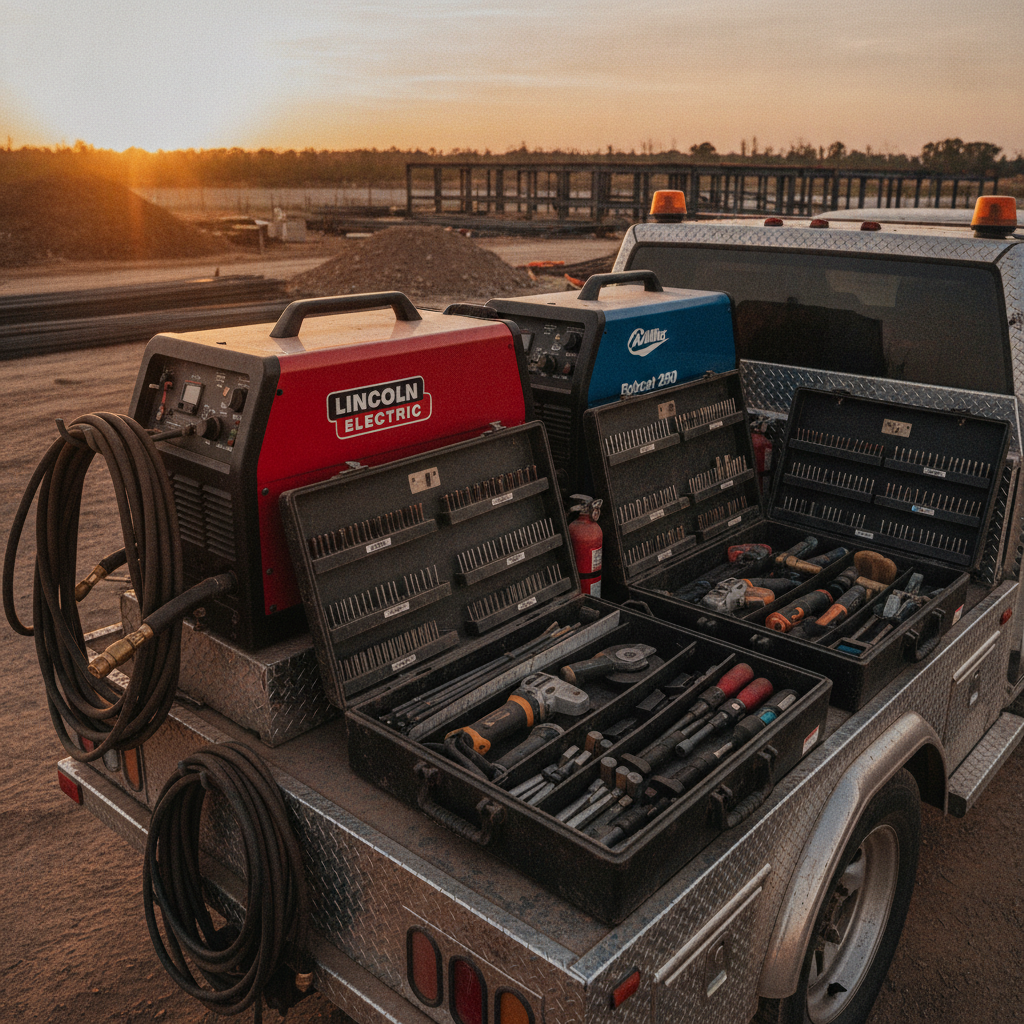
- Hot zone: Everything you touch before you strike an arc. Leads, stinger, ground clamp, helmet, gloves. This stuff lives in the most accessible spot on the truck. Period.
- Consumables zone: Rods, wire, tips, nozzles, anti-spatter. Together. Always. Not scattered across three different compartments.
- Gas zone: Cylinders secured upright, regulators protected, hoses coiled and hung. Not laying on their side in the bed with everything else on top of them.
- Tool zone: Grinders, clamps, squares, chisels, brushes. These live together because they’re used together.
Once you build zones and stick to them for a week, muscle memory takes over. You stop thinking about where things are. You just go get them.
Mistake #2 — Leads Stored Like Spaghetti
Welding leads that aren’t stored properly are a time sink and a safety hazard. A tangled lead set can eat five to ten minutes of your morning before you’ve done a single thing productive. It also gets damaged faster when it’s crammed in a pile.
The fix here is simple and cheap. Mount a set of lead hooks or a reel on the back of the truck or inside a compartment door. Coil your leads properly — over-under if you know it, or at minimum in consistent large loops — and hang them the same way every time. When you pull up to a job, you grab the leads and they come out clean. No drama.
Same goes for your ground cable. It should have its own hook and it should never be tangled with your electrode lead. When you’re working fast on a tight timeline, you don’t want to sort out cable knots. That’s not what you’re getting paid for.
Mistake #3 — Consumables Spread Across the Entire Truck
I once watched a guy spend eight minutes looking for a contact tip. Eight minutes. For a part that costs less than a dollar. That’s the kind of thing that quietly destroys your efficiency over a week of jobs.
Every consumable you use regularly needs a dedicated, labeled home. I don’t care if it’s a compartment, a drawer, a bin, or a tackle box — it needs to be consistent and logical. Wire tips organized by size. Rods in sealed tubes sorted by process. Nozzles together. Anti-spatter near the nozzles because that’s when you use it.
If you run multiple processes — and if you’re running a mobile operation, you probably should be — organization gets even more critical. Keeping your SMAW, MIG, and TIG consumables sorted separately saves real time when you’re switching between jobs. If you haven’t thought through running multiple processes from the same rig, it’s worth reading up on field-ready multi-process welders to see how the equipment side of that works.
Mistake #4 — The Machine Isn’t Ready to Run
You pull up, you set up your leads, you go to fire up the machine and realize you need to adjust settings from the last job. Or your wire tension is wrong. Or you didn’t check your gas flow since the last cylinder swap and it’s barely trickling.
Get in the habit of resetting your machine at the end of every job, not the beginning of the next one. When you button up a job site, take two minutes to set your machine back to a neutral baseline. Wire tension checked. Gas flow set to standard. Polarity confirmed for whatever you run most. Heat settings back to center.
That way, when you pull up to the next job, the machine is ready to make minor adjustments — not major ones. You’re dialing in, not starting from scratch. Speaking of dialing things in, if you’ve ever had questions about gas setup on a mobile rig, smart shielding gas management covers that side of things in solid detail.
Mistake #5 — No System for the Small Stuff
Markers, soapstone, tape measure, speed square, clamps, magnets, scribe. These are the things you use constantly. They’re also the things most likely to be missing when you need them because they migrate all over the truck.
Small stuff needs small homes. A chest with labeled shallow drawers works great. So does a pegboard panel mounted inside a compartment door. The goal is that each small item has a specific spot it returns to every single day. Not “somewhere in the truck.” Exactly one place.
This is the kind of system that takes a weekend to build and saves you five minutes every day for the rest of your career. That math is extremely good. If you’re just getting your mobile operation off the ground, some of the startup principles covered in the from garage to shop post apply directly to how you think about your rig as a working system.
Mistake #6 — Safety Gear Is Never Where It Should Be
Your helmet, gloves, jacket, and eye protection should have exactly one place on the truck. Not “usually in this area” but exactly one spot. This matters for two reasons.
First, it saves time. Second, and more practically, if something happens on a job site and you need to grab your gear fast, you don’t want to be thinking about where it is. It should be automatic.
Mount a helmet hook. Dedicate a bin for PPE. Keep a spare pair of gloves in the consumables zone because gloves disappear on job sites like socks in a dryer. This isn’t complicated. It’s just discipline.
Mistake #7 — The Truck Itself Isn’t Set Up for the Work You Actually Do
This one takes longer to fix, but it’s worth addressing. A lot of welders are running the same basic truck layout they started with, even though their work has evolved significantly. The guy who primarily does pipeline emergency repairs needs a different setup than the guy doing ag equipment and trailers. The guy running TIG on stainless has different storage needs than someone who runs flux core all day.
Take an honest look at the five jobs you did last month. What did you use every single day? That stuff should be the most accessible. What did you use once? That stuff can live in the back corner. Your truck layout should reflect the work you actually do — not some generic mobile welder configuration you copied from someone else.
If you’re doing multi-material work, that complexity has to be reflected in how your consumables and tooling are organized. The principles in adaptive multimaterial welding are useful here because the material complexity demands organizational complexity to match.
What a Solid Truck Setup Actually Looks Like
Let me paint you a picture of what a well-organized rig looks like in practice. You pull up to a job. You know exactly where your leads are. You grab them, hang your ground, run your electrode lead to the work. Your machine is already at baseline. You check your gas — it’s where it should be, flowing correctly. You grab your helmet from its hook, your gloves from the PPE bin, and your soapstone from the small parts drawer. You’re striking an arc in under ten minutes of arriving on site.
That’s not fantasy. That’s just what happens when you stop making truck setup mistakes and treat your rig like a professional tool instead of a rolling junk drawer.
Customers notice this. They don’t always say anything, but they notice. And when renewal time comes or a referral gets passed around, the guy who showed up organized and got to work immediately is the guy who gets the call.
The One-Time Investment That Pays Back Forever
Fixing a disorganized truck usually takes one solid Saturday. Pull everything out. Lay it on the ground. Be brutal about what you actually use and what’s just been riding around doing nothing. Then build your zones and install whatever storage makes those zones work — drawers, bins, hooks, reel mounts, whatever fits your truck and your workflow.
The investment is a few hundred bucks in storage hardware and a day of your time. The payoff is every single job going smoother from that point forward. That’s the kind of measure twice, invest once decision-making that separates welders who run tight operations from welders who stay frustrated.
Your truck is your shop. It’s your first impression, your workspace, and your inventory system all in one. Treat it like it matters, because it does.
Quick Checklist — Fix These This Weekend
If you want to stop making truck setup mistakes, here’s the short version of everything above:
- Define and stick to zones: hot, consumables, gas, tools, PPE
- Install lead hooks and coil your leads the same way every time
- Label every consumable storage location and never cross-contaminate
- Reset your machine to baseline at the end of each job
- Give every small item exactly one permanent home
- Review your five most recent jobs and reorganize around the actual work you do
- Do a full cleanout at least once per quarter
None of this is complicated. All of it works. The difference between a rig that runs smooth and one that fights you every morning isn’t equipment — it’s organization. Fix the setup, and the job takes care of itself.
And if your operation is growing to the point where you’re thinking about what comes after the truck — shop space, employees, equipment upgrades — the smart heat maps for startups post is worth a read for thinking about where to put your resources next.