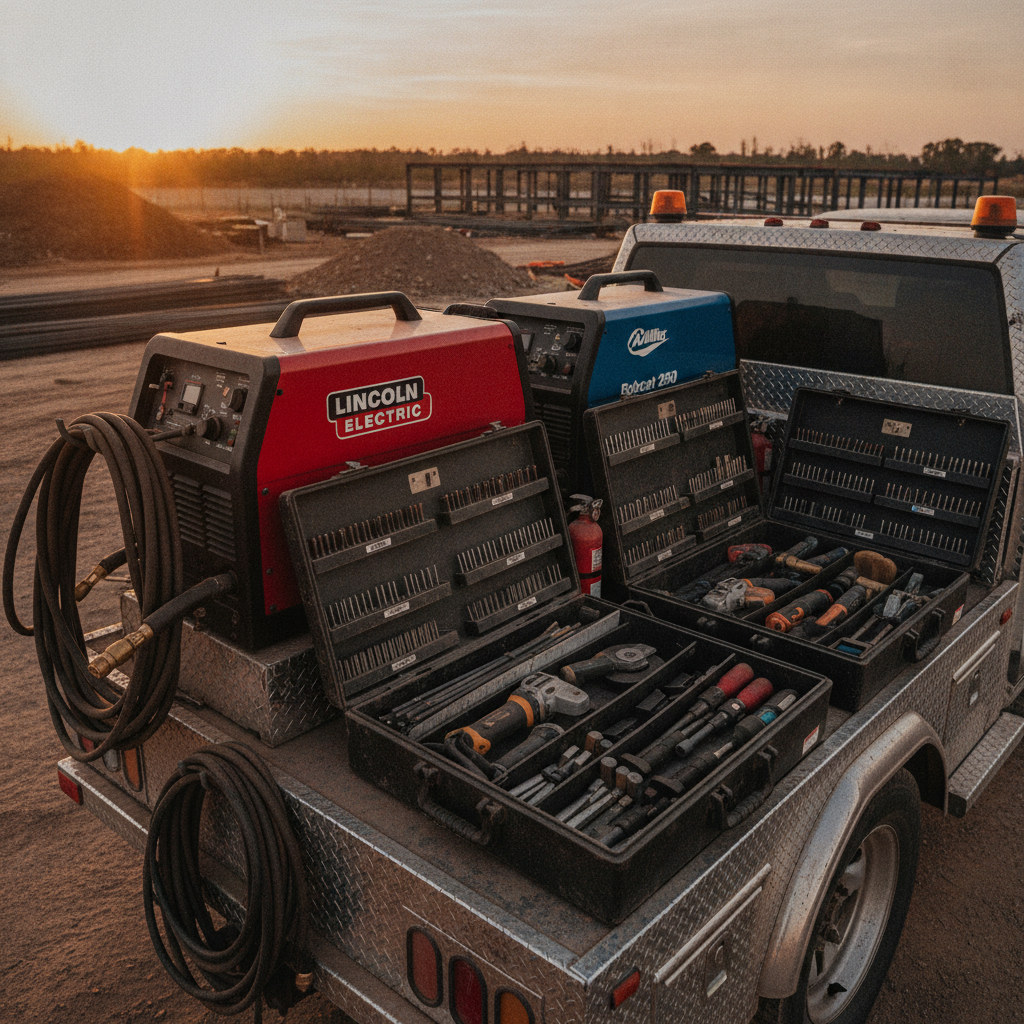
If you’ve ever spent twenty minutes on a customer’s property rooting around behind your seat for a grinding disc you swore you had, congratulations — you just donated a chunk of your hourly rate to the void. Truck setup mistakes are one of the most expensive things a mobile welder can make, and most guys don’t even realize they’re doing it. You’re not losing money on bad welds. You’re losing it on bad habits before the hood ever goes down.
This isn’t a post about fancy toolboxes or spending ten grand on a custom rig. This is about the dumb, fixable stuff that costs you time on every single job. Small changes. Real hours saved. Let’s get into it.
Why Truck Setup Mistakes Hit Your Wallet Harder Than You Think
Here’s the math nobody talks about. Say you bill at $85 an hour. You waste 25 minutes per job digging around, reorganizing cable that got tangled, or making a hardware store run because you couldn’t find your consumables. That’s roughly $35 gone before you strike an arc. Five jobs a week, that’s $175 a week. Over a year? We’re talking over nine grand in lost billable time.
Nine grand. For being disorganized.
And that’s not counting the jobs where customers are watching you fumble around. First impressions matter in this business. A guy who rolls up and has his rig dialed in looks like a professional. A guy who spends ten minutes looking for his wire brush looks like he backed into this trade by accident. Building a legitimate operation from the ground up means treating your truck like part of your business, not just a vehicle that hauls your machine.
So let’s talk about what’s actually going wrong.
Mistake #1: No Designated Home for Anything
This is the big one. The root cause of almost every other problem on this list. If every item on your rig doesn’t have a specific, permanent home, your truck turns into a junk drawer on wheels within about three days of owning it.
Consumables end up loose in a bucket. Cables pile up in a corner. Your angle grinder lives on top of whatever you tossed in last. And every morning you’re playing the same guessing game about where anything is.
The fix is stupidly simple: assign a spot to every single item and build a system around that. Use bins, hooks, magnetic strips, pegboard panels, whatever works for your space. Label everything if you need to. Yes, label it. I don’t care how it looks. If you know where your 4.5-inch grinding discs are without thinking about it, you just saved yourself five minutes every job.
Start with your most-used items. What do you grab on literally every job? Those things get prime real estate — eye level, right at the back of the truck, first things your hands touch. Everything else organizes around them.
Mistake #2: Cable Management That Would Make a Plumber Cry
Tangled leads are a rite of passage for mobile welders who haven’t figured out the cable management thing yet. You throw them in, they knot up, you waste five minutes unspooling something that looks like a snake fight. It gets old fast.
There are a few ways to deal with this properly. Figure-eight coiling is the gold standard — it kills the twist and keeps cables manageable. A dedicated rack or a set of large hooks mounted inside the compartment keeps coiled cables off the floor and out of each other’s way.
Your lead length also matters more than people admit. Carrying 100 feet of lead when most of your jobs need 25 feet is just extra weight and extra tangle. Think about your actual job mix and right-size your leads accordingly. If you do a lot of work where you need to reach far from the truck, having a machine that handles multiple processes without dragging extra equipment makes the whole cable situation cleaner.
Velcro straps over zip ties. Always. You’ll thank yourself when you need to adjust on the fly instead of cutting plastic off a cable you’re in a hurry with.
Mistake #3: Gas Cylinder Setup That Wastes Time and Gas
Unsecured cylinders are a safety problem first and an efficiency problem second. But beyond the obvious — chain your bottles down, every time, no excuses — there are setup habits that cost you time with gas.
Leaving regulators attached to cylinders and just chucking everything in the truck is how you end up with bent gauges, cracked fittings, and a cylinder that ran out halfway through a job because you had a slow leak you didn’t notice. A few minutes at the end of each day checking connections and reading your gauge levels saves you from finding out you’re out of gas when you’re forty-five minutes from a supplier.
Keep your cylinder position consistent. Same spot, every day. If it moves around, you’re fighting it every time you go to hook up. Dedicated cylinder holders mounted to the bed or trailer keep things in place and make the hookup routine something you can do without thinking. And if you’re using a battery-powered machine for smaller jobs, think about whether you even need gas cylinders on every run or if you can stage them more selectively.
Also — and I cannot believe I still see this — label your cylinders. Mixed gases on a job are not a fun problem to diagnose.
Mistake #4: No System for Consumables
Running out of wire, discs, electrodes, or contact tips mid-job is a rookie mistake. Staying a rookie about it after the first time it happens is a choice.
Build a par system. That means every consumable has a minimum quantity that triggers a restock. When you pull your last pack of discs off the shelf, that’s your signal to reorder — not when you’re standing on a job site with nothing left. Keep a small notepad or use your phone to track what’s running low as you pull it.
Store consumables in clearly labeled, waterproof containers. Not cardboard. Not a grocery bag stuffed in a corner. Moisture ruins electrodes fast, and a box of low-hydrogen rod that’s been sitting loose in a wet toolbox is going straight in the trash. Invest in a few quality airtight containers and your consumables last longer and are easier to grab.
Organize by process if you run multiple. Your MIG consumables in one place, your stick gear in another, TIG stuff separate. Working across multiple materials and processes means you’re already switching gears constantly — you don’t need your consumables to be another thing you have to figure out on the fly.
Mistake #5: Tools Buried Under Everything Else
Hand tools and power tools need to be accessible without unloading half your truck to reach them. This sounds obvious. And yet, here we are.
The problem usually isn’t that people don’t have the right tools. It’s that the tools end up buried. The angle grinder ends up under the welding blanket. The chipping hammer is behind the spare cylinder. The wire brush is somewhere between the seat and the door and three other things you forgot you had.
A simple tool board or hanging organizer inside a rear compartment solves most of this. Silhouettes or outlines of each tool on a backing board make it dead obvious when something’s missing. Takes you two hours to build on a Saturday and saves you five minutes on every job you run. Do the math.
Keep your grinders accessible and ready to go. Most field jobs involve prep and cleanup, and you’ll grab that grinder more than almost anything else. If it’s a pain to get to, you’ll skip prep steps you shouldn’t skip — and that shows up in your work quality.
Mistake #6: Forgetting the Business Side of Your Rig
Your truck isn’t just a piece of equipment. It’s your office, your storefront, and your first impression all in one. How it’s set up says something about how you run your business — whether you meant it to or not.
That means having a dedicated spot for paperwork, even if it’s just a clipboard and a folder. Work orders, invoices, safety sheets — they need a home that isn’t the passenger seat floorboard. If you’re billing customers correctly and tracking your jobs, you need those documents to be findable. Tracking where your work comes from and managing your costs starts with basic organization habits, and your truck is where those habits live or die.
Also: keep a basic customer-facing cleanup kit. A broom, a magnet on a stick for picking up spatter and wire, a drop cloth. Leaving a job site cleaner than you found it is the kind of detail that gets you referrals. It’s also just basic professionalism.
Mistake #7: Never Auditing the Rig
The truck that was set up perfectly six months ago might be a disaster now. Things drift. New tools get added without a designated spot. Old gear hangs around past its usefulness. The system that worked for the jobs you were doing then might not fit the work you’re doing now.
Build in a monthly rig audit. Pull everything out. Inspect, clean, restock, reorganize. This is also when you catch equipment issues before they become mid-job problems — worn cables, sketchy connections, low gas, bad consumables. Gas management issues in particular sneak up on you if you’re not regularly checking.
An audit doesn’t need to take all day. Two hours once a month keeps your rig sharp and your setup efficient. It also gives you a clear picture of what you’re actually using versus what you’re just hauling around for no reason.
The Bigger Picture: Your Rig Reflects Your Business
Every truck setup mistake you fix is money back in your pocket. But there’s a bigger point here. How you manage your rig is a direct reflection of how you manage your operation. Disorganized truck, disorganized quoting, disorganized scheduling — it tends to travel in packs.
Guys who run tight operations have tight rigs. It’s not a coincidence. Finding your niche and building a business around it means developing systems that scale, and your truck is the most physical, tangible system you run every day.
If you’re just starting out or trying to level up, treat your rig like the business asset it is. Spend the Saturday to set it up right. Build the habits that keep it that way. Stop losing hours before you even strike an arc.
You didn’t get into this trade to spend your mornings digging through junk. Get organized, run tighter, and let your work do the talking.
Quick-Hit Checklist: Rig Organization Basics
Here’s a fast reference to gut-check your current setup:
- Every item has a designated, permanent home — no freelancers floating around the bed
- Cables are figure-eight coiled and hung on dedicated hooks
- Cylinders are secured in the same position every single day
- Consumables are in labeled, waterproof containers with a par level tracked
- Tools are accessible without moving anything else to reach them
- Paperwork has a dedicated spot that isn’t the floor
- Monthly audit is scheduled and actually happens
That’s the whole game. None of it is complicated. All of it pays.
Fix your truck setup mistakes and the work gets easier. Your customers notice. Your bank account notices. And honestly, your back notices too, because you stop contorting yourself into weird positions trying to reach something that should’ve been right in front of you from the start.
Run a tight rig. That’s the job.